





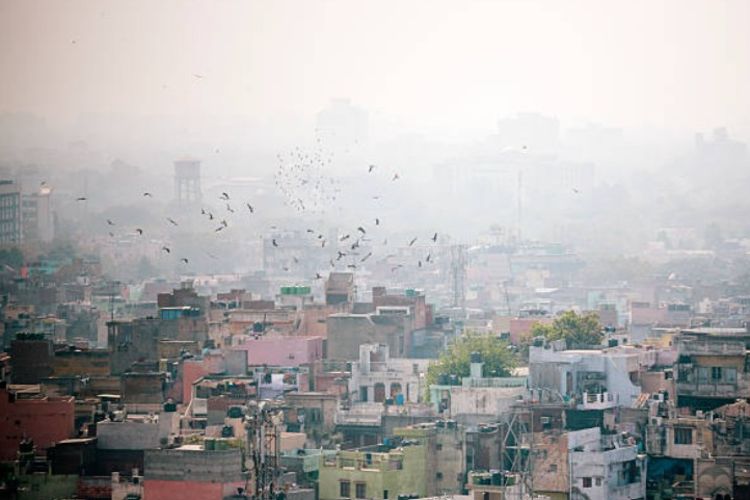
India’s air pollution crisis is no longer only a public health problem. It is a structural economic problem that hurts GDP, reduces labour productivity, raises healthcare costs, weakens human capital and threatens long-term development goals.
Public debate still peaks around winter smog in Delhi and other large cities. That framing is too narrow. Dirty air now affects labour force participation, agriculture, industry, education, health systems and investment. A country that wants to become a global manufacturing and investment hub cannot treat air quality as a seasonal inconvenience.
READ | Air pollution inequality is turning clean air into a class privilege
The World Bank estimates that air pollution caused economic losses of $36.8 billion in India in 2019, equal to 1.36% of GDP. Of this, $28.8 billion came from lost output due to premature deaths and $8 billion from morbidity. The cost is likely higher when lost working days, climate effects, cognitive stress, and long-term human capital loss are included.
India’s central mistake is institutional. Air pollution is still handled as an environmental issue. It should be treated as economic governance.
Air pollution and labour productivity
The most immediate economic cost is lower labour productivity. Higher PM2.5 exposure increases the risk of respiratory disease, cardiovascular illness, fatigue, and cognitive stress. These conditions reduce a worker’s ability to perform physically and mentally.
India is especially exposed because a large share of employment remains outdoors or informal. Construction workers, street vendors, transport workers, farm labourers, logistics staff, and factory workers spend long hours in polluted environments. They cannot work from filtered offices or move indoors when air quality collapses.
The Indian School of Business’ Bharti Institute has estimated that air pollution cost India about $6 billion in lost productivity and 1.3 billion working days in 2019. It also pointed to a larger workplace-efficiency loss of more than $24 billion. The damage is not confined to absenteeism. Many workers continue to work while physically present but less productive, a problem often described as presenteeism.
This has direct implications for Make in India. Manufacturing output depends not only on infrastructure, land, power, and logistics. It also depends on the physical efficiency of workers. Chronic exposure to polluted air increases medical leave, absenteeism, and long-term illness. Labour-intensive sectors bear the first cost.
The damage also reaches white-collar work. Research increasingly link air pollution with poorer cognitive performance and decision-making. That means finance, technology, administration, research, and services may also suffer productivity losses that rarely appear in conventional economic data.
READ | Delhi air pollution crisis a failure of prevention, not prediction
Air pollution and healthcare costs
Air pollution also imposes a large burden on India’s health system. Asthma, chronic obstructive pulmonary disease, heart disease, stroke, lung cancer, and other pollution-linked conditions are rising across cities and peri-urban areas. The Lancet Planetary Health study estimated that 1.67 million deaths in India in 2019 were attributable to air pollution, accounting for 17.8% of all deaths.
The economic effect is twofold. Households face higher out-of-pocket medical spending, especially low-income families with weak insurance cover. Governments, in turn, must spend more on healthcare capacity and pollution control. That leaves less fiscal room for productive capital expenditure.
The burden falls hardest on poorer households. A prolonged respiratory illness can push a family into debt, cut savings, and reduce consumption. Pollution therefore weakens domestic demand as well as household resilience.
Air pollution and human capital
The long-term cost is even more serious. Children exposed to polluted air face higher risks of reduced lung function, poor school attendance, developmental problems, and weaker cognitive outcomes. These effects accumulate over time.
For India, this is not only a health concern. It is a future productivity concern. A workforce that grows up with impaired health and learning outcomes will be less productive, less adaptable, and more expensive to support. The costs will show up years later in lower earnings, weaker skills, and higher public health expenditure.
Clean air as economic policy
The economic cost of pollution also creates a policy opportunity. Investments in clean energy, public transport, industrial emission control, construction-dust management, and better urban design are often described as environmental costs. That is the wrong lens.
READ | Air pollution, inequality, and collapse of accountability
Cleaner air reduces healthcare expenditure, improves labour productivity, raises life expectancy, and protects human capital. The World Bank has argued that integrated air-quality management can generate large economic gains through better health and higher productivity.
Reducing coal dependence, expanding electric mobility, strengthening public transport, regulating construction emissions, and enforcing industrial standards are therefore economic imperatives. They are not merely climate commitments.
Air pollution governance failure
India’s biggest constraint is fragmented governance. Air pollution management is spread across state governments, municipal bodies, pollution control boards, transport departments, industrial regulators, and sectoral ministries. This produces inconsistent enforcement and weak accountability.
Air does not respect municipal or state boundaries. Pollution control cannot succeed through isolated city-level action. India needs airshed-level governance, credible monitoring, enforceable sectoral targets, and clear responsibility for implementation.
Dirty air is an economic catastrophe dressed up as an environmental problem. It lowers productivity, raises health costs, reduces labour efficiency, damages human capital, and weakens growth.
The damage is no longer hypothetical. It is quantifiable, systemic, and visible across sectors. If India wants to become a major economic power, air quality cannot remain a seasonal governance issue. Clean air is a precondition for sustained growth.
Anusreeta Dutta is a columnist and climate researcher with experience in political analysis, ESG research, and energy policy.