





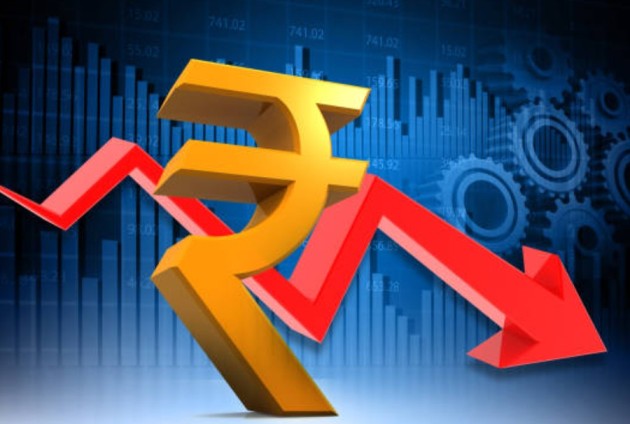
Rupee depreciation: The Indian rupee’s fall to record lows is not an episodic market accident. It is the visible price of a difficult external adjustment. Oil has turned hostile, capital flows have weakened, the dollar has hardened and India’s structural import dependence has become harder to disguise. The government and the Reserve Bank of India can slow a disorderly move. They cannot reverse the trend without imposing larger costs on growth, inflation, reserves, or market credibility.
The most immediate pressure comes from energy. Brent crude has traded above $110 a barrel as the West Asia conflict disrupted shipping and raised fears around the Strait of Hormuz. Reuters reported that oil import demand alone can add roughly $12–13 billion a month to India’s trade bill when prices remain elevated.
READ | RBI curbs test the rupee internationalisation push
India imports about 85% of its crude requirement. That single fact narrows the policy room. When oil rises, refiners need more dollars. When refiners buy dollars, the rupee weakens. This is not speculation. It is payment arithmetic. The government can cut excise duties or delay retail fuel price increases. That protects households for a while. It does not remove the dollar demand. It merely shifts the burden to oil companies, the fisc, or future consumers.
The shock is also a terms-of-trade shock. India is paying more for what it imports without receiving a matching gain in export prices. In such circumstances, depreciation is not merely a market mood. It is part of the adjustment.
India’s trade deficit is not just about oil
The article must not overstate oil as the only cause. India’s merchandise deficit is structural. Official trade data show merchandise imports of $774.98 billion in FY2025-26 against merchandise exports of $441.78 billion, leaving a merchandise trade deficit of $333.19 billion.
This is the deeper constraint. Electronics, capital goods, chemicals, fertilisers, energy products, and industrial intermediates create persistent dollar demand. Oil worsens the imbalance, but it does not create it.
Services exports partly offset this gap. They remain India’s strongest external buffer. But the buffer is no longer risk-free. The same reports behind the current rupee weakness point to foreign investors reassessing India’s technology earnings because of slower global IT demand and AI-led disruption. A currency supported by services exports cannot ignore the weakening of its most reliable surplus sector.
READ | RBI’s rupee defence is about volatility, not control
Capital outflows and rupee depreciation
The second pressure is capital. Foreign portfolio investors have sold heavily in Indian equities. The reports provided for this article estimate equity outflows of more than Rs 1.81 lakh crore between April 2025 and March 2026, with further selling in April.
Such outflows create direct dollar demand. Investors sell rupee assets, buy dollars, and take capital out. But the larger point is allocation. Global money is moving towards the United States and towards markets linked more directly to AI hardware and semiconductor supply chains. India still offers long-term growth. It is not, for now, the preferred short-term trade.
Net FDI has also weakened as repatriation and outward investment have increased. That matters because FDI is the more stable form of capital. When both portfolio flows and net FDI soften, the exchange rate carries more of the burden.
Strong dollar, high yields, weak rupee
The rupee is also moving with the global dollar cycle. Hawkish signals from the US Federal Reserve have lifted the dollar and US bond yields, adding pressure on emerging-market currencies. Reuters reported on April 30 that the rupee was likely to face fresh headwinds after such signals from Fed policymakers, alongside the continued rise in oil prices.
India cannot neutralise this by wish. Raising interest rates sharply to defend the rupee would hurt domestic credit and growth. Letting liquidity tighten too much would strain banks and borrowers. Selling reserves indefinitely would invite the market to test the RBI’s tolerance.
That is why the policy choice is not between a strong rupee and a weak rupee. It is between an orderly adjustment and a disorderly one.
REER shows the adjustment has already gone far
There is another layer. The rupee is not simply weakening against the dollar. Its trade-weighted valuation has also fallen sharply. Reuters reported that the 40-currency real effective exchange rate fell to 92.72 in April 2026, below its long-term average of 98.25, while the six-currency REER touched a record low of 89.61 in March.
This complicates the usual argument that the rupee is merely correcting past overvaluation. Earlier, that may have been true. Today, the real exchange rate suggests that the currency has already become cheap on a trade-weighted basis.
That does not mean the RBI must force appreciation. It means the central bank has less reason to welcome further sharp depreciation. The correct policy objective is therefore narrow: prevent overshooting, not restore an old exchange rate.
RBI intervention: Smoothing, not defending
The RBI has acted. It has sold dollars, used forward positions, tightened banks’ net open position limits, and curbed parts of the non-deliverable forward market. These moves initially supported the rupee by forcing banks to unwind positions and reducing speculative pressure.
But the effect was temporary. Once markets adjusted, crude prices, importer demand, and capital flows reasserted themselves. Some curbs were partly rolled back because a currency market cannot function well if hedging and arbitrage channels are choked for too long.
Governor Sanjay Malhotra has made the doctrine clear. RBI intervention is meant to smooth excessive and disruptive volatility, not target a particular rupee level.
This is not weakness. It is realism. A central bank can influence market behaviour at the margin. It cannot permanently offset the balance of payments.
Rupee depreciation: Corporate hedging can amplify pressure
There is also a private-sector balance-sheet channel. Indian companies with foreign currency liabilities must hedge when depreciation risk rises. If hedging becomes costlier or harder, firms either rush to cover exposures or delay hedging and accept greater balance-sheet risk.
The government’s external debt report notes that non-financial corporations account for the highest share of short-term external debt by residual maturity, largely because of short-term trade credit. This matters during currency stress. Trade credit and foreign currency borrowing create recurring dollar needs. As the rupee weakens, hedging demand can become self-reinforcing.
The RBI is right to worry about speculative positions. But if market restrictions raise hedging costs for genuine users, they can deter capital inflows and increase corporate caution. Currency control then begins to work against external stability.
Remittances are a buffer, not a guarantee
India’s remittances remain a major stabiliser. They help finance the trade gap and support household income. But the composition has changed. RBI-linked analysis of the sixth round of India’s remittances survey shows that advanced economies, especially the United States and the United Kingdom, have overtaken Gulf economies as the dominant source of inflows. India’s remittances more than doubled from $55.6 billion in 2010-11 to $118.7 billion in 2023-24.
This shift is useful. It reduces exclusive dependence on the Gulf. But West Asia still matters. UAE, Saudi Arabia, Kuwait, Qatar, Oman and Bahrain remain important sources. A prolonged regional conflict can affect employment, shipping, oil prices and confidence. That makes remittances a partial cushion, not an insurance policy.
READ | Rupee under pressure from oil shock and foreign outflows
Why old crisis tools may not return
India has used extraordinary instruments before. Resurgent India Bonds, India Millennium Deposits, and FCNR(B) schemes helped stabilise external accounts in earlier stress episodes. The current moment is different.
India’s reserves are large. The current account deficit is not at a 2013-style danger point. Macro credibility is stronger. Using special NRI deposit schemes too early would send the wrong signal. It would tell markets that the authorities see a crisis when the data still show stress, not breakdown.
That is why the RBI is more likely to ration intervention than escalate it. It will sell dollars when moves become disorderly. It may tighten rules when speculation becomes one-sided. It will not spend reserves to defend a symbolic number.
Rupee depreciation is an adjustment, not a verdict
The government cannot do much more without paying elsewhere. Passing through high oil prices risks inflation and political pain. Absorbing them strains fiscal balances. Subsidising the shock weakens public finance. Cutting imports quickly is not feasible because many imports are inputs into production.
The RBI faces the opposite constraint. Rate hikes may support the rupee at the margin, but they would weaken demand and investment. Rate cuts would support growth but may worsen currency pressure. Intervention can buy time, not a new equilibrium.
The rupee is therefore serving as a pressure valve. A weaker currency makes imports costlier and can add to inflation. It may help exporters, but only where demand exists and imported inputs are not dominant. The benefit is uneven. The pain is more immediate.
The rupee’s fall is not a verdict on India’s macroeconomic collapse. It is the market’s way of pricing oil dependence, capital outflows, a strong dollar, a structural trade deficit, and a changing RBI doctrine.
The government and RBI can prevent panic. They can discourage one-way speculative bets. They can smooth the path. They cannot reverse the direction without creating larger damage.
That is the hard lesson. A currency can be managed. It cannot be commanded.