





Delimitation math behind Lok Sabha expansion: The government’s plan to reserve one-third of Lok Sabha seats for women through a 50% expansion of the House risks distorting representation. It abstracts from India’s uneven demographic transition and weakens the constitutional norm of equal voting value. The proposal collapses two distinct questions—gender representation and constituency apportionment—into a single institutional change without resolving the underlying distributional problem.
The design links women’s reservation to an expansion of parliamentary size that has not been grounded in a defensible apportionment framework. Seat allocation, in this formulation, follows neither current population weights nor a transparent rule of adjustment. The result is a reform that advances descriptive representation while leaving the arithmetic of representation unsettled.
READ | Women’s reservation cannot wait for delimitation
Constitutional basis of representation
Democratic design requires that each elected representative speaks for roughly similar population sizes. Article 82 mandates periodic readjustment of seats after every census to reflect demographic change.
This principle was suspended in 1976, when delimitation was frozen to incentivise population control. The freeze was extended through the 84th Constitutional Amendment (2001), with 2026 set as the horizon for population stabilisation under the National Population Policy.
The compact was clear. States that succeeded in slowing population growth would not lose representation in the interim. The expectation was that demographic divergence would narrow over time, allowing a fairer redistribution later.
Delimitation without stabilisation
That convergence has not occurred. Population growth has remained uneven across regions. A strict population-based redistribution today would reduce seats in southern states and shift them to faster-growing northern states.
The freeze deferred this outcome. Lifting it now, without convergence, abandons the original bargain. It reopens the question of representation without resolving the conditions that justified postponement.
Recent projections suggest population stabilisation may extend well beyond 2060. The timing of delimitation, therefore, is no longer a technical issue. It is a political decision that redistributes voice across regions.
READ | Delimitation debate risks deepening India’s regional fault lines
A flawed expansion model
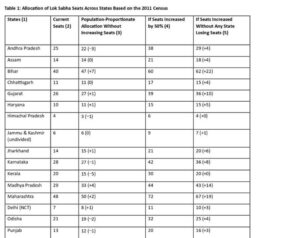
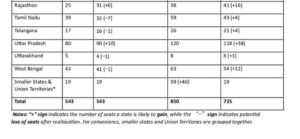
The reported proposal expands the Lok Sabha from 543 to around 850 seats using 2011 Census data, with one-third reserved for women.
The arithmetic does not hold. Uniform expansion across states ignores five decades of uneven population growth. Using 2011 data compounds the problem, as demographic shifts since then have been significant.
High-growth states remain under-represented relative to their population. Smaller states and Union Territories gain disproportionately. Adding around 40 seats to these regions deepens an existing bias that has persisted since the freeze.
Even after expansion, population-to-representation ratios remain uneven. MPs from populous states represent far larger constituencies than those from slower-growing regions. This weakens the value of individual votes across states.
The distortion is not marginal. It is structural. Expanding the House without recalibrating allocation preserves legacy imbalances while creating new ones.
Timing and constitutional inconsistency
Current constitutional provisions require that the next readjustment be based on the first census after 2026. A new census is already underway, with results expected around 2029.
Proceeding with seat allocation based on 2011 data, when updated population figures are imminent, creates avoidable inconsistencies. It also complicates the mapping of reserved constituencies, especially with new data on Scheduled Castes and other backward groups expected from the next census.
The sequence matters. Delimitation based on outdated data, followed by another adjustment within a few years, risks institutional instability. It introduces uncertainty into the structure of representation.
Alternative pathways
Three broad approaches emerge from the current debate.
A pure population-based redistribution without increasing total seats would correct representation but trigger political resistance, especially from states that would lose seats.
The current proposal expands seats uniformly across states while preserving existing allocations. This avoids immediate political costs but entrenches distortions.
A third approach retains existing seats for all states and allocates only the additional seats in proportion to population. This reduces political friction while moving closer to demographic fairness. It also limits the expansion of the House to around 725 members, rather than 850.
This approach does not eliminate imbalance. But it aligns incremental change with demographic weight, rather than freezing past allocations into a larger structure.
READ | Rewarding inefficiency: Delimitation of Lok Sabha, state assembly seats can wait
An incomplete correction
Even with expansion, disparities in representation will persist. The proposed model does not restore parity in population-to-representation ratios across states, nor does it reconcile the tension between demographic weight and political allocation.
The reform advances women’s representation through an institutional design that leaves the core problem of apportionment unresolved. It treats expansion as a substitute for redistribution, without addressing the underlying inequities embedded in the current allocation.
The political opening is evident. The long-pending demand for women’s reservation may finally be realised. But the design choice embeds a structural trade-off: descriptive representation is strengthened, while the principle of equal voting value remains only partially addressed.
J Retnakumar is Senior Research Fellow (visiting) at IIMD Thiruvananthapuram. KP Vipin Chandran is Associate Professor of Economics at Krishna Menon Memorial Government Women’s College, Kannur.