






WPI rebasing: India’s wholesale price index entered a new series on June 15, with the base year shifted from 2011-12 to 2022-23. The government had approved the revision on May 25, along with the compilation of producer price indices.
A base-year revision changes the basket, weights and coverage of an index. This was overdue. The economy of 2022-23 bears little resemblance to that of 2011-12. Manufacturing has changed. New products have entered the market. Supply chains have shifted. Services account for a much larger share of output and household spending.
The question is whether a better WPI can regain the influence it lost over the past decade.
READ | RBI MPC meeting faces growth-inflation trade-off
WPI rebasing and lost policy ground
For decades, WPI was India’s headline inflation gauge. Until 2014, the Reserve Bank of India watched wholesale inflation closely while setting monetary policy. Government departments, firms and analysts treated it as the main signal of price pressure. Monthly inflation headlines usually meant wholesale prices.
The flaw was always there. WPI measured prices at the wholesale level, not prices paid by households. That distinction became harder to ignore as India’s economy changed.
The commodity price collapse of 2014-16 exposed the gap. WPI stayed in deflation for a long stretch, while consumer inflation remained positive. Households did not see the price declines visible in wholesale markets. The old index looked increasingly remote from lived inflation.
The shift became formal after flexible inflation targeting. Since 2016, the RBI’s target has been defined in terms of CPI, not WPI. Markets now react more strongly to consumer inflation. Welfare spending, wage demands and household budgets are tied more closely to retail prices.
The new WPI series does not alter that hierarchy.
CPI now carries the inflation burden
CPI has one advantage WPI cannot match. It includes services. WPI remains a goods index.
That matters in an economy where health, education, transport, telecom, rent-linked expenses and financial services occupy more of the household budget. Services also account for well over half of India’s gross domestic product.
Wholesale prices can move sharply without the same movement appearing at the retail level. Retail margins, taxes, administered prices, transport costs and services prices all intervene. CPI captures more of that final effect. WPI captures an earlier part of the chain.
This does not make WPI useless. It makes its role narrower.
READ | New CPI series: Inflation may look steadier after rebasing
WPI still catches producer cost pressure
Wholesale inflation remains useful for tracking producer costs and pipeline inflation. Commodity prices, fuel, metals and industrial inputs often show up in WPI before they affect retail prices.
Manufacturers, traders and economists still watch WPI for cost pressure. It matters for some contracts, industrial analysis and government assessment of supply-side inflation. When crude oil, metals or fertilisers surge, WPI can warn of pressure building inside production.
The outgoing 2011-12 series captured a turbulent period: the mid-decade commodity slump, Covid disruption, the Russia-Ukraine commodity shock and the renewed energy pressure from West Asia.
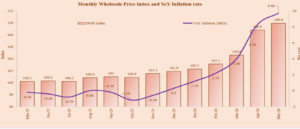
The numbers show why the index still deserves attention. WPI inflation reached 16.63% in May 2022, driven by fuel, metals and industrial raw materials. It had fallen to minus 6.14% in August 2015. Wholesale prices remained in deflation for 20 consecutive months between November 2014 and June 2016, one of the longest such stretches in India’s recent economic history.
Fuel and power caused much of this volatility. Prices in this category fell steeply in 2015 and surged after the Russia-Ukraine shock. Primary articles and manufactured products also saw large swings, but energy remained the main source of violent movement.
April 2026 offered a fresh reminder. WPI inflation rose to about 8.3%, driven by fuel, power and crude oil prices after tensions in West Asia pushed up energy costs. The first reading under the new series, for May 2026, put wholesale inflation at 9.68%, with fuel and power up sharply.
Such jumps do not always reach consumers at once. They can pass through later through freight, manufacturing costs and retail margins.
READ | CPI overhaul could deepen gap between inflation data and reality
Producer price index may matter more
The WPI revision sits inside a larger statistical clean-up. The government has also begun work on producer price indices, including output, input and service PPIs. Reuters reported that India plans to move towards PPI over the next five years, with services such as banking, insurance, railways and telecom added to the producer-price system.
That may be more important than the WPI rebasing itself.
A producer price index is conceptually cleaner than WPI because it measures prices received by producers rather than wholesale market prices. A service PPI would also plug the biggest gap in WPI coverage. For a services-heavy economy, that is essential.
WPI will therefore not return to its old place as India’s main inflation gauge. CPI has taken that role. PPI may gradually take over part of WPI’s analytical function. The rebased WPI will still matter, but as a cost-pressure index, not as the country’s inflation anchor.
The new series makes WPI more current. It does not make it central again.