





The graduate unemployment crisis: India has never had more young people in higher education. It has also rarely had so many graduates waiting at the edge of the labour market. For decades, education has been India’s most enduring promise of social mobility. Families across villages, towns and cities have invested their life savings in the belief that a university degree would secure stable employment, dignity and a better future. Today, that promise stands dangerously weakened.
The latest State of Working India 2026 report by the Centre for Sustainable Employment at Azim Premji University exposes a structural contradiction at the heart of India’s development story- while higher education has expanded rapidly, the economy has failed to create productive employment for its graduates. The result is not merely graduate unemployment but a crisis of economic strategy, human capital and public trust.
READ | Why engineering education must focus on coding skills
Education expands faster than graduate jobs
The transformation in education has been remarkable. India’s Gross Enrolment Ratio (GER) in higher education has risen to nearly 28 per cent, placing it broadly alongside countries at similar income levels. Even more significant has been the educational progress of women. Among girls aged 15–19 years, enrolment has increased from 38 per cent in 1983 to 68 per cent in 2023, representing one of independent India’s most profound social achievements (Azim Premji University, 2026). Yet these educational gains have not translated into commensurate labour market opportunities.
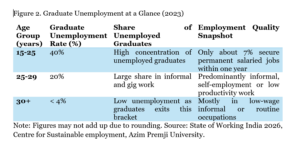
The employment data are deeply unsettling. Nearly 40 per cent of graduates aged 15–25 remain unemployed, while unemployment among graduates aged 25–29 stands at approximately 20 per cent. Of India’s nearly 63 million graduates in the 20–29 age group, almost 11 million were unemployed in 2023 (Azim Premji University, 2026). More disturbing is the quality of employment available. The report finds that only 7 per cent of unemployed graduates obtain permanent salaried jobs within a year. The overwhelming majority eventually enter informal employment, platform-based gig work, self-employment born out of necessity or occupations requiring little of the education they have acquired (Azim Premji University, 2026; Chettri, 2026).
READ | Emotional intelligence: The missing link in India’s education system
This is not simply unemployment; it is a classic case of brain waste. Public resources invested in higher education and private household investments in degrees are yielding declining economic returns. India is producing graduates at a pace unmatched by the creation of productive jobs. Between 2004–05 and 2023, the economy added nearly five million graduates every year, but generated employment for only about 2.8 million of them, with an even smaller proportion entering formal salaried work (Azim Premji University, 2026). Employment elasticity—the capacity of economic growth to generate jobs—has weakened steadily. India may have become the world’s fourth-largest economy, but it has not become a sufficiently employment-intensive one.
The explanation lies not within universities alone but within the country’s growth model. Manufacturing, historically the largest absorber of educated youth in successful East Asian economies, employs only around 11–12 per cent of India’s workforce. Much of India’s recent growth has been driven by services, many of which remain informal, fragmented and incapable of generating large-scale quality employment. Simultaneously, the information technology sector—once the principal destination for engineering and science graduates—is undergoing structural transformation. Automation, artificial intelligence and generative AI are eliminating routine cognitive work and reducing demand for entry-level positions. Universities, however, continue to prepare graduates for labour markets that are rapidly disappearing rather than those that are emerging.
READ | AI divide threatens India’s higher education goals
The consequence is a widening disconnect between credential creation and capability creation. Degrees have multiplied, but productive skills, interdisciplinary competencies, technological adaptability and entrepreneurial capacities have not kept pace with the evolving economy. Periodic Labour Force Survey findings consistently show that unemployment among graduates remains substantially higher than the national average, reinforcing that education alone is no longer a guarantee of employability (Ministry of Statistics and Programme Implementation, 2025).
Graduate unemployment signals brain waste
The economic implications extend well beyond individual hardship. Graduate unemployment depresses household consumption, delays family formation, reduces tax revenues, discourages private investment in education and lowers overall productivity. More importantly, it erodes the social contract. Education has long represented India’s great equaliser, assuring citizens that merit and perseverance would eventually be rewarded. When years of education culminate in insecure employment or prolonged joblessness, that assurance weakens. A generation whose aspirations remain systematically frustrated is vulnerable to social alienation, political disillusionment and declining faith in public institutions.
The response, therefore, cannot be another round of skill-development slogans or curriculum revisions. India requires an integrated employment strategy that aligns higher education with industrial policy. Labour-intensive manufacturing, green technologies, healthcare, logistics, digital public infrastructure, creative industries and the care economy must become engines of graduate employment. Universities must evolve from degree-producing institutions into centres of capability formation by embedding interdisciplinary learning, digital fluency, applied research, apprenticeships and entrepreneurship within the curriculum. Equally important is the creation of dynamic labour market information systems that continuously align educational planning with emerging economic demand rather than historical preferences.
India’s challenge is no longer educational access; it is economic absorption. The country is producing credentials faster than it is producing productive sectors capable of rewarding them. Unless this structural imbalance is corrected, the demographic dividend that policymakers have celebrated for decades may become India’s greatest missed opportunity. Prosperity cannot be built on degrees alone. It must be built on an economy that values, utilises and rewards the knowledge those degrees represent.
READ | Coaching industry feeds on public education failure

Debdulal Thakur is Professor, Department of Economics, Alliance University, Bengaluru.