





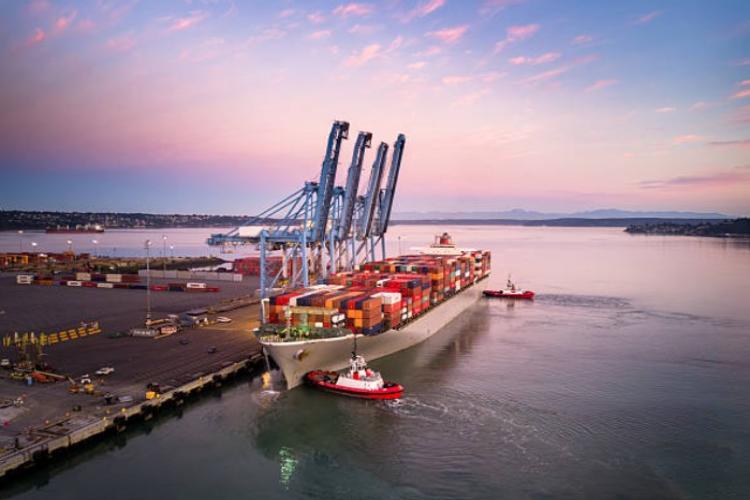
Globalisation works until it doesn’t. The United States announced two-week ceasefire with Iran may have reduced the immediate risk of a wider West Asia conflagration, but it has not erased the export disruption already caused by weeks of instability in shipping routes, insurance markets and commodity prices. For India, the episode is less a passing scare than a reminder of how fast external shocks can weaken export momentum at home.
Commerce and industry minister Piyush Goyal had outlined fresh measures to help exporters absorb the shock. The immediate pressure point is logistics. Shipping costs have risen. Insurance premiums have climbed. Exporters in sectors such as engineering goods, textiles and perishables are seeing margins erode.
READ | West Asia oil shock narrows India’s fiscal space
Last month, the government launched the Rs 497-crore Resilience & Logistics Intervention for Export Facilitation scheme, or RELIEF, to contain the damage. It offers freight support to exporters hit by the disruption. Within it, the government has created a targeted window for exporters already covered by Export Credit Guarantee Corporation insurance. The first phase applies to consignments shipped between February 14 and March 15, 2026, to selected West Asian destinations, including the UAE, Saudi Arabia and Israel, covering full, partial and refrigerated container cargo.
The purpose is clear: keep insurance premiums at pre-disruption levels and absorb the additional burden arising from war and political risk claims beyond normal policy limits. That should prevent a sudden rise in risk costs from derailing shipments already in motion. With an estimated outlay of Rs 56 crore for a one-month period, the measure is designed to protect active exporters from immediate stress and preserve trade continuity.
Export resilience needs more than relief
The more important question is whether India will continue firefighting or begin planning ahead. That is neither an abstract nor an unreasonable demand. Several East and Southeast Asian economies have spent years building buffers against precisely such disruptions.
China did not reduce its vulnerability to trade chokepoints by stepping back from global commerce. It diversified routes, built redundancies and expanded its room for manoeuvre. Rail corridors through Central Asia, access to ports across geographies and long-term shipping arrangements have given it alternatives, however imperfect. What once looked excessive now looks like insurance.
Southeast Asian economies took a different route. Vietnam embedded itself deeply in trade arrangements that preserve competitiveness even when logistics costs rise. Agreements such as the CPTPP and the EU-Vietnam FTA do not remove disruption, but they soften the blow by lowering tariff barriers and protecting market access.
Indonesia has focused on downstream industrial capacity, especially in minerals, to reduce dependence on volatile external supply chains for intermediate goods. Malaysia and Singapore have invested heavily in port efficiency and digital logistics. In a disrupted trading environment, speed and reliability become strategic assets.
READ | West Asia war puts the rupee under fresh pressure
India’s logistics strategy lacks coherence
India has fragments of all these approaches, but not a coherent strategy. Its push for free trade agreements is useful. Preferential access to major markets can improve competitiveness. But trade agreements cannot compensate for logistical weakness.
India’s vulnerability is also more concentrated than the present crisis response suggests. A narrow set of sectors, destination markets and shipping corridors bears a disproportionate share of export risk. When disruption hits one region, the damage is magnified because many firms lack alternative routes, diversified buyers or institutional guidance on managing geopolitical trade shocks. That makes the problem larger than freight costs. It is also a question of export concentration and weak risk anticipation.
READ | West Asian conflict sends jitters through crisis-ridden global economy
What India needs is a layered response. The first layer is immediate relief. Schemes such as RELIEF, freight support and targeted credit for export-oriented MSMEs can buy time. The second is diversification. Indian exporters remain too dependent on a limited set of routes and markets. That exposure can be reduced through trade agreements as well as more active trade diplomacy in Africa, Latin America and Central Asia.
The third layer is domestic logistics reform. India’s logistics costs, at an estimated 13-14% of GDP, remain well above those of East Asian competitors. Initiatives such as PM Gati Shakti and the dedicated freight corridors matter. But the next step is harder: improving port capacity and port efficiency together. In a world of recurring supply shocks, the ability to move goods quickly within India is as important as the ability to ship them abroad.
Exporters also need better tools to manage volatility. In more developed markets, freight and insurance risks are often hedged through financial instruments and long-term contracts. Indian exporters, especially smaller firms, rarely have access to such mechanisms. Unless that changes, every geopolitical crisis will trigger another round of ad hoc support.
The West Asia conflict should be treated not as a temporary trade disturbance but as a warning. The next disruption may come from war, climate events or technology shocks. The question is whether India responds with another emergency package or with a trade system that has learned to anticipate risk, diversify exposure and build resilience before the next crisis hits.