





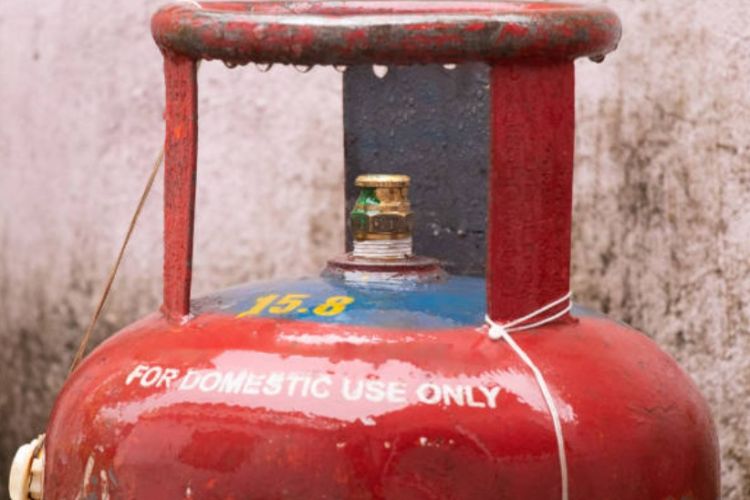
LPG price shock: India is facing an LPG supply squeeze triggered by disruptions in West Asian imports. Domestic production meets about 40% of demand and the rest is imported. In early March 2026, the government asked refineries to maximise output and diverted supplies from commercial to household use, while assuring that domestic supply was protected.
Yet unease persists. Panic booking has pushed up demand even where stocks are adequate. The stress points are clear: import dependence and weak last-mile access in rural markets.
READ | Crude prices, LPG shortages, and the cost of Gulf dependence
Policy success, emerging financial strain
India’s shift to clean cooking fuel remains a major public policy achievement. The Pradhan Mantri Ujjwala Yojana expanded LPG access to low-income households at scale. But affordability is now under strain.
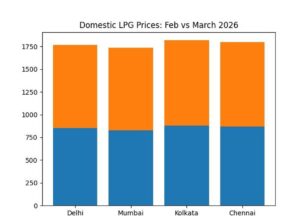
A ₹60 jump in a month is not incremental inflation. It is a shock. Low-income households cannot smooth such spikes. Consumption adjusts immediately—often at the cost of other essentials.
Access without usage: The Ujjwala gap
India has over 330 million LPG connections, including more than 10 crore Ujjwala beneficiaries. Access is near universal. Usage is not.
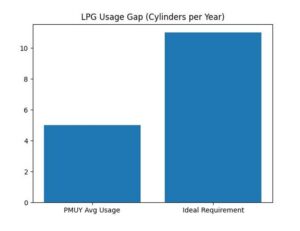
The gap reflects affordability. Households ration LPG and revert to biomass to manage budgets.
READ | LPG import dependence meets Hormuz disruption: Indian kitchens may feel the pinch
Import dependence and pricing stress
India imports roughly 60% of its LPG needs. Prices therefore track global benchmarks. But domestic prices do not always move in step.
State-run oil marketing companies—Indian Oil Corporation, Bharat Petroleum Corporation Limited, and Hindustan Petroleum Corporation Limited—often absorb part of the increase when retail prices are not revised immediately. These under-recoveries accumulate and are later offset through delayed price hikes or fiscal support.
This creates a pattern: prices remain stable for a period, then adjust sharply. The current spike reflects that lag.
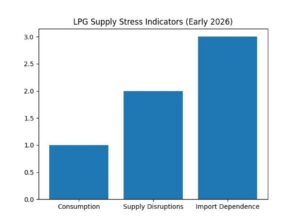
External shocks continue to transmit into domestic prices, but with a delay that amplifies their impact.
In several states, the constraint is not supply at source but delivery economics. LPG distribution depends on a dense network of bottling plants, transport contracts, and local dealers whose viability rests on steady refill volumes.
When households cut consumption, dealer throughput falls, raising per-cylinder delivery costs and stretching refill cycles in remote districts. This weakens last-mile reliability precisely when prices are already suppressing demand. The result is a feedback loop: lower usage undermines distribution efficiency, which in turn reinforces irregular access.
READ | India’s LPG industry faces severe financial strain
Household impact: Cost, health, gender
LPG prices now absorb a larger share of monthly income for poorer households. The response is immediate: fewer refills, more biomass use.
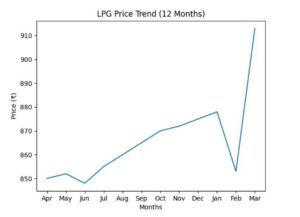
The consequences follow. Indoor air pollution rises. Health risks increase. Women bear the exposure and the added labour. Higher prices widen inequality: affluent households absorb the increase; poorer households downgrade fuel quality.
The phase-out of subsidised kerosene has removed a cleaner fallback for many households. When LPG becomes unaffordable, the shift is directly back to firewood and other traditional fuels.
Subsidy policy and fiscal limits
The policy dilemma is constrained by the budget. LPG subsidies compete with food and fertiliser support. Over time, subsidy coverage has narrowed, with transfers becoming more targeted and less predictable.
The result is partial protection. Households remain exposed to market volatility, especially during periods of global price stress.
Structural fault lines
The current stress reveals four weaknesses:
Price volatility: Adjustments are infrequent but sharp due to deferred pricing.
Limited subsidy coverage: Fiscal constraints restrict broad-based support.
Import dependence: External shocks pass through with lagged impact.
Weak alternatives: Electric cooking depends on reliable power; piped gas remains urban.
These factors reinforce each other. High price sensitivity among low-income households ensures that even modest increases reduce consumption. he LPG crisis is unfolding inside kitchens, not in headline numbers. But the implications are large—public health, gender outcomes, and welfare policy credibility.
Access alone does not sustain a clean cooking transition. Affordability determines usage. Without intervention, the shift away from biomass will stall. he question is no longer whether LPG connections exist. It is whether households can use them consistently. For many, the answer is increasingly no.
Neetigya Verma and Suhani Singhal are students, and Dr Reeta Tomar Assistant professor at CHRIST University, Delhi NCR.
READ | LPG price cut: Government unveils its election playbook