





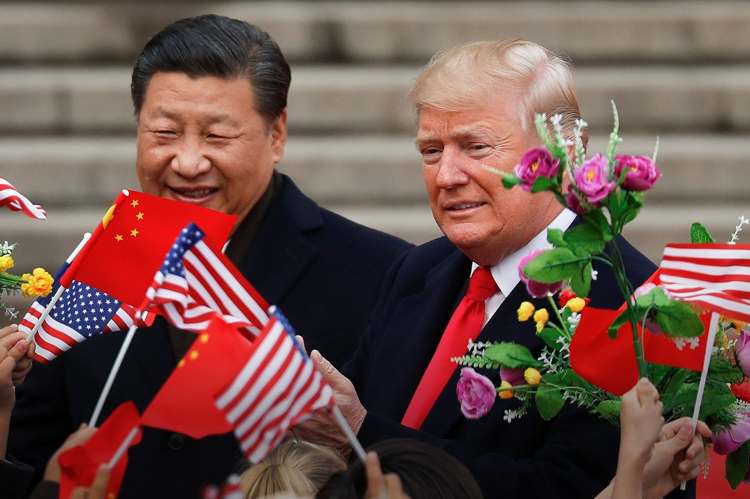
Trump China visit leaves issues unresolved: US President Donald Trump went to Beijing promising deals. Xi Jinping received him with theatre. The result was neither a reset nor a rupture. It was a carefully staged pause in a rivalry that neither side can yet afford to settle.
The visit produced warmth, phrases, handshakes, banquet language, and familiar claims about business wins. It did not produce a durable bargain on tariffs, technology, Taiwan, Iran, or market access. Reuters reported that China’s Commerce Ministry described the deals as “preliminary,” with details on volumes, values, companies, and timelines still unresolved. That one word is the most accurate summary of the summit.
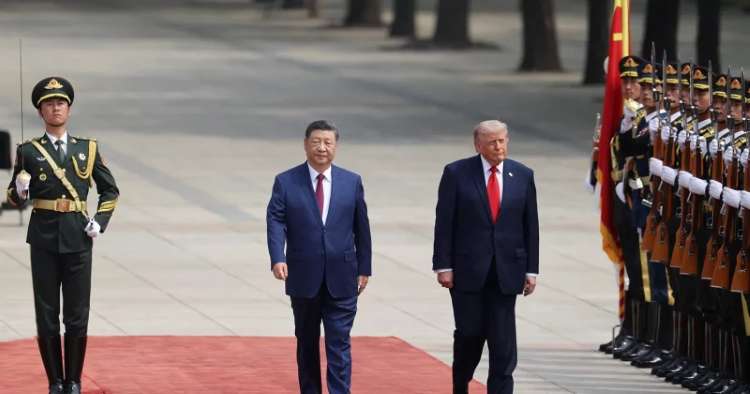
The optics mattered because Beijing wanted them to matter. Xi hosted Trump at Zhongnanhai, a rarely opened Communist Party leadership compound, and framed the meeting around “constructive strategic stability.” Trump responded with praise. The asymmetry was striking. China offered a governing phrase for the relationship. Trump offered superlatives.
READ I Credible threats shape US-Iran nuclear talks
Trump China visit delivered optics, not outcomes
This was not accidental. For Xi, the visit was an opportunity to project China as America’s peer, not its supplicant. The choreography conveyed status. The American president arrived with corporate chiefs. Chinese officials received them. Trump spoke of respect. Beijing could present itself to its domestic audience and to the global South as a power before which even Washington must show deference.
Trump, for his part, needed visible wins. He claimed China would buy 200 Boeing aircraft and more American oil and farm goods. But China did not confirm the substance in comparable detail. The Boeing claim was weaker than market expectations and, according to Reuters, still required further negotiation.
This has been a familiar pattern in Trump’s China diplomacy. Big numbers are announced before contracts are settled. Market access is described before rules change. The press conference precedes the policy.
The business delegation reinforced the message. Executives from Boeing, GE Aerospace, Qualcomm, Cargill, Visa, Goldman Sachs, Citigroup and others held meetings with Chinese agencies during the visit. Their presence showed that American firms still want the Chinese market. It did not show that China had agreed to structural concessions on subsidies, data controls, procurement, financial access, or industrial policy.
READ I Indian Ocean trade can anchor India’s growth aspirations
Taiwan became the real test
The most consequential moment did not concern aircraft, oil, or soyabeans. It concerned Taiwan.
Xi warned Trump that mishandling Taiwan could put the relationship in danger. Trump later said he had discussed arms sales to Taiwan with Xi and would decide soon. Reuters reported that Trump said Xi had asked whether the US would defend Taiwan if China attacked, and that Trump declined to answer.
That is not a minor diplomatic detail. Under the Taiwan Relations Act, the US is bound to help Taiwan maintain the capacity to defend itself. Washington has also long avoided consulting Beijing on arms sales to Taipei. Trump’s description of Taiwan arms sales as a “negotiating chip” therefore raised legitimate anxiety in Taiwan and among US allies.
A summit that leaves Taiwan wondering whether its security is tradable cannot be called a substantive success for American strategy. Beijing may not have secured a public concession. It secured something better: ambiguity from a US president who treats commitments as bargaining assets.
Trump said nothing had changed. Perhaps. But in East Asia, uncertainty is itself a change. It affects Tokyo, Seoul, Manila, Canberra, and New Delhi. It tells allies that American guarantees may depend on the next negotiation.
READ I NATO crisis deepens over US-Iran war divide
China set the tone
The phrase “constructive strategic stability” was Beijing’s most important diplomatic gain. It sounds harmless. It is not. In Chinese usage, such phrases become instruments. They create a standard against which US actions can later be judged.
If Washington tightens chip controls, Beijing can call it destabilising. If the US sells weapons to Taiwan, China can say America violated the spirit of stability. If American firms diversify supply chains, Beijing can frame the move as a rejection of cooperation.
The White House did not fully adopt the phrase. But Secretary of State Marco Rubio said Washington agreed with the need to avoid misunderstandings that could lead to wider conflict, according to reports summarised in the pasted source material. That is reasonable in principle. The danger lies in allowing Beijing to define stability as American restraint and Chinese freedom of action.
No tech breakthrough in Trump China visit
Technology was present everywhere and settled nowhere. Nvidia’s Jensen Huang, Apple’s Tim Cook, Tesla’s Elon Musk and other corporate leaders gave the visit a Silicon Valley gloss. Reports suggested limited clearance for some Chinese firms to buy Nvidia H200 chips, but US officials also said chip export controls were not a major topic of the formal talks.
That contradiction reveals the summit’s weakness. Semiconductors are no longer a trade dispute. They sit at the centre of military power, artificial intelligence, surveillance capacity, industrial productivity, and geopolitical leverage. A few licences for chip sales do not alter the structural contest between Washington’s technology controls and Beijing’s push for self-reliance.
China wants access where it remains dependent. The US wants revenue for its firms without surrendering strategic advantage. There is no elegant bargain here. The summit did not find one.
Iran exposed the limits of personal diplomacy
Trump also wanted Chinese help on Iran. China wants the Strait of Hormuz open and energy prices stable. That creates overlap, not alignment.
Beijing remains a major buyer of Iranian oil and has channels to Tehran that Washington lacks. But it has little incentive to rescue an American-led Middle East strategy from its own contradictions. Reports from the summit showed both sides agreeing broadly on keeping energy flows open and preventing Iran from acquiring nuclear weapons. They did not show a Chinese commitment to pressure Tehran in ways that would impose real costs on Beijing.
This is where Trump’s personal approach meets its limit. Xi can flatter him, host him, and praise stability. He will not subordinate Chinese energy security or anti-US alignments to Trump’s need for a diplomatic headline.
Trade truce, not trade settlement
The best that can be said for the visit is that it preserved the truce. That matters. The world economy benefits when Washington and Beijing are not escalating tariffs, export controls, and rare earth restrictions every week.
But a truce is not a settlement. The underlying disputes remain. China’s industrial policy has not changed. US tariffs have not been placed on a coherent strategic footing. Rare earths remain a Chinese lever. American firms remain exposed to Chinese regulation. Chinese firms remain vulnerable to US technology controls.
The proposed trade and investment boards may create channels for negotiation. They may also become holding pens for disputes that neither side wants to resolve. Reuters reported that both countries agreed to negotiate product-specific tariff reductions and address non-tariff barriers, but the commitments still lacked operational detail.
That is not failure in the dramatic sense. It is failure in the policy sense. The summit managed the temperature but did not treat the fever.
What the summit really achieved
Xi achieved status. Trump achieved talking points. Businesses achieved access to rooms. Markets achieved temporary relief. Taiwan received uncertainty. The rest of the world received another reminder that US-China competition is being managed through spectacle rather than strategy.
For India, the lesson from Trum China visit is direct. A transactional US president may seek leverage everywhere, including on issues that allies regard as strategic red lines. China will use ceremony, patience, and phrase-making to convert tactical meetings into long-term diplomatic advantage. Neither conclusion should surprise New Delhi.
The Trump China visit was not empty. It had content of a kind. But the content lay in the staging, not in the agreements. Beijing wanted a picture of equality and restraint. Washington wanted announcements without hard obligations. Both got enough to claim success.
That is why the summit looked historic and felt hollow.