





Recent reports suggest the central government may be considering a way around the delimitation deadlock on women’s reservation. The proposal, if it advances, would expand the Lok Sabha from 543 to 816 seats, with 273 of the new seats reserved for women and allocated using 2011 Census data rather than waiting for a fresh Census. If that happens, it would mark the biggest change in India’s representative structure since universal adult franchise.
That national discussion acquires urgency as five states: West Bengal, Tamil Nadu, Kerala, Assam and Puducherry — go to the polls in April 2026. Together, they account for 824 assembly seats and more than 17 crore voters. The contradiction is plain. Many of the schemes dominating these elections — free rations, cooking gas, housing support — are targeted and marketed at women. But women remain largely missing from the candidate lists of the parties making those promises.
READ | Delimitation debate risks deepening India’s regional fault lines
At the birth of the republic, Indian women received equal voting rights immediately and unconditionally. More than seven decades later, the right to vote has still not translated into the right to govern. If past trends hold, fewer than one in ten of those 824 seats will be contested by a woman.
State assembly representation remains the real deficit
This matters because state assemblies decide the issues that shape daily life most directly: schools, hospitals, ration shops and welfare delivery. Yet women occupy just 9 per cent of seats across India’s state assemblies. The problem is not electoral participation. Women now vote in numbers comparable to, and often higher than, men in many states. The gap lies elsewhere: in access to candidature, controlled by party selection committees.
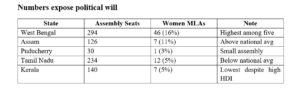
Among the five poll-bound states and Union territory, West Bengal performs best, with 46 women in a 294-member assembly, or 16 per cent. Assam has 7 women in a 126-member House, around 11 per cent. Puducherry has 1 in 30. Tamil Nadu has 12 in 234, and Kerala 7 in 140 — both around 5 per cent.
Kerala is the sharpest example of the disconnect. It routinely leads India on women’s literacy, health outcomes and social development. Women hold more than half the seats in local bodies. Yet the state assembly has only 7 women members. Tamil Nadu has produced two women chief ministers, but women have averaged less than 5 per cent of MLAs since 1967. West Bengal does better in part because the Trinamool Congress has shown greater willingness to field women in winnable seats. The presence of prominent women leaders, by itself, does not widen legislative inclusion.
READ | Rewarding inefficiency: Delimitation of Lok Sabha, state assembly seats can wait
Selection is where women’s reservation is blocked
The evidence is clear about where the barrier lies. ADR analysis of recent elections found that 1,698 of 4,123 assembly constituencies, or 41 per cent, had no woman candidate at all. In the 2024 Lok Sabha elections, 154 of 543 seats had no female candidate from any major party. The constraint is not a lack of qualified women. It is party gatekeeping. Candidate selection remains a rationed resource, and women continue to be pushed to the back of the line.
That is what makes the current moment politically revealing. The Constitution’s 106th Amendment, passed in September 2023 as the Nari Shakti Vandan Adhiniyam, mandates one-third reservation for women in the Lok Sabha and state assemblies. But implementation was deferred until after a fresh Census and delimitation. Celebration came first; representation did not. The Lok Sabha that passed the amendment had 14.4 per cent women. The present Lok Sabha has 13.4 per cent.
Against that backdrop, the reported plan to use 2011 Census data matters because it would remove the procedural alibi that has kept the law frozen since passage.
READ | 16th Finance Commission: Why the north-south tax row has shifted
Women’s reservation: April 2026 elections will test intent
The reported proposal to reserve 273 seats in an expanded Lok Sabha may hasten implementation. But it also throws up a more immediate question. In the absence of compulsion, will parties act on their own?
The record says no.
Across West Bengal, Tamil Nadu, Kerala, Assam and Puducherry, women have become central to campaign design. Parties recognise them as a decisive voting bloc. Yet that recognition rarely extends to ticket distribution. Women’s votes are pursued. Women’s candidacies are postponed.
Reserved seats, when they come, will force parties to nominate women in designated constituencies. They will not force parties to build a deeper political pipeline through which women gain organisational experience, local credibility and internal leverage before ticket allocation begins. That work cannot be subcontracted to constitutional design. It has to begin inside parties, before the law compels it.
That is why the five April 2026 elections matter. They offer a cleaner test of political intent than any amendment on paper. There is no legal obligation on parties to field more women. There is no electoral penalty yet for fielding fewer. What these elections will show is whether parties treat women’s inclusion as a political commitment or merely as campaign rhetoric — useful in manifestos, dispensable at the nomination stage.
India has announced a larger destination for women’s representation. These elections will reveal whether its parties are willing to move towards it voluntarily, or whether they will do what they have done before: wait to be compelled.
Jyoti Thakur is Associate Fellow, National Council of Applied Economic Research (NCAER), New Delhi.