





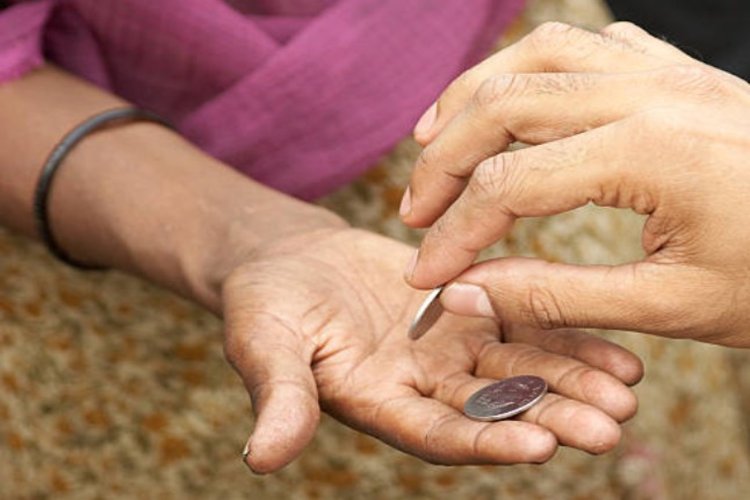
Indians donate an estimated ₹34,000 crore a year to its roughly 4.13 lakh beggars. That money relieves immediate distress, but it does little to build assets, incomes or a route into the formal economy. Beggars Corporation, a Varanasi-based for-profit social enterprise, starts from a different premise- some part of that giving can be redirected into enterprise.
“Don’t donate, invest. Beggars can do business, beggars can pay tax,” says founder Chandra Mishra.
READ | New MPI data: Poverty and climate are now the same crisis
Founded by Mishra, a journalist-turned-social entrepreneur from Odisha, Beggars Corporation was incorporated on August 12, 2022, though its work in Varanasi began in June 2021. It is recognised by the Department for Promotion of Industry and Internal Trade as a social impact startup. More important than the label is the structure. It is not an NGO distributing aid; it is a for-profit company trying to build businesses around people who have survived on alms.
Mishra calls the idea “Employonomics”. The argument is straightforward. Philanthropic money routed into alms may ease hardship for a day, but it does not create productive capacity. Beggars Corporation wants to direct at least a slice of that money into ventures that can generate income, ownership and, eventually, taxes.
OBOM model and the SPV structure
The operating core is the One Beggar, One Mentor programme. For each person enrolled, a mentor invests ₹2 lakh over three years. The investment is treated as equity, not charity. The special purpose vehicle is structured with 24% equity for the beggar-turned-entrepreneur, 24% for the mentor or social investor, and 52% for Beggars Corporation, which handles operations, marketing and training. The enrolled person also gets an onboarding guarantee of ₹10,000 a month for three years plus a lump sum of ₹1 lakh, while training compensation is fixed at ₹7,000 a month during the three-month training period.
READ | Multidimensional poverty gains and fiscal federalism
The appeal of the model lies in how it aligns incentives. The person leaving beggary gets ownership, not a handout. The mentor is not just giving money away but backing an enterprise. Beggars Corporation retains control because it is responsible for execution and scale.
That is the theory. The reported early results are what make the model worth examining. The enterprise says it has generated more than ₹10 crore in economic activity in less than three years. Former beggars are said to be earning between ₹10,000 and ₹30,000 a month, and some have entered the tax net.
From welfare recipients to producers
The larger conceptual move is important. C.K. Prahalad’s bottom-of-the-pyramid thesis framed the poor as an underserved consumer market. Beggars Corporation tries to reverse that lens. It treats the poorest not as consumers of charity, but as producers.
The product line reflects that commercial intent. Eco-friendly cotton bags, Banarasi patchwork stoles, laptop and conference bags, and wedding accessories are sold to hotels, companies and institutional buyers. The BJP reportedly bought conference bags for its national executive meeting in November 2021. Karma Cafe in Varanasi directly employs former beggars. Helping Hands, a home-cleaning service under the initiative, has also created employment. The point is not that these are large businesses yet. It is that they are being built as businesses, not as pity-driven activity.
“For the donor, it’s about moving from charity to investment. For the beggar, it’s about rediscovering dignity,” as Prof. Sreevas Sahasranamam of the University of Glasgow put it.
Begging economy and social dead capital
The macroeconomic case made by Beggars Corporation is that India’s donation economy, at least in this segment, is a form of dead capital. Money changes hands but creates no asset, no multiplier, no durable tax base. That formulation borrows from Hernando de Soto’s broader argument about assets lying outside formal economic circuits.
To test the proposition, the company has proposed a Begging Free Bharat Fund of ₹14.9 crore. Its stated goal is to build a member-customer revenue base of ₹1,125 crore within five years by transforming 1,000 beggar families in Varanasi before attempting replication elsewhere. The arithmetic is simple enough: if an investment of ₹2 lakh over three years can create a taxpaying entrepreneur, the return to society is larger than the return to the individual enterprise.
Former chief economic adviser K.V. Subramanian called it “a unique initiative, the first of its kind in the world”. That endorsement matters less as praise than as a sign that the model has drawn attention beyond the social sector.
READ | Eradication of extreme poverty in Kerala sets a new benchmark
Limits of scale in the anti-poverty model
The constraints are plain. Reach remains small relative to the scale of the problem. Moving a little over 100 people in three years is meaningful at the level of proof of concept, but modest against India’s documented beggar population and irrelevant against the wider pool of urban destitution. The model is capital-intensive per beneficiary. It depends on recruiting mentors willing to stay engaged. The market for its products is still limited. And every social enterprise that mixes purpose with profit faces the risk that commercial pressures will dilute social intent.
The expansion to Dehradun through an MoU and the School of Life’s Learn and Earn programme for child beggars suggest some institutional ambition. But scaling from Varanasi to a national platform will need more than entrepreneurial energy. It will require policy support, CSR alignment and a clearer framework for social impact investing.
Capital allocation and poverty policy
Beggars Corporation is not yet a national solution. It is a live experiment in treating visible, street-level poverty as a problem of capital allocation rather than permanent welfare dependency. That is a sharper claim than the usual language of rehabilitation, and it explains why the initiative has drawn attention.
Whether it can scale is still open. But it has already shown that at least some people trapped in beggary can be moved into ownership, work and the formal economy if the money around them is structured differently. That is reason enough to take the model seriously.
Nihar Nalini Sarangi is an analyst and columnist based in Bhubaneswar.