






CPI-IW revision must reflect how workers actually live: The Labour Bureau’s revision of the Consumer Price Index for Industrial Workers (CPI-IW) offers an opportunity to improve an inflation measure that influences wage compensation. Its 2026–27 Citizens’ Charter confirms that work on updating the existing series is under way. The proposed inclusion of construction and expansion from 88 to 130 centres remain proposals under consultation. Their value will depend on how well the revised index represents workers’ households. Adding new locations will achieve little if the survey misses the families whose spending differs from those already covered.
The stakes extend beyond statistical accuracy. CPI-IW is used in dearness allowance calculations and wage adjustments. Errors can affect workers’ compensation and employers’ costs. A basket that falls behind changes in household spending can misrepresent inflation, although the direction of that error cannot be assumed.
READ | RBI interest rate pause reflects caution on fuel-led inflation
The existing series has a base year of 2016 and applies from September 2020; it was released the following month. It covers 88 industrial centres and seven sectors, including factories, mines, plantations, railways and public motor transport. Electricity generation and distribution, and ports and docks, complete its coverage.
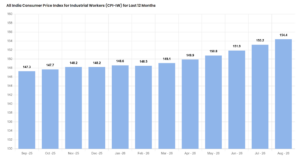
Household spending may have changed considerably since the expenditure survey underlying that series. Healthcare, transport and digital services warrant fresh examination. The survey must establish the extent of those changes among industrial-worker households, rather than infer them from consumption trends among urban consumers generally.
CPI-IW revision: Construction workers need a different survey approach
Including construction would address a gap in the index’s occupational coverage. But it would also make the survey more demanding. Construction employment can be seasonal, arranged through contractors and spread across changing worksites. Workers may move between districts or states, while their families remain elsewhere.
A survey designed around settled factory-worker households could miss these arrangements. It must distinguish spending at the place of work from expenditure by family members at home, and account for shared accommodation. Otherwise, construction could enter the index without its workers’ living costs being adequately represented.
The choice of centres deserves equal attention. Workers in manufacturing hubs, mining belts and smaller industrial towns can face different housing and transport costs. Access to public services also affects what households must purchase privately. Even neighbouring districts need not have comparable expenditure patterns.
Employment data should guide the selection of centres, with explicit provision for differences in establishment size and local labour markets. The Bureau should publish the basis for that selection. Readers need to know which workers the expanded sample represents and where its coverage remains limited.
No practical index can reproduce every household’s experience. The objective should be a defensible average for a clearly defined population, supported by enough detail to reveal substantial differences within it.
READ | India inflation rises as RBI faces October test
Spending weights determine whose inflation is measured
The revision must distinguish changes in prices from changes in what households buy. If food takes a large share of a family’s budget, food inflation will weigh more heavily on its measured cost of living than an equivalent price increase in a service it seldom uses. The expenditure survey determines those relative weights.
The Working-Class Family Income and Expenditure Survey underlying the existing series covered 48,384 families. A fresh survey must establish both the contents of workers’ consumption baskets and the expenditure shares assigned to them.
Digital records could help households recall some purchases. They cannot substitute for an expenditure survey. Cash transactions, informal services and spending shared among several workers require careful questioning. Migrant households present an additional difficulty because their consumption may be divided between two locations.
Changes in spending also need interpretation. A family may switch to a cheaper product because its income no longer covers its usual purchases. That substitution should inform the basket without being presented as evidence that living standards have improved. A price index measures price change; it cannot, by itself, explain whether households are better off.
The same discipline should govern new products. Streaming subscriptions and other online services belong in the basket where survey evidence supports their inclusion and weight. Their visibility in urban markets is insufficient reason to give them prominence in an industrial-worker index.
The new headline CPI offers useful lessons
The broader Consumer Price Index provides a recent example of updating coverage. On February 12, 2026, the government released the series with a 2024 base year, using expenditure weights from the Household Consumption Expenditure Survey 2023–24. It adopted the international COICOP 2018 classification, added rural housing and streaming services, and removed several obsolete products.
READ | Retail inflation surge puts RBI’s growth priorities to test
Price collection now covers 1,465 rural markets and 1,395 urban markets across 434 towns, supplemented by 12 online markets. The expansion illustrates how collection methods can accommodate changing purchasing habits.
CPI-IW should draw on that experience while retaining its distinct population and purpose. Weights derived for households generally cannot simply be transferred to industrial-worker families. Nor does adopting a common classification eliminate the need to investigate their particular expenditure patterns.
Survey delays can leave a new index outdated
The present series illustrates the gap between a reference year and publication: its 2016 base preceded its release in 2020. Some delay is unavoidable when household surveys, basket design and price collection must be coordinated. A prolonged gap, however, reduces the benefit of updating the index.
The Bureau needs a published timetable for the expenditure survey and the revised series. It should explain methodological changes before implementation and provide clear guidance on linking the old and new indices. Workers, employers and governments need to understand how the transition affects wage calculations.
Regular reviews would reduce the pressure to undertake a large correction after long intervals. They would also make revisions easier to scrutinise by separating routine statistical maintenance from disputes over the resulting inflation number.
The decisive test is whether the survey captures workers who are hardest to reach. If migrant construction families and workers in smaller centres remain poorly represented, a larger sample and a newer base year will leave the central weakness unresolved.