





RBI interest rates held at 5.25%: The Reserve Bank of India had little reason to change the repo rate on August 5. Inflation has crossed its 4% target, but the rise has come mainly from fuel. Core inflation remains contained. Economic growth is holding up well enough to rule out another cut. A rate increase, meanwhile, would have imposed a domestic cost before the effect of higher oil prices on wages and other prices became clear.
The Monetary Policy Committee therefore voted unanimously to retain the repo rate at 5.25% and continue with a neutral stance. The decision was expected. Yet the pause is more than an absence of action. It defines the evidence the RBI wants before it acts again.
India’s monetary policy now turns on whether an imported oil shock spreads through the economy. If businesses absorb higher transport and input costs, inflation may ease as crude prices retreat. If they pass those costs to consumers, and workers seek compensation through higher wages, the RBI will have a case for raising rates. The June inflation number does not settle that question.
READ I Economic policy must build India’s strategic power
RBI interest rates await broader inflation evidence
Retail inflation soared above 4% in June for the first time in 17 months. The breach was noted, but the composition of inflation was given more attention than the headline number. RBI focused on the fact that fuel accounted for much of the increase while broader price pressures remained in check.
The RBI reduced its average inflation forecast for 2026-27 to 5%, from 5.1% in June. Its estimate of core inflation was cut from 4.7% to 4.3%. These revisions sit uneasily with an immediate rate increase. A central bank that expects underlying inflation to be lower than it did two months ago would need strong evidence of a coming surge before tightening policy.
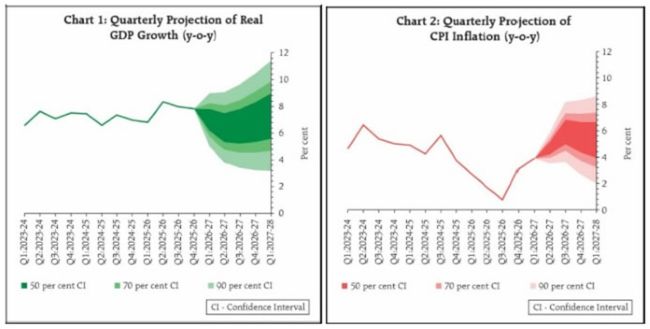
The quarterly path is less comfortable. The RBI sees inflation rising to 5.9% in the third quarter before easing. Oil prices, food supplies and the monsoon may push the number higher. India imports most of the crude oil it consumes, so an extended disruption in West Asia would affect transport costs, the trade account and the rupee.
Interest rates cannot produce oil or improve rainfall. They can restrain the second-round effects of such shocks by reducing demand and anchoring expectations. Acting before those effects appear would amount to using a costly instrument against a price increase that may prove temporary.
Indonesia and the Philippines have responded to energy inflation and currency pressure by tightening policy. India has more room to wait because core inflation is moderate and the external account has improved. The tolerance band of 2% to 6% also gives the MPC some latitude, though a prolonged stay near its upper end would exhaust that room.
READ I Income tax amendment rewrites rules for foreign capital, industry
Stronger growth rules out RBI interest rate cut
The case for an interest rate cut is weaker. The RBI raised its growth forecast for 2026-27 from 6.6% to 6.7%. Bank credit is expanding at close to 18%, and domestic demand has held up despite softer manufacturing activity. The economy does not require cheaper money to avert a marked slowdown.
This is an unusual combination for monetary policy. Growth is strong enough to withstand the current rate, while inflation is high enough to prevent further easing but insufficiently broad to demand a rise. The appropriate rate decision is therefore a pause, provided the RBI is ready to move when the data change.
The neutral stance preserves that freedom. A formal shift towards tightening would have suggested that a rate increase was approaching. Retaining neutrality allows the MPC to respond to either a sharper inflation shock or an unexpected loss of growth. Markets received no assurance that 5.25% is the peak.
Upasna Bhardwaj, chief economist at Kotak Mahindra Bank, expects cumulative increases of 50 basis points by the end of March. That forecast assumes higher fuel costs will persist and enter other prices. The RBI has chosen to wait for evidence rather than validate that assumption in advance.
READ I Next phase of economic reforms must tackle tariffs
Rupee pressure did not force the RBI’s hand
The rupee presented a second argument for raising rates. It has lost more than 5% against the dollar this year, increasing the domestic cost of oil and other imports. Higher Indian rates could support the currency by improving the return available to foreign investors. But using the repo rate primarily to defend the rupee would have tightened credit across the economy.
The RBI instead relied on foreign-exchange intervention and measures designed to attract overseas capital. A subsidised foreign-currency deposit facility for non-resident Indians, coupled with incentives for external borrowing, has brought in more than $41 billion. India’s foreign-exchange reserves reached $692.9 billion on July 31, according to Reuters. These inflows have given the central bank room to curb disorderly currency movements without raising the cost of every rupee loan.
Such deposits are borrowed money and cannot repair a persistent external deficit. For now, they have separated exchange-rate management from interest-rate policy. The MPC could judge inflation and growth without being forced into a interest rate increase by the currency market.
The August decision leaves the RBI with a demanding task. It must distinguish a temporary increase in fuel prices from the beginning of a wider inflation cycle. Waiting is justified while core inflation remains contained. Delay will become harder to defend if firms begin passing higher energy costs through to retail prices, inflation expectations rise or the rupee resumes a steep fall.
The RBI has bought time. The next few inflation readings will determine what that time is worth.