






India’s unemployment rate hides shortage of quality jobs: The controversy over the Chief Justice of India’s (CJI) likening of unemployed people as cockroaches provoked understandable anger and nationwide protests. The remark also exposes a common misunderstanding of India’s labour market. A person without a regular job is not necessarily idle. Millions work long hours without a contract, social security or an assured wage.
In India, labour market is inherently informal. More than 90% of Indian workers are informal. No country in the world comparable to India in terms of size has this volume of informality. Informal employment accounts for over half of total urban employment in China, and roughly 40% to 54% of the country’s total nationwide workforce. The share of informal labour in Brazil accounts for approximately 35.6% to 37.5% of total employment. This translates to roughly 38.5 million Brazilian workers operating without formal employment registration, guaranteed rights, or social security contributions. The informal sector accounts for approximately 21.4% to 34.8% of total employment in South Africa.
READ | Graduate unemployment shadows India’s degree boom
Why India has such unprecedented informality? The probable answer lies in priorities within the existing political economy framework, particularly so after the liberalisation, privatisation and globalisation (LPG) of the economy since 1991. The crux of the matter is that informal labour cost significantly less than formal labour. This is because informal workers by definition do not have access to institutional social securities like EPF, ESI, maternity benefit, bonus etc. In fact, in India informality is defined in terms of whether a worker has access to EPF or ESI. Absence of social security help reduce labour cost from employers’ perspective. Also, informal labour gives employer greater flexibility in terms of deployment of human resources.
Informal workers dominate India’s workforce
As per the latest available statistics, India’s labour force participation rate is 55 percent that translate to 600 million workers in absolute terms. If about 90 percent are informal, in absolute numbers, that would be 540 million workers and formal workers would be around 60 million. Out of this 52 percent that about 280 million are self-employed as those lacked a recognised visible employer. These workers are outside the protective labour law framework. Among the rest 280 million workers, a significant number of such informal workers are engaged in formal sectors.
For example, an overwhelming majority of construction workers are informal even though majority of employers are formal entities. These are staggering numbers and scattered across the length and breadth of our country.
What are pitfalls of informal labour? Poor wages (in 50% of cases below minimum wages), precarious working conditions, lack of occupational safety and health (as per industry statistics, on an average every day 36 construction workers die at construction sites), absence of any form of social security and job security etc. One question that can asked here if working conditions are so poor and if the return on employment is so meagre, why workers voluntarily agree to join the labour market. This is valid question and answer lies intricately to the characteristics of Indian labour market.
READ | Unemployment problem runs deeper than the headline rate
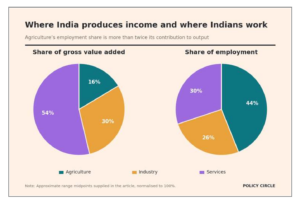
India has a huge excess supply of labour. This is because over time surplus labour released from agriculture did not get fully absorbed in manufacturing or service sector. This becomes clear if you compare sectoral distribution of national income with that of occupational distribution over time. The sectoral composition of India’s national income reflects a transition from an agrarian base to a service-led economy. The tertiary (services) sector accounts for the largest share at roughly 53-55% of the Gross Value Added (GVA), followed by the secondary (industry) sector at around 30%, and the primary (agriculture) sector at about 16-17%.
Primary sector employs 40% of workforce
Indian economy features a stark structural imbalance: while the service sector dominates national income, the primary (agricultural) sector continues to employ the largest share of the workforce. Despite generating the smallest portion of the national income, agriculture remains the primary source of livelihood for the majority of the working population. Primary sector employs approximately 40% to 43% of the Indian workforce. Secondary sector accounts for roughly 24% to 25% of total employment. Tertiary sector employs about 27% to 30% of the workforce.
Thus, it is amply clear that agriculture has almost three times more labour than it ought to have. This implies substantial underemployment and disguised unemployment in agriculture and existence of huge reserve army of labour. This surplus labour in rural areas move to big cities and urban centre(s) in search of meaningful livelihood opportunities. A few of them manages to get decent jobs but large number of those either return to agriculture or do some petty economic activities on urban fringes to survive. Employment elasticity of India’s manufacturing sector is low. It could not provide the necessary absorption of surplus labour coming out of agriculture.
READ | A national employment policy key to solving the jobs crisis
Modern services saw steep productivity gains, while traditional, labour-heavy services expanded in employment but created only modest value. This means many workers leaving agriculture have ended up in activities only slightly more productive than farming. Modern services can reach productivity levels eight to ten times those of agriculture, while construction remains around one and-a-half times. Manufacturing improved its productivity too, but employment gains were weak because output became more capital-intensive. Scholars describe this as a shallow structural transformation, where growth continues but too few workers move into high-productivity sectors.
For obvious reasons, the official unemployment rate in India is low. India’s overall unemployment rate stands at 5.2% as of April 2026, according to the Ministry of Statistics and Programme Implementation (MoSPI). The labor market has experienced slight deterioration recently, with rural joblessness rising to 4.6% and urban joblessness easing to 6.6%. However, most of India’s labour are traded every morning at important cross-sections (also known as labour Chowks) all over India. This is the stark reality of Indian labour market.
Given this context, being unemployed or being employed without adequate compensation is not about a choice or lack of initiative on the part of an individual. It’s about the incomplete structural transformation of Indian economy. The statement by CJI or some of his ilk in recent times manifest the ignorance about this reality and taking too seriously the shiny part of urban life around us in big cities. In practice, these are more aberrations rather than practice.
Dr Kingshuk Sarkar is Professor, General Management & Public Policy, and member, Centre for Public Policy & Governance, Goa.
READ | The fixed-term employment paradox

Dr Kingshuk Sarkar is an associate professor at the Goa Institute of Management. He has worked as a labour administrator with the government of West Bengal. He earlier served as a faculty member at VV Giri National Labour Institute, Noida and NIRD, Hyderabad. Views expressed are personal.