




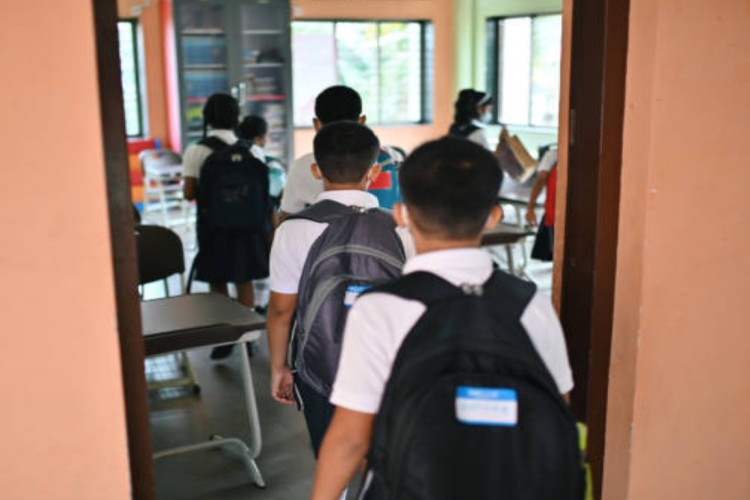
Back-to-school reuse: This June, millions of Indian parents will buy school bags, bottles, lunch boxes and stationery that their children may not need.
The habit is familiar. A new academic year is treated as a reason to replace everything. Some of it is necessary. Much of it is not. The old bag works. The bottle is intact. The pencil box has another year left in it. Yet the market, the school list, and social expectation together push families towards fresh purchases.
READ | India’s food waste is turning into an environmental time bomb
India has 24.69 crore students enrolled in school education in 2024-25, according to UDISE+ data. Even a small change in consumption behaviour can therefore have a large effect. A typical backpack has a carbon footprint of about 17.5 kg CO₂e, with the range varying by material and manufacturing process. If 10 million students used an existing bag for one more year, the avoided emissions from bags alone would be about 175 million kg of CO₂e.
The question is not whether children deserve a good start to the school year. They do. The question is whether preparedness has been confused with replacement.
School supplies and hidden emissions
A school bag is not just cloth, zips and straps. Most are made from petroleum-derived synthetic materials such as nylon and polyester. Their environmental cost is modest for one household, but not for a country with nearly a quarter of a billion schoolchildren.
Water bottles tell the same story. A 500 ml PET bottle has been estimated to generate about 82.8 grams of CO₂. The bottle itself, plastic resin, filling, and transport all add to the footprint. Reusable bottles are not automatically greener if they are discarded quickly. Their value lies in long use. Buying a new bottle every June defeats the point.
Paper has its own burden: pulp, water, energy, chemicals, transport and waste. Notebooks are often necessary. Decorative stationery sets are often not. The distinction matters.
India’s school supply economy still follows a linear model: buy, use, discard, replace. A circular school year would ask a simpler question before every purchase: is the old item still fit for purpose?
Reuse saves household money
The financial case is more immediate than the climate case.
A decent school bag can cost ₹500 to ₹2,500. A steel or BPA-free bottle may cost ₹300 to ₹800. Stationery, geometry boxes, lunch boxes and accessories can add ₹500 to ₹1,500 per child. For a household with two or three school-going children, the June bill can easily cross ₹10,000.
Most bags and bottles are built to last more than one academic year. Extending a bag’s life by one year can save a family ₹1,000 or more. Over a child’s school life, disciplined reuse of bags, bottles, lunch boxes, uniforms and books can save tens of thousands of rupees.
For lower-middle-income families, this is not virtue signalling. It is household economics. Money not spent on unnecessary replacement can go to tuition, transport, nutrition, books or savings.
READ | A circular economy can tackle India’s waste crisis
Back-to-school reuse: What parents can do
The first step is to pause before buying. Lay out last year’s supplies before visiting a shop or opening an e-commerce app. Check the bag, bottle, lunch box, pencil case and geometry box. A broken zip may cost ₹50 to repair. A dented bottle may still be perfectly usable. Half-used notebooks can be finished before new ones are opened.
When replacement is necessary, buy for durability rather than novelty. One ₹1,500 bag that lasts four years is cheaper, and cleaner, than four ₹600 bags bought in four successive years.
Parents can also organise small exchange circles in apartment blocks, Resident Welfare Associations and school WhatsApp groups. Bags, uniforms, textbooks and reference books often outlast one child’s need. They need not become waste.
Children should be told why this matters. Reuse should not be presented as deprivation. It is judgment. A child who learns to value usefulness over novelty is learning a lesson that no environmental studies chapter can fully teach.
Schools must stop pushing replacement
Schools are central to the problem and therefore to the solution.
Many schools already run informal book exchanges. The practice should be formalised and extended to bags, uniforms, lunch boxes and stationery. A beginning-of-year supply exchange drive would reduce waste and lower parental expenditure.
Uniform policy also needs attention. Standard colours and basic designs allow uniforms, sweaters and blazers to move between siblings and families. Excessive branding, annual design changes and proprietary accessories make reuse harder. They also raise costs.
Textbook lending libraries should become routine. Schools can maintain class-wise banks of textbooks and reference books, issued for one year and returned in good condition. This is not a radical idea. It is common sense.
There is also a governance angle. CBSE has earlier advised affiliated schools not to indulge in commercial activity by selling books, stationery, uniforms and school bags, and not to compel parents to buy from specific sources. Recent state-level action, including in Maharashtra and Chandigarh, has also targeted forced purchases from designated vendors. The same principle should be extended from vendor choice to unnecessary replacement.
READ | Plastics treaty stalls; business warns of triple waste surge
Policy can make reuse normal
India does not lack a policy frame. The Supreme Court, in M.C. Mehta v Union of India, endorsed compulsory environmental education. Mission LiFE calls for mindful and deliberate utilisation rather than mindless consumption. The Ministry of Environment has described Mission LiFE as a programme to promote sustainable lifestyles and sustainable consumption patterns.
What is missing is translation.
The Ministry of Education, CBSE and state boards should issue pre-June advisories asking schools to promote reuse, run exchange drives, avoid unnecessary uniform changes, and discourage compulsory fresh purchases when existing items are serviceable.
The Ministry of Environment, Forest and Climate Change can use the back-to-school season for a targeted Mission LiFE campaign. A simple message — repair before replacing — is easier to act on than a general appeal to save the planet.
GST incentives for recycled paper, refillable stationery and durable school products would help. So would voluntary durability labels for bags and bottles. Parents should know whether they are buying a one-year product or a four-year product.
Manufacturers and retailers should also be pulled into the circular economy. Repair services, take-back programmes and “designed to last” labels would shift competition from colour and cartoon branding to durability and value.
Circular school year
A circular school year does not require a moral lecture. It requires a better default.
Schools should not make children feel shabby for carrying last year’s bag. Parents should not treat every June as a compulsory shopping season. Manufacturers should not profit from waste disguised as aspiration. Governments should connect environmental education with ordinary consumer choices.
A well-maintained old school bag is not a sign of neglect. It is evidence that a family understands value. It says that usefulness matters more than novelty.
India’s transition to a circular economy will not be built only in factories, policy documents or climate summits. It will also be shaped in homes, classrooms and school corridors. Repair before replacing. Reuse before repurchasing. Buy durable goods when buying is necessary.
The most useful lesson children carry into the classroom this June may not be in a textbook. It may be in the decision to use what they already have.