






When JPMorgan Chase committed to a 2 million square feet global capability centre in Mumbai’s Powai—large enough to house nearly 30,000 employees—it was not merely expanding office space. It was relocating strategic capacity. Expected to become the largest GCC campus in Asia by 2029, the project reflects how deeply India is now embedded in the operating core of global finance, technology, and risk management.
The moment is significant. Global firms are rethinking where work is done, not as a matter of cost alone but of capability. At the same time, India faces an unrelenting employment arithmetic: it must create close to 10 million jobs a year merely to hold unemployment steady. Few sectors offer an answer that combines scale, skill intensity, and export earnings.
Global capability centres do. But momentum by itself is not policy. Without deliberate action, India could find that today’s advantage hardens into tomorrow’s constraint.
READ I H-1B visa squeeze pushes Wall Street to India’s GCC Hubs
India’s GCC advantage is now structural
India hosts around 1,800 GCCs, employing 1.9 million professionals and generating nearly $65 billion in annual revenues, according to Nasscom and Zinnov. By 2030, the count is projected to reach 2,400 centres with revenues exceeding $100 billion. This already places GCCs among India’s largest and fastest-growing export engines.
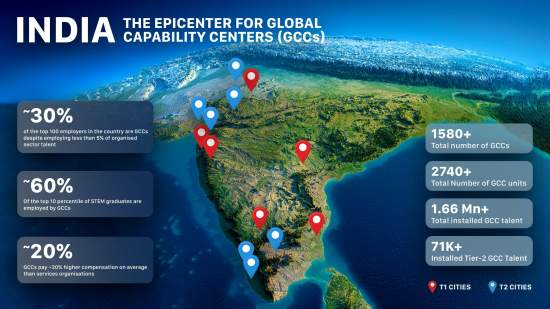
What distinguishes the current phase is not size but mandate. Over half of all GCCs established in the past five years began operations with engineering, R&D, or digital innovation responsibilities. India-based teams now design AI models, build cloud architectures, manage global cybersecurity operations, and own product roadmaps. NITI Aayog estimates that India accounts for nearly one-fifth of global integrated circuit design talent, anchoring the expansion of semiconductor and advanced mobility centres.
This shift explains why trade tensions or immigration crackdowns in the United States have failed to slow the trend. As the IMF has noted, advanced economies face chronic skill shortages and ageing populations. India’s GCC ecosystem is filling a structural gap, not exploiting a cyclical arbitrage.
READ I GCCs to drive the next growth wave beyond metros
High-quality jobs is the real dividend
The most important consequence of GCC expansion lies in the quality of jobs created. In 2025 alone, GCCs generated nearly 200,000 new roles, concentrated in AI engineering, data science, cloud systems, product management, and cybersecurity. More than 60% of GCCs increased fresher hiring, a shift away from talent poaching toward long-term capability building.
This matters for India’s labour market. India produces roughly 1.5 million engineers and 2.4 million STEM graduates each year, yet underemployment remains stubbornly high, according to MoSPI’s Periodic Labour Force Survey. GCCs shorten the distance between education and productive work by inserting graduates directly into global production networks.
The broader economic spillovers are substantial. Nasscom estimates the sector’s direct output at $76 billion, with an additional $165 billion in indirect and induced impact, taking its total footprint to $241 billion. These centres anchor demand for urban services, commercial real estate, and advanced professional services, aligning closely with the UN Sustainable Development Goal on decent work and economic growth (SDG 8).
READ I GCCs open doors to high-skilled jobs and tech leadership
Tier-2 cities offer scale, but not by default
A quiet but important shift is under way. GCCs are beginning to spread beyond the six dominant metros. The share of centres in Tier-2 cities has risen from 5% in 2019 to 7% in 2025, according to the InCommon GCC Tier-2 Report. Cities such as Coimbatore, Kochi, Indore, Jaipur, Bhubaneswar, and Mysuru are emerging as viable secondary nodes.
The economics are persuasive. Operating and talent costs are 20–25% lower, attrition is 20–30% lower, and local STEM talent pools are expanding. States including Gujarat, Maharashtra, Uttar Pradesh, and Madhya Pradesh have rolled out GCC-specific policies to attract investment beyond their capitals.
But dispersion will not happen automatically. High-value work still clusters where universities, transport, housing, and cultural infrastructure intersect. Without sustained investment in these public goods, Tier-2 cities risk becoming support appendages rather than innovation centres. The World Bank’s urban productivity research is unambiguous on this point: incentives attract firms, but cities retain them.
Policy is falling behind the market
Here the narrative becomes less comfortable. The growth of GCCs in India has been overwhelmingly market-led. Corporate strategy has moved faster than public policy.
The constraint today is not global demand or private capital. Both are already in motion. The constraint is the Indian state’s ability to keep pace. Urban infrastructure approvals move slowly. University reform proceeds by committee. Data governance is scattered across ministries that rarely coordinate. Markets are acting with urgency. The state is not.
This gap shows up in three places. First, the skills pipeline remains uneven. While leading firms partner with universities, public higher education reform continues to lag industry needs, despite repeated warnings in National Education Policy review assessments. Second, urban governance is underpowered. The RBI’s State Finances studies consistently flag weak municipal finances and execution capacity, even in cities that host global firms. Third, regulatory clarity on data localisation, cross-border flows, and digital taxation remains fragmented, raising compliance costs, as noted in OECD digital economy reviews.
The absence of a national GCC framework is not an oversight. It is a coordination failure between central economic ministries and states now competing for the same investment.
A narrow window that will not stay open
India has arrived at a rare inflection point. Global enterprises are reorganising around talent rather than geography. India offers scale, skill depth, and institutional credibility that few competitors can match. But advantages that are not consolidated tend to erode.
A credible GCC strategy must rest on four pillars: faster skilling reform tied directly to industry demand; sustained urban investment beyond a handful of metros; regulatory certainty on data and digital operations; and fiscal incentives linked to capability depth rather than headcount alone. None of these require invention. They require coordination.
Other regions—from Eastern Europe to Latin America—are aligning policy, education, and infrastructure to capture similar mandates. India has a head start, but not an indefinite one. If policy keeps pace with markets, GCCs can become India’s most durable integration into the global economy—not as the back office to the world, but as one of its operating centres.