





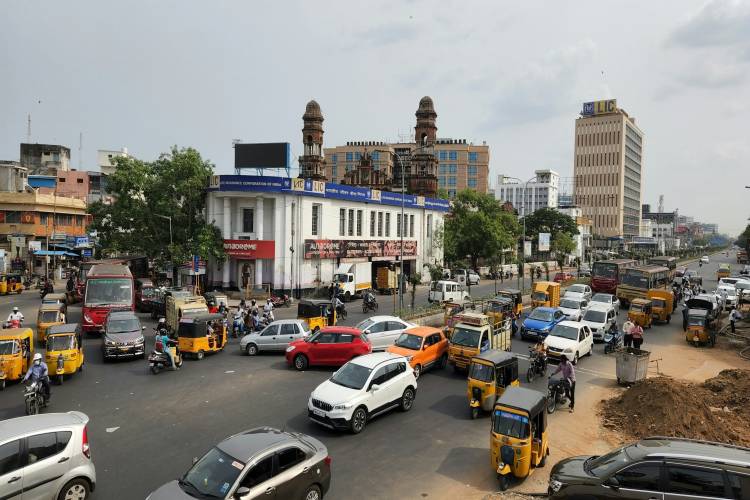
Alternative fuel cars: Passenger vehicle (PV) retail sales crossed four lakh in August, but the more consequential number was in the fuel mix. For the first time, CNG, hybrids and electric vehicles together accounted for 41.95% of passenger vehicle sales, edging past petrol/ethanol at 40.85%, according to the Federation of Automobile Dealers Associations. Petrol remains the largest individual fuel category, with diesel accounting for another 17.21%. The figures point to a fragmentation of India’s car market rather than an electric vehicle takeover. Buyers are moving away from petrol, but they are moving towards several alternatives.
Two years ago, petrol had a 51.04% share of passenger vehicle retail. CNG/LPG accounted for 18.72%, hybrids 9.17% and EVs only 2.12%. By August 2025, petrol had fallen to 46.89%, while the combined share of these alternatives had risen to 34.98%. The trend has continued this year.
READ | Vehicle-to-vehicle communication faces an India road test
CNG driving change among alternative fuel cars
CNG has made the biggest contribution. Its share rose from 18.72% in August 2024 to 25.28% this August. EVs increased their share from 2.12% to 7.63%. Hybrids were almost unchanged at 9.04%, compared with 9.17% two years ago. Petrol has therefore lost ground to more than one competing technology.
This should hardly surprise anyone familiar with the economics of Indian car ownership. A motorist who drives long distances every day and has access to a reliable CNG network may find a CNG car more economical than either petrol or electric. A household with home charging and predictable daily travel faces a different calculation. Buyers concerned about charging or range may prefer a hybrid.
CNG has an immediate advantage for high-mileage users. It generally reduces running costs without requiring much change in driving or refuelling habits. The technology is familiar, and the additional purchase price can be recovered more quickly when a vehicle is used intensively. Where filling stations are readily available, the proposition is easy for a buyer to understand.
The demand numbers also caution against viewing alternative-fuel vehicles mainly as a metropolitan phenomenon. Passenger vehicle retail rose 16.14% year on year in August, while rural sales grew 24.99%, against 10.93% in urban markets. Two-wheeler retail rose 19.69% to 17.15 lakh units, its strongest August on record. Rural two-wheeler growth of 20.25% also marginally exceeded urban growth.
For alternative powertrains to spread beyond early adopters, they must work for middle-income households and customers outside the largest cities. Lower monthly mobility costs will usually be a stronger sales argument than environmental virtue alone.
READ | Southern states drive India’s electric vehicle adoption
EV sales are rising from a smaller base
The electric car market nevertheless deserves attention. Its August share has risen from 2.12% to 7.63% in two years. SIAM reported that registrations of electric passenger vehicles increased by more than 80% in FY2025-26, while the passenger vehicle market as a whole grew 7.9%. EVs are expanding far faster than the broader market.
Their market share also puts that growth in perspective. More than nine out of ten passenger vehicles sold in August still used another powertrain. Purchase price, access to dependable charging and uncertainty about resale values continue to influence buyers. These constraints will ease at different speeds across cities and income groups.
Hybrids present another useful lesson. They are often described as a bridge between petrol cars and fully electric vehicles, yet their share has barely moved in two years. The market does not automatically reward the technological middle ground. The purchase price, tax treatment and range of models available can matter as much as the powertrain itself.
READ | India’s electric vehicles push gains global momentum
E20 has entered car-buying calculation
Petrol now faces another complication. India has completed its transition to E20 petrol, containing 20% ethanol, as part of a programme intended to reduce petroleum dependence and increase domestic ethanol use. Dealers say concerns over the E20 transition are among the factors prompting some customers to consider CNG, hybrids and EVs.
Those concerns need to be treated carefully. The government and automobile industry reject claims that E20 is causing widespread engine damage. The Automotive Research Association of India says vehicles undergo extensive validation for E20 use, while SIAM says fuel-quality testing under the regulatory framework covers more than 150 parameters. The government has acknowledged that some vehicles may experience a modest reduction in fuel economy, depending on their design and calibration.
The distinction is important. FADA’s numbers cannot establish that E20 caused the decline in petrol’s market share. They do show that dealers are encountering hesitation among some petrol buyers. A car is an expensive purchase that will remain with a household for years. Perceptions about mileage, compatibility and future fuel standards can therefore influence purchase decisions even when manufacturers dispute fears of mechanical damage.
Festive sales will provide a better test
August itself requires another qualification. Passenger vehicle retail reached a record 402,398 units, 16.14% higher than a year earlier, but sales were 3.4% below July. FADA has also warned that the year-on-year comparison benefits from an unusually weak August 2025, when some customers postponed purchases while waiting for GST 2.0 rate changes. Independent industry analysis at the time also recorded deferred buying ahead of the tax cuts.
The September-November festive period should provide a cleaner test. If alternative powertrains retain their combined lead after the favourable base effect fades, August will look less like a statistical crossing and more like a durable change in consumer preference.
India’s car buyer is already choosing among several alternatives to petrol. Manufacturers will have to maintain portfolios that reflect those different ownership economics. Policy should also start from the market that exists rather than assume that every buyer will travel along the same technological path.