





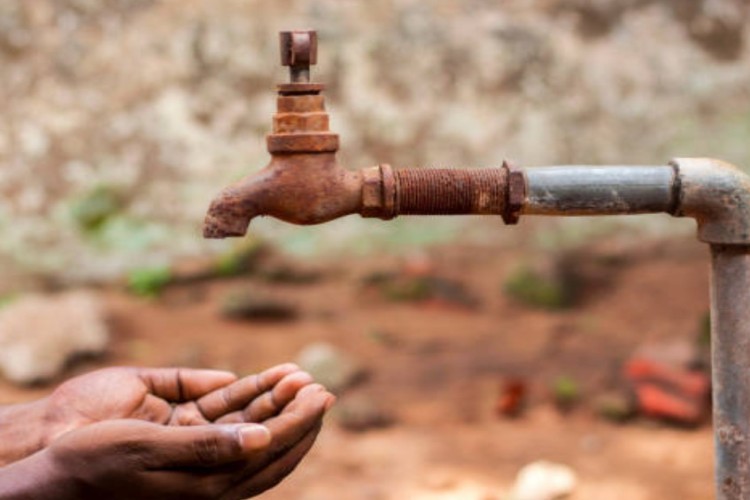
Looming water crisis: The old warning that the next major war may be fought over water once sounded melodramatic. In many parts of India, it now reads like a routine weather report. Groundwater tables are collapsing, rivers are shrinking, and households are spending hours each day chasing a commodity once considered free and inexhaustible.
At the India Water Leadership Conclave 2025, former Central Water Commission chairman Mukesh Kumar Sinha flagged what policymakers have avoided confronting: water security is on track to become the most binding constraint on India’s economic and human development. The warning is hardly isolated. Climate scientists, hydrologists and economists increasingly see water scarcity as India’s most under-appreciated macroeconomic risk.
India receives around 4,000 cubic kilometres of annual precipitation, yet only a fraction becomes usable surface water. Groundwater adds another 435 cubic kilometres. Rapid population growth has pushed per-capita water availability from 5,000 cubic metres in 1951 to 1,486 m³ in 2021, according to the Central Water Commission. NITI Aayog projects a further slide to 1,140 m³ by 2050. The global benchmark for water stress is 1,700 m³; water scarcity begins below 1,000 m³. India is edging towards that line despite several years of above-normal rainfall. This is not a meteorological failure. It is a structural one.
READ | How weak yuan gives China an unfair export edge
Climate change magnifies every weakness in India’s hydrology. The IPCC and World Bank warn that shifts in monsoon patterns, more intense rainfall bursts, and rising temperatures could reduce freshwater availability by up to 30 per cent by mid-century. Floods and droughts now arrive in the same season, draining storage and eroding groundwater recharge. India is not running out of rainfall; it is running out of the ability to store and manage it.

Water crisis: A patchwork of regional distress
India’s water crisis is not uniform. The northeast remains relatively water-rich. But large parts of Punjab, Haryana, Rajasthan and central India face chronic depletion. Patton village in Fatehgarh Sahib saw its aquifers dry up completely last year. In Borichibari, Nashik district, three local wells have collapsed, forcing women to walk 1.5 kilometres for every bucket of water. Lost work hours, poor health and constant anxiety are the hidden economic costs of scarcity.
Urban areas fare little better. Most Indian cities lose 30–50 percent of their treated water through leakages, theft and poor metering, according to the World Bank. This “non-revenue water” exceeds the entire supply of many tier-2 cities.
Agriculture is both victim and driver
Agriculture accounts for 80–90 per cent of water use in several states. The crisis is not just about thirsty crops; it is about distorted incentives. Free or subsidised electricity encourages reckless pumping. Procurement policies push farmers in Punjab and Haryana towards paddy, a water-intensive crop entirely unsuited to semi-arid conditions. Maharashtra’s sugarcane belt faces the same contradiction. Groundwater is vanishing faster than governments can announce new irrigation schemes.
Micro-irrigation, drip and sprinkler systems have expanded but remain far from mainstream. Crop diversification strategies are discussed each year and diluted each year. Without serious reform, rural groundwater will continue to fall, with enormous fiscal and ecological consequences.
Water scarcity is visible, but contamination is quieter and deadlier. Millions rely on groundwater contaminated with arsenic, fluoride, iron and nitrates, as noted by the Ministry of Jal Shakti. Quality receives far less attention than quantity, yet contaminated water imposes heavy health costs and fuels malnutrition. A focus on expanding supply without fixing quality risks solving the wrong problem.
Governance gaps weaken every solution
India’s water governance is scattered across ministries with overlapping mandates. Groundwater regulation remains weak despite successive attempts at a Model Bill. Data systems are antiquated; the Central Ground Water Board still relies on decadal averages for many aquifer estimates. There is little real-time information on extraction or recharge. River-basin management remains fragmented across state boundaries, complicating planning for the Ganga, Cauvery, Krishna and other heavily contested rivers.
Inter-state tensions are rising, and dependence on transboundary flows from China adds another layer of risk. As scarcity deepens, political friction is likely to increase.
Urban and industrial demand is expanding fast
India’s industrial sector uses about 8% of national water, but demand is projected to triple by 2050. Thermal power plants, steel units and textile clusters remain heavy consumers with low recycling rates. Urban India, meanwhile, has invested far too little in sewage treatment and wastewater reuse. Rainwater harvesting bylaws exist in most cities but are poorly enforced.
The government’s flagship Jal Jeevan Mission (JJM) has expanded functional household tap connections to over 75% of rural households. But the programme relies heavily on groundwater, which risks worsening depletion unless accompanied by recharge and conservation initiatives.
Water must be priced rationally
Treating water as a free good guarantees waste. Rational pricing—paired with targeted protection for vulnerable households—can encourage efficiency, accelerate recycling and reduce leakage. Countries that managed scarcity successfully did so through pricing that signalled scarcity and rewarded conservation. India’s reluctance to confront this politically sensitive reform will prove costly.
Every major analysis—from the World Bank to NITI Aayog—concludes that India needs a unified policy architecture. A National Water Framework Law, basin-level coordination, credible data systems, mandatory state reporting on groundwater extraction, and a unified national water database are essential to long-term planning. Water management cannot be left to fragmented institutions, election-cycle politics and ad hoc state responses.
The World Bank estimates that water scarcity could shave 6 per cent off India’s GDP by 2050. That figure alone should push water security to the top of India’s economic agenda. Without decisive action, India’s growth story will face an ecological ceiling long before it reaches its demographic or financial limits. Water scarcity is no longer a rural hardship or a seasonal inconvenience; it is emerging as the single most important constraint on India’s long-term prosperity.