





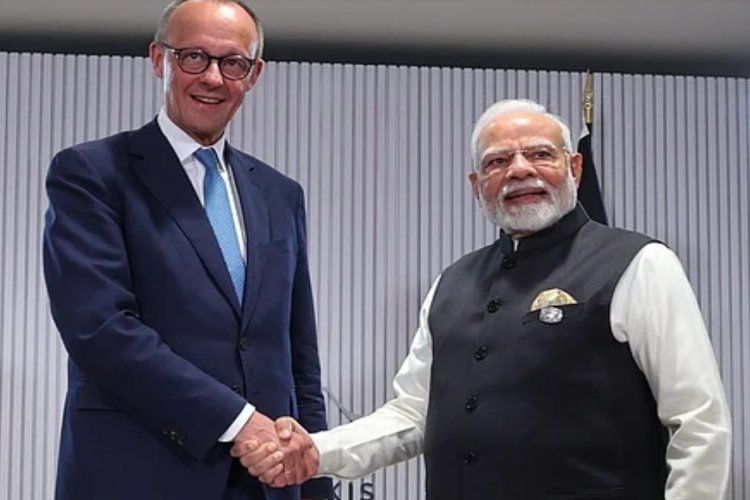
At a time when global supply chains are fragmenting, energy systems are being rewritten, and trade is increasingly shaped by geopolitics, India’s external economic strategy must prioritise reliability over novelty. Few bilateral relationships meet this test as well as Indo-German partnership. Built steadily over 7 decades, the Indo-German partnership combines industrial depth, technological credibility, and institutional trust, qualities that are scarce in today’s volatile global economy. As India seeks to transition into a developed economy and Germany restructures its energy and industrial base, the scope for co-creating long-term growth is unusually strong.
Germany has been a consistent participant in India’s industrialisation since the early post-Independence years. Indo-German partnership helped shape India’s capabilities in heavy engineering, chemicals, machine tools, automobiles, and vocational training. Unlike many contemporary partnerships driven by short-term trade incentives, Indo-German economic ties have been marked by continuity and a shared commitment to manufacturing-led development. That historical ballast matters today, when policy uncertainty has become the norm rather than the exception.
READ I With Friedrich Merz visit, Indian diplomacy to find its rhythm
Manufacturing: From assembly to integration
The automobile sector captures both the strength of existing ties and the opportunity ahead. German automotive firms have played a formative role in India’s auto ecosystem, embedding global standards in quality control, supplier discipline, and engineering design. As the global industry shifts toward electric mobility, software-defined vehicles, and tighter emission norms, India’s challenge is to move beyond assembly and incremental localisation.
Integrating Indian Tier-2 and Tier-3 suppliers into German original equipment manufacturer (OEM) value chains through certification alignment, testing infrastructure, and supplier development programmes would deepen domestic capabilities while anchoring India more firmly in global production networks. This is not merely about exports; it is about absorbing design, systems integration, and process know-how that determine long-term competitiveness.
READ I How India-Germany MSME ties could reshape European sourcing
Capital goods and precision engineering
India’s manufacturing ambitions depend critically on access to advanced machine tools and precision engineering. Here, Germany’s leadership in capital goods complements India’s scale and cost advantages. Germany dominates global exports of CNC machines, industrial robotics, and precision components—inputs that shape productivity across sectors.
Joint manufacturing and localisation of machine tools, robotics, industrial sensors, and automation equipment in India can reduce import dependence while upgrading factory productivity. For India, this would strengthen domestic manufacturing depth; for Germany, it offers scale and diversification in an increasingly concentrated global supply chain.
READ I European powerhouse struggles to regain competitive edge
MSMEs and Mittelstand: An underused bridge
A striking but underdeveloped dimension of the Indo-German partnership lies in small and medium enterprises. India’s MSMEs and Germany’s Mittelstand share common characteristics: family ownership, export orientation, and deep specialisation. Yet linkages between the two remain thin.
Cluster-level cooperation covering supplier development, quality certification, and Industry 4.0 adoption can unlock productivity gains for Indian MSMEs while expanding markets for German industrial technologies. This is also where technology transfer is most durable, because it is embedded in firms rather than mediated solely through governments.
Indo-German partnership in climate action
Sustainability cooperation will succeed only if it is framed as an industrial transition strategy, not a compliance exercise. Germany’s expertise in decarbonisation technologies, climate finance, and regulatory design aligns well with India’s industrial scale and cost efficiencies. This creates room for pragmatic collaboration in hard-to-abate sectors such as steel, cement, chemicals, and refining.
Joint pilot projects in green steel, energy efficiency, waste-heat recovery, and process electrification can help Indian firms prepare for emerging global standards, including the European Union’s Carbon Border Adjustment Mechanism, without eroding competitiveness. Early adaptation matters, because carbon standards are rapidly becoming trade barriers by another name.
Green hydrogen and the next energy economy
Green hydrogen is a flagship area where the partnership can shape new global value chains. The Indo-German Green Hydrogen Partnership, launched in 2022 and operationalised through a roadmap in 2024, positions India as a potential low-cost producer of green hydrogen and ammonia, anchored in its renewable energy expansion.
Joint development of electrolyser technologies, safety standards, certification systems, and export infrastructure would allow India to move beyond raw energy exports toward higher-value participation in the clean energy economy. For Germany, such collaboration supports energy security while accelerating its own decarbonisation targets.
Skills, labour mobility, and institutional depth
Skills and labour mobility are often treated as peripheral issues. They should be seen instead as economic infrastructure. Germany’s ageing workforce and India’s demographic scale create a natural complementarity. Adapting elements of Germany’s dual vocational training system to Indian conditions can strengthen workforce quality at home while supporting ethical and structured mobility abroad.
Delivering on these ambitions will require stronger institutional coordination. India’s experience with bilateral partnerships shows that potential often dissipates due to fragmented execution. A dedicated Indo-German Economic Strategy Council which brings together government departments, industry, MSMEs, research institutions, and skills bodies can provide continuity, monitor outcomes, and align incentives over the long term.
In a turbulent global economy, countries need partners they can trust to co-develop technology, shape standards, and build resilient value chains. India and Germany are well placed to meet that test. By building on historical ties and anchoring cooperation in manufacturing depth, climate pragmatism, and institutional coordination, the Indo-German partnership can deliver not just higher trade numbers, but durable economic resilience for both sides.
READ I Europe’s Greenland dilemma as Trump threatens force

Dr Charan Sigh is a Delhi-based economist. He is the chief executive of EGROW Foundation, a Noida-based think tank, and former Non Executive Chairman of Punjab & Sind Bank. He has served as RBI Chair professor at the Indian Institute of Management, Bangalore.