





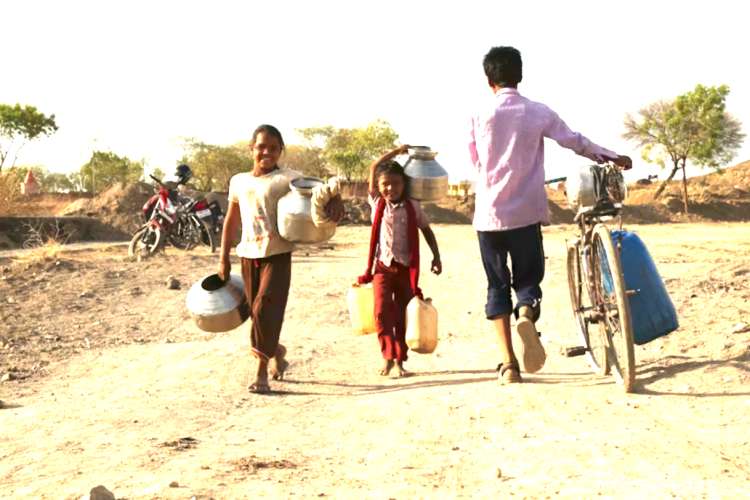
India water crisis: Moody’s has given India the highest score on its water-management risk scale. The number is narrow, but the signal is not. An old failure in water governance has entered the language of sovereign credit. Rating agencies usually begin with debt, growth, fiscal capacity and external vulnerability. Moody’s has now put water reliability in the same conversation.
The agency assigned India a water-management score of 5 on its five-point environmental risk scale, citing excessive groundwater depletion, ageing infrastructure and fragmented governance. It also noted that India has about 18% of the world’s population and only 4% of global freshwater resources. That mismatch has long been known. What has changed is that investors are being asked to see it as a possible source of weaker growth, higher public spending and credit strain.
READ | Delhi water crisis is a governance failure
Water management and sovereign credit
Water becomes a macroeconomic variable when shortages hit farms, factories, power plants, and cities at the same time. Agriculture loses output. Thermal plants need water for cooling. Textiles, steel, chemicals and food processing need assured supply. Cities spend more on tankers, pumping, repairs and emergency works. These costs do not remain local for long. They show up in state budgets, utility balance sheets, industrial downtime and household distress.
Moody’s has also linked India’s water risk to subsidised pricing, slow reallocation across sectors and rising demand from agriculture, industry and AI data centres. The last category is still small compared with farming, but it matters because data centres compete for reliable urban water and power at the same time. India’s digital ambitions will have to be built on pipes, reservoirs and reuse systems, not only on fibre and chips.
Groundwater depletion drives India’s water crisis
The immediate pressure point is groundwater. India is the world’s largest user of groundwater, extracting more than the United States and China combined, according to the World Bank. It also notes that 63% of Indian districts are threatened by falling groundwater levels.
READ | Jal Jeevan Mission needs a shift from taps to tested water
This is not a seasonal failure. It is the result of decades of private extraction supported by public subsidies. Tube wells turned groundwater into a farm input. Free or cheap electricity removed the price signal. Procurement policies kept rice and sugarcane attractive in regions where they made poor water sense. Once millions of farmers invested in pumps, the politics of correction became harder.
Agriculture still uses about 80% of India’s available water, according to the President’s address at India Water Week in 2024. Moody’s placed the figure at about 80% of freshwater consumption. The crop pattern is therefore not a side issue. It is the centre of the problem. Water pricing without crop diversification will fail. Crop diversification without procurement reform will remain a slogan.
Urban water stress is already fiscal stress
Indian cities show the same failure in another form. Bengaluru, Chennai and Delhi have faced severe shortages despite large public spending on water supply. The problem is not only scarcity. It is leakage, old networks, poor metering, contamination and weak utility finances.
Urban utilities lose large volumes before water reaches consumers. ORF estimates average non-revenue water in Indian urban utilities at 38%. It puts Delhi’s figure at around 58%, Mumbai’s at 30%, and Chennai’s at up to 30%. A city that loses a third of treated water cannot solve scarcity only by building another dam or drawing from a more distant river. It has to repair the network, meter supply and price water in a way that protects the poor without bankrupting the utility.
Climate risk worsens the arithmetic. A delayed monsoon strains reservoirs and aquifers. Heavy rain floods streets without restoring usable supply when storage, drainage and recharge systems are weak. Floods and droughts are treated as opposite events in public debate, but both expose the same failure: India stores too little, reuses too little and governs water through too many disconnected agencies.
Water governance remains split across states
Water is largely a state subject, while rivers and aquifers ignore state boundaries. The Cauvery, Krishna and Ravi-Beas disputes show how quickly allocation becomes a political contest. Each state has incentives to protect its farmers, cities and industries. River-basin management remains weak because no state wants to surrender control before others do.
The Union government can fund schemes and set broad priorities. The Jal Shakti Ministry can push missions. The Finance Ministry can attach conditions to capital flows. But pricing, irrigation choices, groundwater enforcement and urban utility reform sit mainly with states and local bodies. That is where India’s water crisis becomes difficult. The institutional map does not match the hydrological map.
Jal Jeevan Mission expanded access, not water security
The Jal Jeevan Mission has delivered measurable gains. At launch in 2019, 3.23 crore rural households had tap connections. By March 3, 2026, state-reported coverage had risen to about 15.82 crore households, or 81.71% of rural homes. That is a large expansion of access.
READ | India’s data centre ambitions hinge on availability of water, power
Access, however, is not the same as assured supply. A tap is useful only if the source is secure, the network is maintained, the water is tested and the village system has funds to operate. The next phase of rural drinking water policy will be less photogenic than the first. It will involve source sustainability, repair budgets, local metering, grey-water reuse and accountability for service quality.
Water security needs a fiscal lens
Moody’s warning should not be treated as an external rebuke. It is a useful reminder that water stress has moved from the environment pages to sovereign risk assessment. The World Bank warned in 2016 that water scarcity, worsened by climate change, could cost some regions up to 6% of GDP by 2050. India does not need to accept that trajectory. It does need to stop treating water as a free local input.
The policy choices are known. Shift procurement away from water-intensive crops in stressed regions. Regulate groundwater extraction where aquifers are falling. Repair urban distribution networks before funding distant supply projects. Reuse treated wastewater for industry and construction. Build river-basin institutions that have data, money and enforcement powers. Price water better while protecting lifeline consumption.
India’s 2047 ambitions assume abundant water for farms, factories, cities, power plants and digital infrastructure. That assumption is no longer safe. Credit markets have begun to price what Indian politics has avoided.