




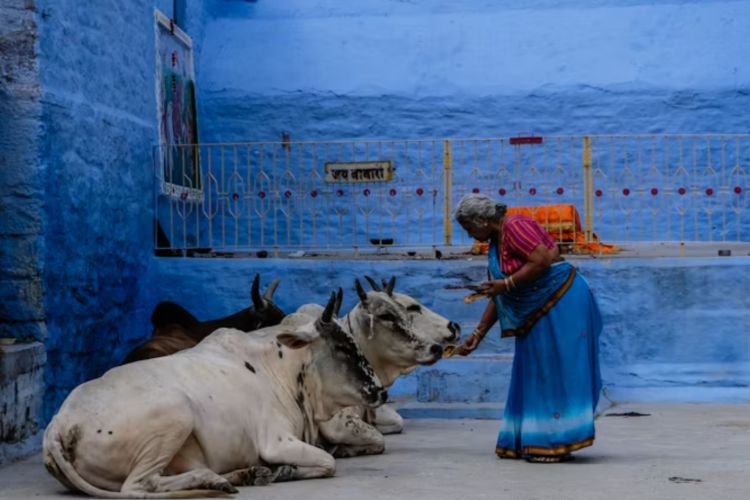
The article Dairy industry exposes India’s cattle protection contradiction raises a valid ethical question. It asks whether a society that invokes cattle protection can ignore the conditions under which milk is produced. That question cannot be dismissed.
But the answer cannot rest only on animal welfare. Livestock in India is not merely an ethical category. It is an economic asset, a nutrition source, a risk hedge, a waste recycler, and a livelihood base. The issue is therefore not a simple contradiction between cattle protection and dairy production. It is a trade-off among competing public objectives.
READ | Dairy industry exposes India’s cattle protection contradiction
Dairy economy and rural livelihoods
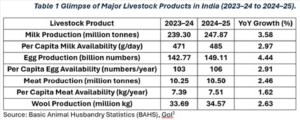
India produced 247.87 million tonnes of milk in 2024–25, against 239.30 million tonnes the previous year. Per capita milk availability rose from 471 grams a day to 485 grams. India remains the world’s largest milk producer.
The livestock sector has also become one of the faster-growing parts of Indian agriculture. The Department of Animal Husbandry and Dairying has estimated its compound annual growth at 12.99% between 2014–15 and 2022–23 at current prices. Its share in agriculture and allied GVA rose from 24.38% to 30.23% over the same period.
These are not ornamental numbers. They mean that nearly a third of the value created in agriculture and allied activities now comes from livestock. For a country where agriculture still absorbs a large share of workers, the sector cannot be treated as a marginal ethical inconvenience.
Any proposal to sharply reduce or abolish dairy production would affect rural employment, milk cooperatives, women’s self-help groups, transport chains, feed suppliers, veterinary services and small processors. Meat and leather, too, sustain employment and exports, even if they sit uneasily with the politics of cattle protection.
There is also an agronomic link. Crop residues feed animals. Animal waste returns nutrients to fields. A sudden retreat from livestock would not automatically produce a cleaner rural economy. It could raise dependence on synthetic fertilisers and disrupt mixed farming systems that have evolved around small holdings.
READ | Dairy industry continues to block India’s trade deals
Livestock production data
The numbers do not settle the ethical question. They do define the scale of the policy problem. A sector of this size cannot be judged only by the treatment of animals, important though that is. It must also be judged by employment, nutrition, ecological cost and transition feasibility.
India’s nutrition deficit makes this trade-off sharper. NFHS-6 data show that 29.3% of children under five are stunted, 31.8% are underweight and 19.3% are wasted. Only 15.3% of children aged 6–23 months receive a minimum adequate diet.
In such conditions, milk and dairy products remain important sources of protein, calcium and micronutrients, especially for low-income households with limited dietary diversity. This does not excuse poor animal welfare. It does mean that a policy response must ask what replaces dairy in diets, at what price, and for whom.
Ethics that ignore affordability risk becoming class-specific. A household with access to diverse foods, fortified products and private health advice can more easily reduce dependence on dairy. A poorer household may not have that option.
Cattle protection and welfare reform
The stronger case is not for defending existing dairy practices without scrutiny. It is for moving from sentiment to regulation.
Better welfare standards, scientific breeding, veterinary care, disease control, shelter management, traceability, and rules against abandonment are more relevant than symbolic protection. India’s cattle politics often protects the idea of the animal more vigorously than the animal itself.
A binary choice between exploitation and abstention narrows the policy space. The practical question is how to reduce avoidable suffering while preserving livelihoods and nutrition. That requires enforceable standards, not moral theatre.
READ | US-India trade deal nears; digital, dairy disputes weigh
Ethical trade-offs in livestock policy
Human use of nature is never cost-free. Farming involves intervention in plant life and soil systems. Forestry uses trees for housing, furniture and infrastructure. Domestic animals depend on feed chains. Even modern technologies sold as clean carry ecological costs: electric mobility shifts demand to power generation and minerals; artificial intelligence consumes electricity and water.
This does not make all forms of use morally equal. Nor does it absolve dairy of responsibility. It only means that protection always has a cost somewhere else. Protecting one value can impose a burden on another.
That is the central weakness in treating dairy only as a contradiction. The contradiction is real at the level of rhetoric. It is less useful as a guide to policy. India needs neither denial nor abolitionist simplicity. It needs a livestock policy that is honest about welfare, livelihoods, nutrition and ecological limits.
Cattle protection, if it is to mean anything beyond politics, must begin with the living conditions of animals. Dairy reform is one place to start. But the reform must recognise the rural economy in which those animals are embedded.
Shrabani Mukherjee is Professor, Alliance University.