





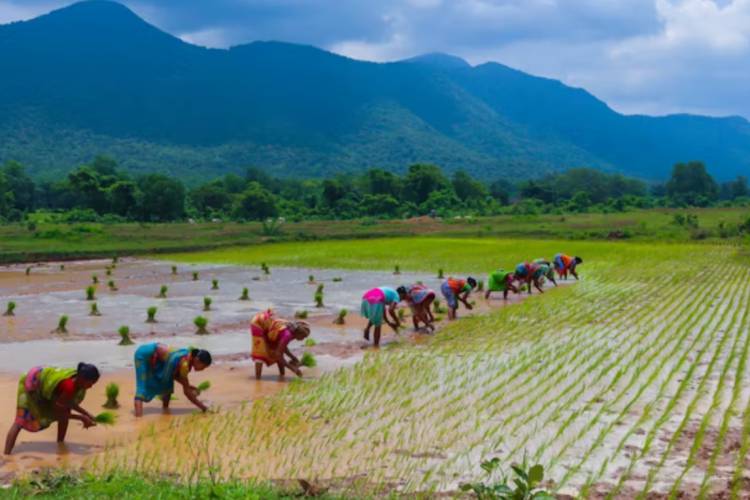
Indian agriculture presents a hard paradox. It employs 44% of the workforce, occupies 60% of the land and uses 83% of freshwater, but contributes about 15% of gross value added. Farm productivity is barely a quarter of that in the rest of the economy. Nearly 44% of cultivated land remains rain-fed. Floods and droughts now strike every second or third year with rising frequency.
Farming is still the only major enterprise conducted under the open sky. Even good planning cannot assure output. Crop insurance should therefore be a powerful shield. In practice, it has often failed that test.
READ | PMFBY: Crop insurance scheme faces coverage crisis
An EGROW Foundation webinar examined why decades of crop insurance schemes have left Indian farmers exposed to nature’s vagaries, and how the system can be repaired.
Crop insurance and farmer trust
The session, chaired by a former chairman of the Commission for Agricultural Costs and Prices, identified four reasons for low insurance penetration: adequacy of cover, credibility of government promises, transparency in claims assessment, and timely payment.
Even a well-designed policy reimburses only part of the farmer’s cost. It does not replace the income he expected to earn. That distinction matters. As agricultural economist Theodore Schultz observed, Indian farmers may be poor, but they are rational. If they hesitate to insure, the product has not yet met their needs.
The lead presentation, based on field research in Punjab’s Malwa cotton belt around Bathinda, placed the issue in sharper relief. Crop insurance is also climate finance. It helps farmers absorb losses from a warming and more unstable climate.
READ | Plantation crops need FPO reform, not just budget support
India has tried crop insurance since the crop insurance bill of 1965, followed by the Comprehensive Crop Insurance Scheme, the National Agricultural Insurance Scheme and the Pradhan Mantri Fasal Bima Yojana, launched in 2016. PMFBY brought useful features: area-based cover, voluntary participation, inclusion of non-loanee farmers, and indemnity based on average productivity over the previous seven years. Recent changes extend protection to leased land, individual losses and post-harvest damage. Claims can be reported within 72 hours through a mobile app.
The record remains mixed. The claim-to-premium ratio slipped from 0.74 in 2016 to 0.66. Coverage has reached only about 41% of farmers. Delayed payments have damaged trust.
Punjab’s crop insurance gap
Punjab has never joined PMFBY. The state’s case is familiar. Assured irrigation makes food crops low-risk. The indemnity benchmark, it argues, should be based on 10 years rather than seven. It is also reluctant to bear its 50% share of the premium.
That position is less persuasive today. Punjab is facing both an agrarian and climatic crisis. Floods have become recurrent. Groundwater in some villages has sunk below 250 feet. The paddy-wheat monoculture is no longer environmentally tenable.
Cotton shows the cost of staying out. The whitefly infestation of 2016 and the pink bollworm attack of 2019-20 devastated growers in Malwa. Farmer suicides followed. For paddy and wheat, PMFBY may offer limited welfare gains. For cotton, which is prone to failure, insurance support arrives where risk is highest.
The field research produced an important finding. When only paid-out costs are counted, returns remain positive even in a bad year. But once land rent paid by tenant farmers is included, the benefit shrinks sharply. The leased-in cultivator, often the most vulnerable, gains the least.
Raising the indemnity level from 90% to 95%, or even 98%, would improve farmer welfare. If Punjab will not join PMFBY, it should launch its own scheme, as Kerala, West Bengal and Bihar have done.
PMFBY and claims delays
The discussant, from the National Insurance Academy, focused on practical frictions. Loanee farmers with a Kisan Credit Card are enrolled automatically unless they opt out. Many do not understand this. Banks sometimes exploit the confusion in either direction.
Awareness varies widely across states. Insurance is a technical product. Farmers often do not know how claims are calculated. The central problem is basis risk, the gap between an individual farmer’s actual loss and the area-averaged compensation he receives.
READ | Parametric insurance: India’s new climate safety net
Delays persist because crop-cutting experiments are still largely manual. Madhya Pradesh shows that this need not be so. Technology adoption has helped the state cut turnaround times sharply. Other states have less excuse for continuing with slow processes.
Two questions framed the debate. First, why do farmers feel short-changed even when claims are paid? Because insurance returns cost, not margin. More than 80% of Indian farmers are small or marginal cultivators. They have no cushion.
Second, if insurers report surpluses, are premiums too high or claims too low? The answer is not simple. Insurers cite administrative loadings, delayed state premium payments, area-correction factors and adverse selection. They also argue that crop insurance profitability must be judged over 30 to 50 years, because one catastrophic season can wipe out accumulated margins.
There is also moral hazard. Inflated or fraudulent claims corrode trust from the other side.
State-specific crop insurance models
International experience offers useful pointers. China uses a bottom-up model involving local government and state support for catastrophic losses. The United States subsidises 70% of premiums. Kenya settles claims within days.
A cooperative or mutual-insurance model, common in Europe, remains largely untested in India. It could help tackle moral hazard and adverse selection, but only if land records are cleaned and digitised. The same plot should not be insured twice.
Crop insurance cannot be separated from groundwater depletion, banned pesticides, tenant farming and cropping choices. India is too large for one model. Products must reflect state-level risk. Some could borrow the loan-to-value logic of banking, protecting both the insurer and the food system.
The test is simple. Crop insurance must protect the farmer, not merely the crop. It must pay on time, recognise tenant costs, reduce basis risk and use technology where manual verification has failed.
Farmers most exposed to nature need more than sympathy. They need an insurance system that is credible, flexible and built around their risks.