





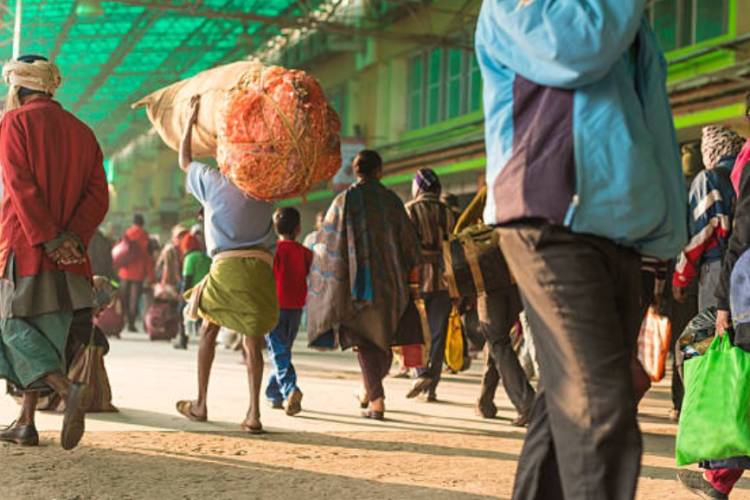
Migrant labour shortage: Elections in West Bengal and Assam, along with the continuing West Asia crisis, have created an unexpected problem for industries in South India. Kerala, Tamil Nadu and Karnataka are facing a shortage of migrant workers who had returned home to vote. Employers are offering free air travel, premium bus tickets and higher wages to bring them back.
The normal flow of workers from eastern and northeastern India has slowed. Many workers have chosen to stay back because of uncertainty over jobs, the spillover effects of the West Asia conflict, cooking gas shortages, and the approaching monsoon in the South. They are employed across manufacturing, construction, hospitality and other services.
READ | Labour codes begin India’s harder reform phase
Migrant labour shortage after elections
The shortage appears acute because West Bengal and Assam reported high voter participation, and election-related mobilisation triggered large-scale reverse migration. Migrant workers remain central to the labour model of several southern industries. Their absence has exposed how dependent these states are on labour drawn from poorer regions.
This does not look like a routine seasonal disruption. Workers are factoring in wages, job security, climate-related disruption and the social cost of migration before deciding whether to return.
Labour migration and regional opportunity
What is unfolding is not only an election-related pause. It also reflects expanding economic opportunity in traditional labour-sending states. Public investment in roads, urban infrastructure and industry has begun to create work closer to home.
For many workers, southern states no longer offer the same premium once the full cost of migration is counted. Long separations from families, high living costs, uncertain contracts and weak social protection reduce the appeal of moving far from home.
READ | Women entrepreneurs grow, but labour gaps persist
South India’s dependence on migrant workers
This is a policy problem for industrialised southern states. Kerala alone is estimated to employ around four million migrant workers, many from West Bengal and Assam. Construction, hospitality and real estate are already facing delays and higher costs.
Labour-intensive manufacturing hubs are also under pressure. Tiruppur, the knitwear centre of Tamil Nadu, has reportedly been operating below full capacity. Labour shortage is one reason. Weak global demand has added to the strain.
Supply disruptions have affected inputs such as tiles for construction and resin for plywood manufacturing. For workers deciding whether to return, these signals matter. Migration decisions are now shaped by domestic distress, global shocks and expectations about wage stability. The migrant worker is more informed and more cautious than before.
The shortage is also a reminder that India has treated labour mobility as automatic while underinvesting in the systems that sustain it. Many workers who want to return are constrained by overcrowded trains and high travel costs. Others are reconsidering migration because housing, contracts, health access and welfare portability remain weak. Higher wages may solve the immediate shortage, but southern states will need a credible migrant-worker welfare architecture if they want a stable labour force.
Wages and migrant bargaining power
Wages have stagnated in many industries even as inflation has eroded purchasing power. Labour scarcity has changed the terms of negotiation. Skilled workers such as welders are now demanding monthly pay in the range of Rs 30,000 to Rs 33,000, against earlier levels of about Rs 20,000.
This marks a shift in bargaining power. For employers, it threatens the low-cost labour model that supported competitiveness in construction, textiles, plywood, hospitality and small manufacturing.
Businesses in North India are also reporting labour shortages. The rise of gig work has changed worker choices. Delivery platforms and app-based services have absorbed part of the labour force that would otherwise have entered factories, workshops and small enterprises.
READ | Flexible staffing model needs stronger labour safeguards
Migrant labour and industrial adjustment
If reduced migration persists, southern industries will have to rethink their labour strategy. They may need more automation, greater reliance on local labour, better dormitories, formal contracts, and higher retention costs.
None of these adjustments will be easy. Automation needs capital. Local labour may not be available at scale. Formal employment raises costs. But the old assumption of a limitless pool of mobile labour is weakening.
For policymakers, the issue is regional balance. More jobs in eastern and northern India are welcome. They can reduce distress migration and spread growth more evenly. But receiving regions have built entire sectors on imported labour. Their adjustment will be costly.
There is also a social dimension. Migration has long transferred income from richer states to poorer households through remittances. A decline in migration may strengthen local economies in sending states. It may also reduce income diversification for families that depended on wages earned in distant labour markets.
For industry, the message is clear. Abundant, easily mobile labour can no longer be taken for granted. For workers, the shift brings both bargaining power and risk. For policymakers, it points to a labour market that is becoming more regional, more selective, and less forgiving of weak employment practices.