





Delimitation plan hits a hurdle: India has operated universal adult franchise since the first general election of 1951-52. Every adult citizen has an equal vote. Yet the weight of that vote is no longer equal across states. A Lok Sabha constituency in a populous northern state can contain far more people than one in a southern state. This is not an accident. It is the result of a constitutional freeze that began in the 1970s and was later extended.
That freeze was adopted for a defensible reason. States that reduced fertility in line with national population policy were not to be punished by losing seats in Parliament. But a temporary protection has become a structural distortion. India now faces a hard choice- restore population-based representation, preserve the political weight of states that succeeded in population control, or design a new formula that balances both concerns.
READ I Lok Sabha expansion: Fixing the representation deficit
Delimitation Commissions in India
The Delimitation Commission is constituted by Parliament to redraw Lok Sabha and assembly constituencies on the basis of census data. Its orders have the force of law and cannot be challenged in court. India has had four such commissions: 1952, 1963, 1973, and 2002.
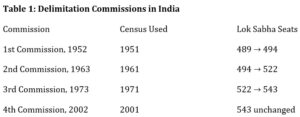
The 1973 commission, based on the 1971 Census, was the last exercise that changed the inter-state distribution of Lok Sabha seats. The 2002 commission redrew constituency boundaries within states, but did not change each state’s seat share. The current constitutional position arose because the 42nd Amendment froze seat reallocation, and the 84th Amendment extended that freeze until the first Census after 2026.
READ I Delimitation math behind Lok Sabha expansion falls short
The North-South divide
The delimitation dispute is not just about numbers. It is about incentives. Southern states such as Tamil Nadu, Kerala, Karnataka, Andhra Pradesh, and Telangana reduced fertility earlier than many northern states. That was a public health achievement and a fiscal achievement. Smaller families improved health outcomes, lowered dependency ratios, and helped state governments invest more in education and services.
The political consequence is perverse. If Lok Sabha seats are redistributed strictly by population, states that followed national population policy could lose relative influence. States with higher population growth would gain. This is the central grievance of the South.
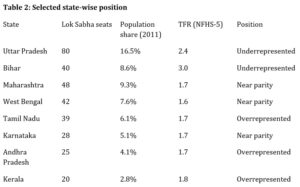
This imbalance has now become an open federal dispute. In 2025, southern leaders argued that population alone cannot decide representation, while the Union government said no southern state would lose seats in absolute terms. That assurance does not settle the issue. Even if no state loses seats, its share of the enlarged Lok Sabha can fall. Reuters reported that the five southern states together account for about 30% of India’s GDP, while leaders from the region fear a reduced voice in Parliament if seats are recast by population.
READ I Climate migration is already reshaping India’s cities
The 2026 Bills change the debate
The latest development makes the issue more urgent. Three Bills were introduced in Lok Sabha on April 16, 2026: the Constitution (131st Amendment) Bill, the Union Territories Laws (Amendment) Bill, and the Delimitation Bill, 2026. These seek to increase the maximum size of the Lok Sabha, enable delimitation on the basis of the 2011 Census, and delink women’s reservation from the Census condition in the 106th Amendment.
PRS says the proposed constitutional amendment would increase the maximum Lok Sabha strength from 550 to 850, with up to 815 members from states and up to 35 from Union territories. It would also return to the principle that each state should have seats in proportion to its population and that constituencies across states should have roughly equal population.
This is not a minor procedural change. If the 2011 Census is used, the relative share of states will change. PRS estimates that, under the current House strength, Tamil Nadu’s seats would fall from 39 to 32 and Kerala’s from 20 to 15, while Uttar Pradesh would rise from 80 to 89 and Bihar from 40 to 46. Even if the total House expands, the relative weight of states would shift.
Constitutional constraint
The debate cannot be framed as a design choice alone. Articles 81 and 82 link Lok Sabha representation to population and delimitation after the Census. Articles 82 and 170 also govern readjustment of parliamentary and assembly constituencies. PRS notes that the 2026 amendment would allow Parliament to decide by law when delimitation is undertaken and which Census is used, instead of following the earlier rule of delimitation after every Census.
This matters for both models discussed below. Equal seats for every state would require a constitutional amendment because it departs from the population principle. A composite index would also need constitutional backing because it gives population only partial weight. A Delimitation Commission cannot create such a formula on its own.
Model 1: Equal Representation Framework
The first model treats each state as an equal federal unit. Every state would receive a fixed number of seats, irrespective of population, tax contribution, or geographical size. For example, each state could receive 20 Lok Sabha seats, while Union territories could receive a smaller fixed allocation. Half the seats could be reserved for women.
The attraction is obvious. No state is punished for population control. No state gains disproportionate power because it had higher fertility. Periodic disputes over delimitation would reduce. The model also fits the federal argument that India is a Union of states, not a unitary electorate.
But the weakness is equally clear. This model makes the Lok Sabha resemble a federal chamber, a function already performed by the Rajya Sabha. It also dilutes the democratic principle of equal population weight. Uttar Pradesh and Sikkim cannot be treated alike in a House meant to represent citizens directly. Equal state representation may protect federal trust, but it weakens the “one person, one vote, one value” principle.
Model 2: Composite Index Framework
The second model is less radical. It keeps population in the formula but reduces its dominance. Representation could be based on a composite index with five equally weighted parameters: population, state GDP, tax contribution, geographical area, and female labour force participation.
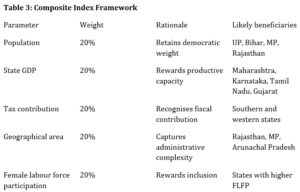
This approach has merit. It accepts population as important, but not sufficient. It recognises that Parliament governs a fiscal union, an economic union, and an administrative union. A state’s claim to representation does not arise from population alone.
The difficulty lies in implementation. GDP data can be volatile. Tax contribution is complicated because corporate taxes are often booked in headquarters states. Female labour force participation varies by measurement method. Weighting each parameter equally may be politically convenient but not necessarily analytically sound. Still, the model has one advantage over pure population: it makes the trade-off explicit.
The women’s reservation link
The delimitation debate is now tied to women’s reservation. The 106th Constitutional Amendment provided one-third reservation for women in Lok Sabha and state assemblies, but linked implementation to delimitation after the first Census following the amendment. PRS notes that the 2026 Bills seek to remove that requirement and enable women’s reservation on the basis of the proposed delimitation.
This link changes the politics. Delaying delimitation may delay women’s reservation. Accelerating delimitation may intensify the North-South dispute. The government’s challenge is to implement women’s reservation without creating a federal backlash.
Structural reform
The next step should not be a rushed arithmetic exercise. A parliamentary committee should examine three options: population-based expansion, equal-state allocation, and a composite formula. It should publish state-wise projections under each model. It should also examine the effect on the Rajya Sabha’s relative weight, presidential elections, joint sittings, and fiscal federalism.
PRS has flagged that increasing Lok Sabha strength without changing the Rajya Sabha cap would alter the balance between the two Houses. If Lok Sabha rises sharply while Rajya Sabha remains capped at 250, the lower House gains greater weight in joint sittings and in the wider constitutional design.
India froze delimitation to protect states that followed national population policy. That protection is now a distortion. Large northern states have a legitimate grievance over under-representation. Southern states have an equally legitimate grievance that they should not be punished for better demographic performance.
The answer cannot be a mechanical return to population alone. Nor can India permanently freeze representation at 1971 levels. The country needs a negotiated federal settlement.
Model 1 offers simplicity but strains democratic equality. Model 2 offers balance but requires careful design. Both require constitutional clarity. The 2026 Bills show that the issue is no longer theoretical. Delimitation is now a live test of India’s federal compact. The question is not how many seats Parliament should have. It is how India will preserve political fairness in a demographically unequal Union.
Dr Priya Gupta is Associate Professor in Jawaharlal Nehru University, New Delhi. Dr Charan Singh is CEO and Founding Director, EGROW Foundation, a Noida-based think tank.
READ I IT hiring slowdown signals structural reset

Dr Priya Gupta is Associate Professor in Jawaharlal Nehru University, New Delhi.

Dr Charan Sigh is a Delhi-based economist. He is the chief executive of EGROW Foundation, a Noida-based think tank, and former Non Executive Chairman of Punjab & Sind Bank. He has served as RBI Chair professor at the Indian Institute of Management, Bangalore.