





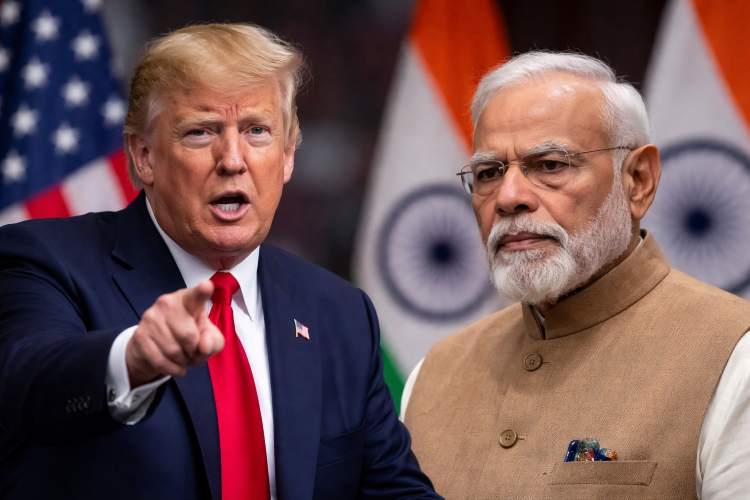
Trump’s foreign policy doctrine and India: Donald Trump’s treatment of US allies is not diplomatic indiscipline. It is a method. He flatters strength, bargains with hard power, and humiliates dependence. Those he considers consequential are dealt with as principals. Those he considers dependent are pressed to yield, pay more, comply faster, and show gratitude while doing so. The recent record with NATO, Ukraine, Canada, Spain and India suggests that New Delhi should draw one clear lesson: sentiment, spectacle and personal chemistry are a poor basis for managing the United States under Trump.
That is the first correction India needs to make. For too long, sections of Indian commentary have mistaken performative warmth toward Narendra Modi for durable strategic regard. Trump’s actual conduct points elsewhere. In 2025, he raised tariffs on Indian goods, including a separate penalty linked to India’s purchase of Russian oil. In February 2026, those duties were cut only after India agreed to halt Russian oil purchases and lower trade barriers. This was not the behaviour of a partner treating India as indispensable. It was the behaviour of a president using market access and sanctions risk as instruments of coercion.
READ I India’s IT industry must outgrow outsourcing
Respect for power, contempt for dependence
The pattern is visible across theatres. At the NATO summit, leaders bent over backwards to accommodate Trump’s demand for far higher defence spending, and Mark Rutte defended his own deferential language on the ground that Trump had forced the alliance to move. When Spain resisted the 5% target, Trump threatened economic consequences. In Ukraine’s case, the White House meeting with Volodymyr Zelenskiy became a public display of coercion. In Canada’s case, even a political advertisement in Ontario triggered tariff retaliation. These are not isolated outbursts. They are examples of a hierarchy Trump wishes to impose on allies.
The contrast is also instructive. Trump speaks of Benjamin Netanyahu as a co-decider in war termination and has publicly intervened in Israeli domestic legal matters on Netanyahu’s behalf. He has long treated Vladimir Putin and Xi Jinping as leaders to be engaged from a position of mutual recognition, whether in rivalry, accommodation or admiration. The point is not that Trump “likes” them in any simple sense. It is that he accords status to leaders who command hard power, control strategic theatres, or can impose costs on the United States.
There is a harsh logic here. Trump does not especially respect alliance loyalty. He respects leverage. He does not reward ideological affinity. He rewards utility, fear, or the ability to disrupt his objectives. That is why flattery can sometimes buy access, but rarely predictability. Even leaders who flatter him are never secure. Reuters’ reporting on Brazil, Canada and Spain, and wider European commentary on Trump’s treatment of allies, all point in the same direction: submission may avoid one immediate blow, but it does not produce stable terms.
READ I Trump tariffs and the new grammar of global trade
India-US ties: Personal rapport no strategic insurance
India should therefore stop reading the bilateral relationship through optics. Trump may speak warmly of Modi at one moment and still impose tariffs the next. The United States may describe India as central to the Indo-Pacific and still compel changes in India’s oil sourcing when it suits American interests. The temporary waiver granted this month for some Indian purchases of Russian oil, amid fears of energy disruption from the Iran conflict, makes the point even more sharply. Washington relaxed pressure not out of deference to India, but because global supply conditions and US domestic fuel politics required it.
That is how a serious state behaves. It adjusts when its interests change. India should do the same.

New Delhi need not take offence at this. It should take instruction from it. Trump’s America is not looking for civilisational partners or democratic sentiment. It is looking for asymmetric bargains. The relevant question for India is not whether Trump values Modi personally. It is whether India can create enough economic, strategic and geopolitical weight to make coercion costly and cooperation worthwhile.
READ I India-US trade framework must be renegotiated after Supreme Court ruling
Foreign policy and strategic autonomy
The first lesson is that strategic autonomy cannot remain a slogan attached to old habits. It must be translated into bargaining capacity. India’s vulnerability is not only military; it lies in trade concentration, technology dependence, payment systems exposure, energy imports, and the periodic tendency to personalise diplomacy at the expense of institutional depth.
The trade piece is obvious. If access to the US market can be weaponised at short notice, India must widen its export options faster than it has done so far. That means treating the India-EU trade negotiations, the UK agreement, and deeper commercial engagement with the Gulf, ASEAN and Africa not as supplementary tracks but as strategic insurance. Diversification is not an abstract virtue in a Trump world. It is a hedge against presidential whim. Reuters’ account of how India ended up settling for the “least bad option” in its recent trade arrangement with Washington should end any complacency on this point.
The energy lesson is equally sharp. India became exposed because Russian barrels had become part of its price-management strategy, while West Asian flows remain systemically important. The Iran crisis, the Strait of Hormuz risk, and the need for a US waiver have underlined how external shocks can narrow sovereign choice. India needs more than a diplomatic balancing act. It needs larger strategic reserves, faster diversification of crude sources, greater gas flexibility, and much quicker progress in reducing oil intensity. Strategic autonomy without energy resilience is rhetoric.
The right response is firmness, not theatrical defiance
There is another lesson from the behaviour of other countries. Those who combine restraint with resolve seem to fare better than those who oscillate between outrage and supplication. Comfort Ero of the International Crisis Group has argued that leaders such as Mexico’s Claudia Sheinbaum and Canada’s Mark Carney have shown that it is possible to stand firm without turning every disagreement into a public spectacle. European analysts have also concluded that Trump respects strength more than pleading.
India should understand this well. Public grandstanding for domestic audiences may satisfy television studios, but it is rarely sound statecraft when dealing with Washington. Nor is ritual deference. The task is narrower and harder: define non-negotiables, identify trade-offs that are acceptable, retaliate where necessary, and keep channels open without advertising anxiety. The choice is not between surrender and melodrama.
That requires institutionalisation. India has often preferred summit diplomacy and leader-level symbolism. Trump’s method exposes the limits of that approach. The ballast in a difficult relationship must come from trade negotiators, defence planners, energy officials, central bankers, technology regulators and private firms whose links survive political mood swings. A relationship dependent on leader chemistry is a vulnerable relationship.
India must raise its own relevance
The most important foreign policy lesson is the least comfortable one. Countries are not treated as equals because they desire respect. They are treated as equals when they can affect outcomes.
China can retaliate at scale. Russia can disrupt entire theatres of war and energy flows. Israel can shape American domestic politics and regional strategy. Europe, for all its weakness, still commands capital, technology and a large market. India matters, but not yet enough in the domains Trump values most immediately. It is a large economy, a major market and a strategic location. But size alone does not guarantee weight in a crisis. Relevance has to be made concrete: manufacturing depth, technology capability, financial resilience, credible military power, and the capacity to alter the calculations of others.
That is why India should resist the temptation to moralise about Trump while continuing business as usual. The proper response is harder. Build capabilities. Diversify dependencies. Negotiate without illusion. Keep the US relationship important, but stop treating it as the organising principle of external policy.
Trump has revealed something that many allies preferred not to see. In Washington, under stress, partnership is often tested not by shared values but by relative power. India should absorb that lesson now, while it still has room to act.