





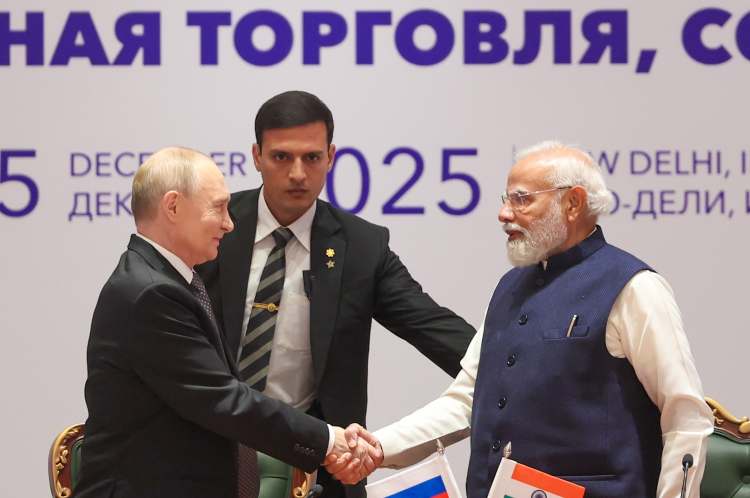
Putin’s New Delhi visit and India-Russia relations: Vladimir Putin’s arrival in New Delhi last week, marked by an unusual tarmac greeting from Prime Minister Narendra Modi, revealed a simple reality: Russia remains central to India’s foreign policy calculus despite intense pressure from the United States. The summit, held amid renewed US sanctions on Russian energy majors and a sharp downturn in Delhi–Washington ties, showed that India sees no strategic or economic case for loosening its Moscow partnership. Russian oil once accounted for 0.2% of India’s crude purchases; it climbed to more than 40% at the peak of the sanctions era. That dependence is only one part of a broader architecture built over decades.
The evidence from trade, defence, and regional security shows that attempts by Western capitals to coerce India away from Russia will not work. India’s approach is shaped by institutional memory, structural geography, and a clear reading of national interest.
READ I India-Russia trade ambitions face geopolitics and hard economics
India-Russia relations are structural in nature
India’s defence ecosystem continues to rely on Russian platforms, even after a decade of diversification. Russia still accounts for the largest share of India’s arms imports, though the proportion has declined from nearly 70% a decade ago to below 40% today, according to the Stockholm International Peace Research Institute (SIPRI). The decline has not diminished Russia’s role as the supplier of legacy systems that make up the backbone of India’s land and air capabilities. Spare parts, maintenance, and upgrades remain critical.
During the summit, New Delhi pressed Moscow to expedite delayed deliveries of the S-400 air-defence units purchased in 2018. These systems played an important role in India’s recent border deployments and the four-day conflict with Pakistan, reinforcing their operational value. The absence of any large new defence deals signals two realities: India wants to reduce dependence, and Russia is constrained by the war in Ukraine. Yet both sides understand that India’s inventory requires long-term Russian support.
Western policymakers underestimate this structural factor. No alternative supplier—whether the United States, France, or Israel—can rapidly replace Russia in legacy support, lifecycle maintenance, or joint production frameworks such as BrahMos. India’s defence cooperation with Russia is therefore not sentimental; it is institutional and embedded in capability planning.
China factor in India-Russia relations
Western pressure also misreads India’s strategic geography. India faces its most volatile security environment in decades. China remains the central strategic threat, with unresolved border tensions and an expanding presence across the Indian Ocean. This reality shapes Delhi’s view of Russia.
Since the Cold War, India has relied on Moscow as a continental balancer—an actor capable of moderating China’s behaviour in moments of crisis. Even though Russia and China today maintain a “no-limits partnership”, India does not see Moscow as fully aligned with Beijing’s interests. India’s goal is to prevent Russia from drifting permanently into China’s orbit and to preserve limited leverage in an otherwise asymmetric regional environment.
This is consistent with India’s tradition of multi-alignment, articulated across successive governments. The doctrine avoids exclusive alliances and maximises manoeuvrability. Western attempts to push India into a binary— “with us or against us”—are incompatible with this framework.
Recent US policies have further eroded trust. Heavy punitive tariffs (an extra 25% on top of existing levies) and public accusations that India is “funding Russia’s war” have been viewed in Delhi as coercive and politically intrusive. The ministry of external affairs publicly rebuked a joint op-ed by the envoys of France, Germany, and the UK for lecturing India on its Russia policy. Such episodes reinforce India’s instinct to hedge, not align.
Energy security and economic realities
India’s energy strategy is driven by affordability and supply security, not ideology. Russian crude offered a rare combination of discounted prices and reliable volumes at a moment of extreme global volatility. The US and EU sanctions regime forced Russia to redirect trade, but India viewed discounted supplies as a macroeconomic stabiliser.
In 2023–24, Russian oil at times covered more than a third of India’s imports. These inflows helped lower India’s import bill and contained inflation—critical for an economy where fuel prices affect transport, food costs, and household budgets. Recent US sanctions on Rosneft and Lukoil have slowed purchases, especially by private refiners who face higher exposure to global finance. But Moscow has signalled that alternative payment routes and shipping arrangements will restore volumes.
India has diversified since the sanctions wave, increasing imports from the US and the Middle East. Yet the structural logic remains: energy security requires multiple suppliers, not a political veto imposed from abroad. Trade is also broader than oil. India is seeking market access in pharmaceuticals, machinery, food products, and civil aviation, aiming to correct a highly skewed balance. Russia, meanwhile, seeks Indian labour to meet shortages intensified by the Ukraine war.
These complementarities are durable. They are not easily undone by Western pressure.
Limits of US leverage in India-Russia relations
The United States remains India’s most important economic partner, a key technology collaborator, and a crucial Indo-Pacific actor. Yet Washington’s leverage over India-Russia relations is limited.
The Trump administration’s tariff escalations and public criticisms have created fractures in the relationship. The push for a G-2 framework with China, the tightening of H-1B visa rules, and the framing of oil trade as a geopolitical betrayal have reduced political goodwill in Delhi. India sees the attempt to dictate its Russia policy as part of a wider pattern of volatility in US behaviour.
Western efforts also underestimate India’s domestic political scenario. Any perception of yielding to US pressure risks a nationalist backlash. Strategic autonomy is not only a foreign-policy doctrine; it is now part of India’s political identity.
Finally, Western capitals misjudge the symbolic element of high-level engagements. Putin’s visits—even when short or light on deliverables—signal India’s refusal to be boxed in. They also reaffirm to domestic audiences that India will retain independent decision-making, regardless of Western preferences.
The evidence shows why Western attempts to isolate Russia by influencing India will fail. India’s defence ecosystem is too intertwined with Russian systems to be replaced quickly. Its energy security benefits from Russian supplies, even if the trade fluctuates under sanctions pressure. Its strategic geography requires maintaining a working relationship with Moscow, partly to balance China and partly to preserve room for manoeuvre in a fractured global order.
The policy implication is clear: Western powers should engage India as a partner with independent agency, not as a proxy battleground for their Russia strategy. A more stable trilateral equilibrium—India–US, India–Russia, and India–Europe—requires recognising India’s structural incentives rather than challenging them. Coercion will not shift India’s Russia calculus. Constructive engagement might.