





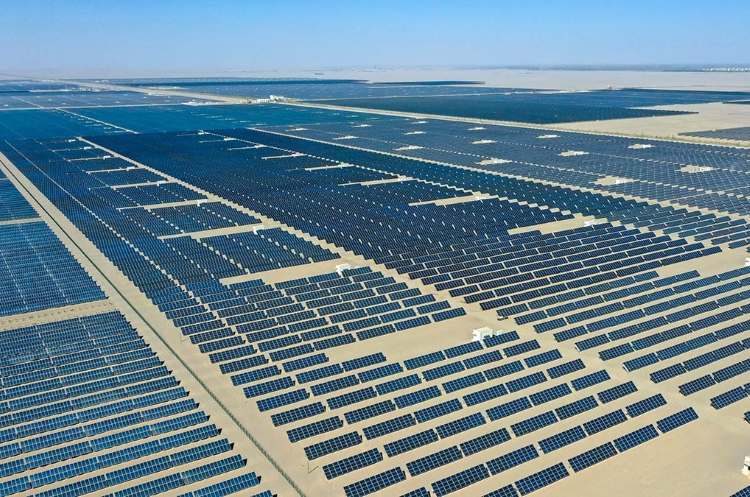
China’s green energy strategy: China’s lead over the US in clean energy is no longer a narrow story about solar panels or electric vehicles. It is becoming a larger story about industrial power. Beijing has treated green energy as a production strategy, a trade strategy and an economic-security strategy at the same time. Washington, by contrast, is still too often treating it as a tariff problem. That difference now matters more than the climate rhetoric that surrounds it. The broad contours of this argument are also reflected in the background material provided for this article.
The scale of China’s position is difficult to overstate. The International Energy Agency says China invested more than $625 billion in clean energy in 2024 and now accounts for almost one-third of global clean-energy investment. The same agency says China hit its 2030 wind and solar target in 2024, six years ahead of schedule. The World Economic Forum has described the global energy transition as a race to build factories, and noted that China has so far dominated that race.
READ I China’s 15th Five-Year Plan bets on tech-led global power
Green energy strategy and economic power
The critical point is not simply that China installs a lot of renewable energy. It is that China has built manufacturing depth across the supply chains that will power the next industrial era. The IEA says China’s share in every major stage of solar-panel manufacturing exceeds 80%. It also says China manufactured well over 80% of all batteries in 2025. BloombergNEF found that 76% of global investment in new clean-tech manufacturing plants in 2024 went to mainland China.

That manufacturing depth changes the economics of everything downstream. Cheap solar modules lower power costs. Cheap batteries reduce stora ge costs. Scale in electro-mechanical equipment improves the economics of grids, data centres, transport fleets and industrial electrification. Once that ecosystem is built, it begins to reinforce itself. Domestic demand supports factory utilisation. Factory utilisation lowers unit costs. Lower costs widen export reach. Export success finances the next round of capacity. It is an old industrial logic, but China has applied it to the technologies that will define the next energy system. The user-provided reports make precisely this link between domestic deployment, export scale and pricing power.
This is why the contest with the United States is not best understood as a competition between two climate models. It is a competition between two industrial models. The United States still has enormous strengths in advanced research, deep capital markets, software, semiconductors and frontier innovation. But in clean-energy manufacturing, it is trying to rebuild supply chains that China already commands at scale. The IEA warned in 2025 that policy support in the United States was being scaled back and project prospects were becoming more uncertain. Reuters has since reported that new rules linked to tax credits and restrictions on “foreign entities of concern” are complicating project economics and supply chains.
READ I Record trade surplus masks weakness of China’s economy
Domestic market gives China advantage
China’s domestic market is doing strategic work that no subsidy table can fully capture. Official data show that renewable energy accounted for more than 60% of China’s installed power capacity in 2025. Wind and solar alone reached 1.84 terawatts and surpassed thermal capacity for the first time. China also accounted for almost two-thirds of all renewable capacity added globally in 2024, according to the IEA.
Those numbers matter because they create a home market large enough to absorb oversupply, drive learning curves and support aggressive cost competition abroad. That is why China can keep cutting prices even when margins are thin. It is not merely exporting products. It is exporting deflation in clean-energy hardware, and with it, dependence.
The economic payoff is already visible. Analysis cited by Carbon Brief found that clean-energy sectors contributed 15.4 trillion yuan in 2025, or 11.4% of China’s GDP, and drove more than a third of the country’s economic growth that year. For an economy still struggling with a property slump and weak household demand, clean industry is no longer a side story. It is part of the new growth model.
That is the point Washington has not fully absorbed. Tariffs can slow imports. They cannot replicate ecosystems. Reuters reported this week that Tesla is in talks to buy $2.9 billion of solar manufacturing equipment from Chinese firms for U.S. production because alternatives are limited. That is a revealing detail. Even where American capital is willing to build, it often still has to lean on Chinese equipment, Chinese process know-how or Chinese upstream inputs.
READ I India-China trade: Structural imbalance, not a one-year problem
The coal paradox and green energy strategy
None of this means China has resolved its energy contradictions. It has not. The IEA says China’s coal demand for power is expected to remain near 3 billion tonnes in 2025. CREA and Global Energy Monitor say proposals for new and reactivated coal projects reached a record 161 GW in 2025. Reuters reported in February that China’s coal output is expected to rise again in 2026 to 4.86 billion tonnes.
That contradiction is not incidental. It reflects Beijing’s refusal to choose between energy security and industrial decarbonisation. China is pursuing both, even when the two sit uneasily together. Inner Mongolia’s 2026 plan captures the logic. The region will add coal mines, coal-fired power and oil projects, while also expanding wind, solar, storage, green hydrogen, transmission infrastructure and zero-carbon computing facilities. This is not an elegant transition model. It is a state-capacity model. It prioritises reliability, local growth and industrial supremacy, and it assumes that the carbon problem can be managed later through grid upgrades, storage, flexible dispatch and eventually carbon-management technologies. That dual-track strategy is explicit in the user-provided material.
The coal story therefore needs care. Installed renewable capacity does not mean equivalent renewable generation. Coal plants run more hours and remain central to grid stability. But the trend line has started to shift. Ember reported that solar and wind growth met all new electricity demand in the first three quarters of 2025, while its China review said clean generation growth in the first half of 2025 exceeded demand growth. Carbon Brief reported in January 2026 that coal power generation in China fell 1.6% in 2025, the first annual decline in more than half a century shared with India.
That matters because the relevant question is no longer whether China still burns coal. It plainly does. The more important question is whether renewable growth is beginning to cap coal’s role in the power system while lowering electricity costs for industry. On that measure, the answer is increasingly yes, though not cleanly and not everywhere.
The United States is reacting from behind
The United States is not absent from this race. It remains a major investor in clean energy, and the IEA notes that clean-energy investment there grew rapidly over the previous decade. There are also pockets of industrial response, including new battery deals and domestic storage expansion. But the policy signal has become unstable. Reuters reported that Trump-era measures accelerated the expiry of many clean-energy credits, created compliance complexity and contributed to a sharp drop in project supply. Another Reuters report said U.S. solar installations fell in 2025 after policy shocks jolted the market.
That is a serious handicap in an industry where scale depends on long investment horizons. Factories are not built on sentiment. They are built on policy continuity, skilled labour, grid access, cheap finance and confidence that demand will persist long enough to recover capital. China offers those conditions more consistently than the United States does.
Nor is the American answer yet strategically coherent. One part of Washington wants domestic manufacturing. Another part is raising trade barriers against Asian supply chains before U.S. capacity is ready. A third is tightening tax-credit rules in ways that may deter precisely the investment it claims to support. The result is a defensive industrial policy that risks producing higher costs without sufficient scale. Reuters’ recent reporting on new import duties and entity restrictions underlines that tension.
Economic dominance will rest on electrified industry
The deeper reason China has moved ahead is that future economic dominance will not be determined only by who invents the next technology. It will also be determined by who manufactures, finances, deploys and exports the physical systems of electrification. Those systems include not just solar panels and EVs, but batteries, transformers, grid equipment, electrolysers, industrial heat solutions and the infrastructure needed to run AI-heavy economies. The World Economic Outlook and other IEA assessments now place China at the centre of renewable deployment and manufacturing for the decade ahead.
This has direct geopolitical consequences. Countries trying to decarbonise quickly need affordable hardware. China supplies it. Countries trying to build local clean-tech industries need time and protection. China can undercut them on cost. Countries worried about strategic dependence are now discovering that dependence is not limited to oil and gas. It can emerge just as easily in batteries, grid equipment and solar manufacturing lines.
There is, of course, a risk in overstating China’s inevitability. Overcapacity can destroy profits. Trade retaliation can narrow export markets. Technological shifts can reorder parts of the value chain. And clean-tech dominance will not by itself solve China’s structural economic weaknesses. But these are limits to China’s lead, not evidence that the lead is imaginary.
The central fact remains. China has understood earlier than the West that the green transition is not merely an environmental programme. It is the industrial foundation of the next world economy. By the time the United States fully recognised that, China had already built the factories.