





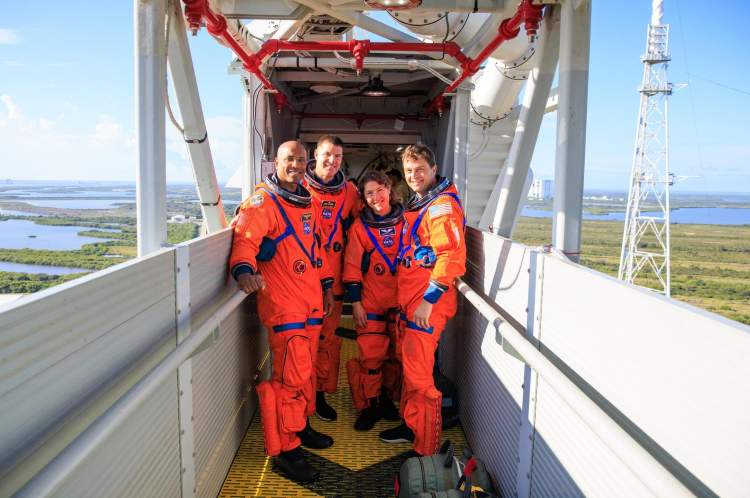
NASA’s Artemis II mission has reopened a frontier that had been closed since Apollo. On April 1, 2026, four astronauts left Earth aboard Orion on the first crewed lunar flyby in more than five decades. The mission is historic for obvious reasons. It takes humans back into deep space. But its significance is not only technological. It also forces a wider public health question: how should health systems think about space when space is becoming both a workplace and a source of health intelligence on Earth?
Artemis II is not a moon-landing mission. It is a test flight of NASA’s Space Launch System, the Orion spacecraft, ground systems, and mission operations with a crew on board. The mission’s purpose is to prove that these systems can safely take humans to lunar distance and back. That makes Artemis II an operational rehearsal for later missions. It also makes it a live exercise in occupational health under extreme conditions.
READ I Healthcare real estate is driving costs, access, priorities
Deep space is a hostile work environment. NASA’s Human Research Program groups the main hazards of human spaceflight into radiation, isolation and confinement, distance from Earth, altered gravity, and closed or hostile environments. Artemis II will not solve those problems. But it will generate evidence on how crews function when they move beyond low Earth orbit and outside the partial protection available on the International Space Station.
That matters because public health is no longer confined to hospitals, cities, and terrestrial environments. In deep space, the basic concerns of public health reappear in a harsher form: life support, air quality, radiation exposure, fatigue, mental resilience, medical monitoring, and delayed clinical response. A mission like Artemis II is therefore not just an engineering milestone. It is also a stress test of future standards for crew safety, telemedicine, and health surveillance in deep space. NASA is already evaluating tools for space-based medical care, including telemedicine systems designed to collect vital data and support diagnosis when crews are far from Earth.
READ I Universal health coverage begins with prevention, not insurance
Space technology and public health
The link between space and health does not begin with astronauts. It already exists on Earth. Satellites and Earth observation systems have become part of the infrastructure of public health. They support air-quality forecasting, climate-informed disease surveillance, emergency response, and environmental monitoring in places where ground-based systems are weak or absent. NASA’s Earth data systems are used for near real-time air-quality tracking, while WHO-backed climate and health programmes use satellite surveillance and early-warning tools to improve preparedness for climate-sensitive risks.

This is where the article’s central insight becomes important. Health is not entirely in our hands. People can reduce exposure to risk, but they do not control orbital infrastructure, satellite coverage, spectrum policy, or the data systems that shape warnings about heat, disease, pollution, floods, or crop failure. When these systems work well, they strengthen resilience. When access is unequal, they deepen existing inequalities. That is why outer space now affects the social determinants of health at a distance.
READ I India’s global health opportunity amid US withdrawal
Data inequality and the health divide
The problem is not only access to technology. It is access to usable knowledge. Earth observation data may be publicly available in principle, but the ability to process, interpret, and apply those data is concentrated in high-capacity states, well-funded research institutions, and large corporations. NASA’s own health and air-quality work notes that satellite data help fill gaps where ground monitoring is inadequate. WHO also uses satellite-derived inputs alongside transport models and ground stations to estimate pollution exposure. The practical result is clear: communities with stronger data systems can identify risk faster and target policy better. Communities without them remain undercounted and therefore underserved.
This creates a new asymmetry in public health. Some places can map urban heat, air pollution, vector habitats, or disaster exposure with precision. Others cannot. That gap affects where clinics are built, how warnings are issued, which populations are prioritised, and whose suffering becomes visible in policy. The old inequality was between those with care and those without it. The new inequality increasingly includes those with data and those without it.
Artemis II, space governance, public health
That is why space governance can no longer be treated as a specialised legal domain with little connection to human welfare. The Outer Space Treaty established outer space as a domain open to exploration and use by all states without discrimination. But the harder question today is not formal access. It is who controls the infrastructure, standards, and commercial gains that flow from space activity.
As commercial spaceflight expands and more states rely on satellite systems for health, communications, and disaster response, public health will have to engage with issues that once seemed remote: data governance, liability, interoperability, privacy, environmental spillovers from launch systems, and the health consequences of militarisation or disruption in orbit. Space is no longer distant from daily life. It is embedded in the systems through which modern societies monitor risk and allocate protection.
Artemis II will be remembered as a space mission. It should also be remembered as a reminder. Public health now extends beyond the Earth’s surface. In one direction, it must protect the men and women who will work in deep space. In the other, it must confront the political economy of satellites, data, and unequal visibility on Earth.
The larger lesson is simple. Outer space is becoming part of the operating system of global public health. The question is whether that system will be governed as a public good or captured by those with the greatest technological and geopolitical power.

Dr Joe Thomas is Global Public Health Chair at Sustainable Policy Solutions Foundation, a policy think tank based in New Delhi. He is also Professor of Public Health at Institute of Health and Management, Victoria, Australia. Opinions expressed in this article are personal.