





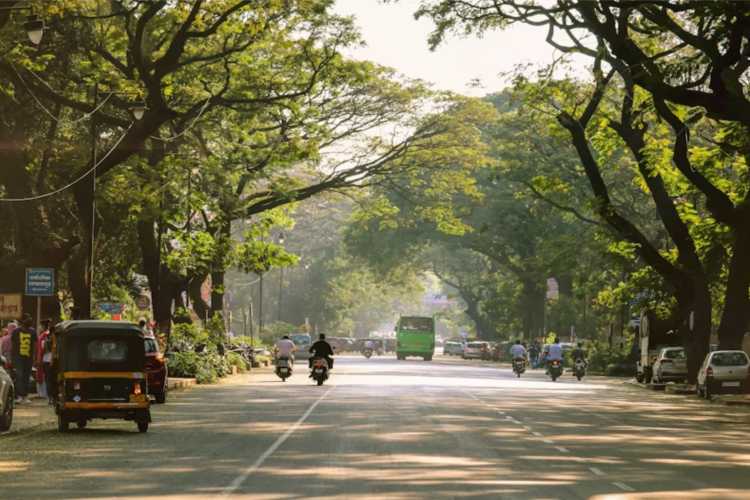
Urban heat in India is increasingly framed as a climate problem. Rising temperatures globally are making summers harsher, heatwaves more frequent and infrastructure more fragile. But climate change alone does not explain what residents experience in many Indian cities.
Much of this heat is structural. Cities now absorb, store, amplify, and redistribute heat through the way they are built and governed.
A city that is 3-4°C hotter because of local urban conditions is not merely experiencing climate change differently. It is producing heat at the urban scale. That difference can decide whether summers remain uncomfortable or become unlivable.
READ | Heatwaves push peak power demand past 270 GW
Urban heat island in Indian cities
Indian cities have not simply expanded. They have been remade. Vegetation has shrunk. Lakes and wetlands have disappeared. Permeable surfaces have given way to concrete, asphalt, glass, and dense built corridors.
Bengaluru is the warning. IISc’s T V Ramachandra has estimated that the city lost 88% of its vegetation cover and 79% of its water bodies over five decades from 1973. Other reports have linked this loss of natural infrastructure to flooding and heat stress.
What replaced these systems does not merely occupy space. It absorbs and radiates heat.
Concrete stores heat during the day and releases it slowly at night. Asphalt traps thermal energy and accelerates runoff. Glass façades reflect and concentrate sunlight. Shrinking water bodies and falling tree cover remove the systems that once moderated temperature naturally.
This is the urban heat island effect. Not as an abstract climatic idea, but as a built reality.
Urban heat, air pollution and flooding
Urban heat does not stop at temperature. Warmer built-up zones can disrupt local airflow, worsen air quality, and intensify short bursts of rainfall. The familiar cycle of pollution, cloudbursts, and flooding is not incidental. It is linked to how cities are shaped.
Delhi shows this interaction clearly. Long stretches of unshaded asphalt, dense built-up corridors, and the loss of permeable surfaces retain heat and reduce airflow. Stagnant heat pockets keep vehicular emissions and pollutants trapped for longer. Ground-level ozone formation rises in summer.
Some of the same urban conditions worsen winter pollution, though through different mechanisms. Thermal inversion keeps cooler air and pollutants close to the ground. Dense construction, weak ventilation corridors, concentrated emissions, and persistent heat retention aggravate the smog episodes that now mark the capital’s winter.

Bengaluru still benefits from elevation and parts of its older green core. But the warning signs are visible. The eastern technology corridor has dense construction, traffic concentration, declining tree cover, and poorer air circulation.
Urban heat is no longer a comfort issue. It affects pollution, drainage, energy systems, infrastructure performance, and public health.
READ | Heatwaves and floods expose India’s urban policy gaps
Air conditioning and waste heat
Urban heat also creates economic and behavioural loops.
As cities expand, demand for housing and commercial space drives more construction. Much of it uses heat-retaining materials and sealed building designs. Rising indoor temperatures then increase dependence on air conditioning.
Cooling systems do not remove heat. They move it.
Heat extracted from indoor spaces is expelled outdoors. This raises ambient temperatures and increases the thermal load on surrounding neighbourhoods. Hotter outdoor environments then create still higher cooling demand.
Modern commercial buildings often optimise for sealed, air-conditioned interiors. Cross-ventilation, shading, setbacks, and thermal responsiveness become secondary. Highly reflective glass façades and specialised glazing may improve indoor performance while worsening reflected radiation, cooling demand, and waste heat from HVAC systems.
The contradiction is plain. Building-level efficiency does not always produce city-level thermal resilience.
The effects extend beyond buildings. Demand rises for delivery services, quick commerce, and air-conditioned mobility. Traffic grows. Heat and emissions rise together. Entire sectors, from HVAC to logistics, expand around these conditions.
Electricity demand also shifts towards late afternoons and evenings, when buildings continue releasing stored heat after solar generation declines. This can push systems towards thermal power generation, often coal-based. The environmental cost of urban heat then travels beyond the city.
Building codes and heat governance
Why do cities continue to produce these outcomes despite growing awareness?
The answer lies in incentives, fragmented governance, and planning systems that have not kept pace with urbanisation.
Master plans are often outdated, weakly enforced, or bypassed through piecemeal approvals and exemptions. Regulations focus on building-level compliance, not neighbourhood or city-scale thermal outcomes.
READ | Extreme heat stress draining India’s gig workforce
The Energy Conservation Building Code 2017 sets minimum energy performance standards for commercial buildings and recognises higher efficiency levels such as ECBC Plus and SuperECBC. It also contains provisions on building envelope performance and window-to-wall ratios. The National Building Code provides wider guidance for building regulation, including ventilation and related building requirements.
These frameworks matter. But they do not, by themselves, solve city-scale heat. A building may comply with parts of the framework and still add to reflected radiation, cooling demand, and waste heat in its neighbourhood.
Governance is equally fragmented. Municipal bodies, development authorities, transport agencies, utilities, environmental regulators, and planning institutions work in silos. No one institution owns the thermal outcome of the city.
Heat Action Plans reveal the same limitation. They are essential during extreme weather events. But many remain emergency-response instruments, not planning frameworks that correct the built conditions producing heat in the first place. Recent assessments of Indian city Heat Action Plans found gaps in long-term urban planning, health surveillance, and intersectoral implementation.
Climate adaptation and urban planning still operate too separately.
That separation is untenable. Urban form shapes airflow, heat retention, surface permeability, drainage, vegetation loss, and even the distribution of intense rainfall within cities.
Urban planning and economic pressure
The problem is not only regulatory weakness. It is also political economy.
Bengaluru, Delhi, Hyderabad, and other large cities expanded around technology parks, business districts, logistics hubs, and real estate growth. Infrastructure, ecological systems, and planning institutions could not keep pace.
For governments, delaying projects that promise investment, jobs, and tax revenue is difficult. A commercial corridor may employ tens of thousands directly and support larger ecosystems around housing, transport, retail, and services.
Some reactive growth was inevitable. But cities cannot remain permanently in catch-up mode.
The larger concern is that major urban centres continue to operate as if every project is an exception. Construction, land monetisation, and aspirational growth dominate decision-making. Thermal performance, compliance, and long-term resilience remain secondary.
The result is heat-intensive development in the short term. Over time, it produces higher infrastructure costs, poorer quality of life, and declining trust in civic institutions.
The challenge is not to stop urban growth. It is to impose tighter climatic, thermal, and planning standards on future growth while correcting past mistakes where feasible.
Property tax and thermal impact
Urban heat also exposes a weakness in city taxation.
Most property tax systems rely on land value, built-up area, or usage classification. They rarely account for the wider environmental and infrastructure costs a property imposes on the city.
That is increasingly inadequate.
Buildings that amplify heat through reflective façades, excessive cooling demand, poor ventilation, or limited setbacks impose costs on others. They raise ambient temperatures. They increase stress on energy, water, drainage, and air-quality systems.
Urban taxation should therefore move beyond static property valuation. It should account, at least partly, for a building’s impact on shared urban systems.
A starting point could be measurable thermal performance benchmarks. A glass-to-area ratio, for instance, could set baseline thresholds for façade design. Buildings that exceed them could face recurring surcharges or higher property taxes. This would price part of their thermal impact without banning design choices.
The principle is simple. What works for individual comfort or commercial aesthetics may not work for the city.
Green-blue infrastructure for cooler cities
Urban heat discussions in India follow a predictable cycle.
In summer, heatwaves dominate public attention. In the monsoon, flooding takes over. In winter, smog and stubble burning return to the centre. The role of urban design in trapping heat and pollutants receives less attention. Once temperatures moderate, urgency fades.
Repeating this cycle has not produced a structural solution.
The issue is no longer awareness. Residents already know that cities are becoming hotter, harsher, and harder to navigate.
The deeper problem is that urban systems reward many of the choices that intensify heat.
Urban heat must be treated as a design, planning, and governance problem. Cities need continuous green and blue infrastructure corridors: linked systems of trees, water bodies, permeable surfaces, and airflow pathways that regulate temperature, improve drainage, and reduce heat accumulation.
Cities are not just becoming hotter. They are being designed to absorb, trap, and reinforce heat.
Unless thermal performance, airflow, vegetation, permeability, and climate responsiveness become core conditions of urban development, Indian cities will keep spending more energy, money, and infrastructure trying to escape conditions they are still creating.
Aadithya Rao is a financial services professional with nearly two decades of experience across the US, UK, Europe, and India.