





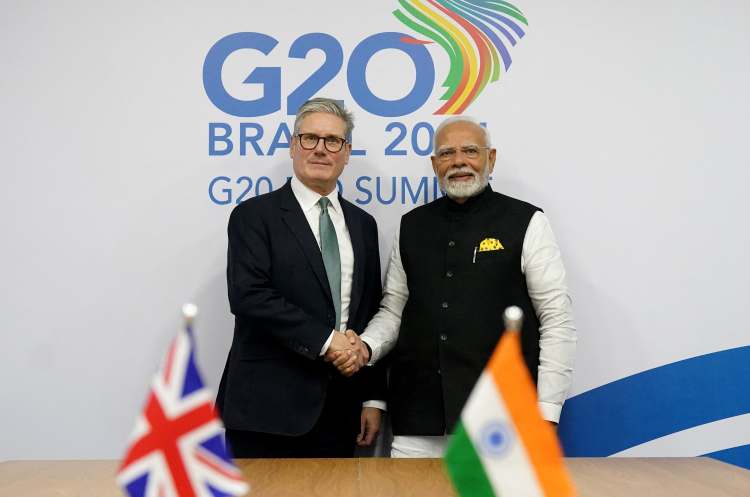
UK-India trade pact must move beyond nostalgia: For decades, politicians have spoken of the “living bridge” between India and the United Kingdom. The phrase has carried too much weight. Shared history, cricket, food, and the English language make good ceremonial material. They do not make strategy.
The India-UK Comprehensive Economic and Trade Agreement and the Vision 2035 framework offer a chance to move the relationship out of its familiar comfort zone. The future of the partnership will not be decided by lower tariffs on Scotch whisky, automobiles, or textiles. It will depend on whether Britain’s research institutions — Oxford, Cambridge, Imperial, the LSE and others — can be connected with India’s talent and scale: the IITs, IIMs, IISc, medical colleges, start-ups, and digital public infrastructure.
This is not a sentimental project. Nor is it development assistance in another form. It is an economic bargain. Done seriously, a knowledge partnership could generate very large value for both economies by 2035. The advertised $10 trillion figure should be treated as an ambition, not a forecast. The direction of the argument is still sound.
READ I Trade negotiations and the fear of exclusion
UK-India knowledge partnership
The logic is simple. The UK has institutional depth. It has strong universities, a mature pharmaceutical and life sciences ecosystem, legal and regulatory credibility, and the NHS, which gives it unusual strength in clinical research. Its problem is also obvious: a limited domestic market and a constrained talent pool.
India has scale. Its school and higher education systems draw from a population base that no advanced economy can match. The IITs and IISc sit atop a severe filtering process. The country’s digital public infrastructure has shown how systems can be built for hundreds of millions of users. India’s weakness is equally clear: uneven research quality, thin university-industry linkages, weak commercialisation, and too little patient capital.
The two systems are not mirror images. That is precisely why the UK-India trade pact matters. Britain brings research depth, standards, and global market trust. India brings engineers, doctors, entrepreneurs, data-rich use cases, and manufacturing scale.
A real knowledge highway would not be a parade of memoranda of understanding. It would mean joint labs with ownership rules, shared intellectual property, doctoral mobility, venture funds, and regulatory pathways that allow discovery in one country to be tested, manufactured, and deployed through the other.
READ I India-US trade deal runs into USTR tariff wall
Pharma and health technology
Health is the most obvious starting point. The NHS already depends on Indian doctors, nurses, and other health professionals. That is the old model: India supplies talent; Britain absorbs it.
The UK-India trade pact must offer a new model. British genomics, clinical research and regulatory science can be paired with India’s biotech manufacturing, diagnostics market, and capacity for low-cost delivery. Rare disease mapping, affordable biologics, AI-assisted diagnosis, medical devices, and preventive health are natural areas of collaboration.
The point is not to romanticise either system. The NHS is under strain. India’s public health system remains underfunded and uneven. But between British research capacity and Indian scale, there is room for a health innovation chain that is faster and cheaper than what either country can build alone.
READ I India-US trade deal: Tariff relief cannot mean surrender
Technology and manufacturing partnership
The second area is advanced technology. The old division of labour — India as back office, Britain as financial centre — is stale. India is now building satellites, digital payment systems, electronics capacity, defence platforms and start-up ecosystems. Britain retains advantages in chip design, aerospace engineering, financial technology, cyber security, standards, and law.
The opportunity lies in combining Indian engineering and cost efficiency with British design, certification, intellectual property discipline, and access to Western markets. This matters in semiconductors, defence technologies, green hydrogen, grid software, cyber security, space applications, and advanced manufacturing.
For this to work, UK-India trade pact must avoid the usual trap. Technology cooperation cannot be reduced to ministerial visits and incubator photographs. It needs export-control clarity, trusted data-sharing rules, transparent public procurement, and IP arrangements that universities and companies can actually use.
Boost to sports economy
Sport is another underused bridge. Cricket already binds the two countries, but the economics have moved. India is now the financial centre of global cricket. Britain has deeper systems in sports science, analytics, rehabilitation, coaching, and high-performance training.
There is a market here that goes beyond elite cricket. Football, tennis, athletics, women’s sport, sports medicine, biomechanics, league management, media rights, data analytics, and youth academies are all areas where the two countries can build commercial platforms.
India has the audience and aspiration. Britain has tested models of club systems, coaching, sports universities and performance management. A structured partnership under UK-India trade pact could create businesses, not just exchange programmes.
India-UK education alliance
Education is the fourth pillar. For years, the route has been one-way. Indian students went to British universities, paid high fees, and often stayed on to work if visa rules allowed. In the year ending June 2025, about 98,000 Indian nationals were granted UK sponsored study visas. That remains a major British export.
But the model is changing. The University of Southampton has opened a campus in India, and other UK institutions have announced plans to follow. This is a more serious development than another round of student recruitment fairs.
The next stage should be co-located excellence. Dual degrees between British universities and IIMs or IITs, joint PhD programmes, research chairs funded by industry, and venture funds linked to student enterprises can turn education into a production system for ideas and companies.
India should not settle for being a source of fee-paying students. Britain should not settle for tuition revenue. The UK-India trade pact should aim to create institutions that produce research, patents, firms, and public policy capacity.
UK-India trade pact and strategic autonomy
The geopolitical case is no less important. Supply chains are fragmenting. Technology is being weaponised. Export controls, sanctions, investment screening and data rules now shape economic power.
India needs trusted partners in technology, defence, finance and education. It also needs access to systems that are governed by law rather than political whim. Britain, after Brexit, needs a role larger than nostalgia and smaller than imperial memory. Its path to relevance runs partly through partnerships with large, fast-growing democracies.
For both countries, the prize is strategic autonomy. That does not mean equidistance from all powers. It means reducing dependence on any one market, one technology source, one university system, or one security patron.
The choice is therefore sharper than the diplomatic language suggests. India and the UK can continue with a polite, transactional relationship built around visas, outsourcing, and trade concessions. Or they can use the UK-India trade pact and Vision 2035 to build a knowledge compact.
That will require vice-chancellors to create joint research hubs with equity and IP rules from the start. It will require investors to build Indo-UK funds for science-led start-ups. It will require governments to cut red tape on data, mobility, clinical trials, standards and procurement.
The language is shared. The trade framework now exists. The timing is favourable. Now, what is missing is institutional seriousness. The living bridge will remain a slogan unless it carries research, capital, talent and technology in both directions.
Kumar Kuntikanamata is Councillor in Fleet Town council, Hampshire, UK. He is an expert in pharma industry and worked for many global firms. He has also worked as Vice Chairman for British South India Council of Commerce.