





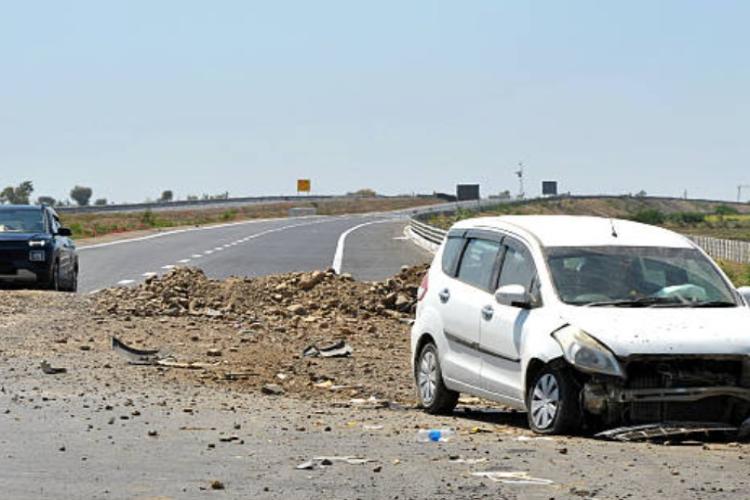
Every three minutes, someone dies on an Indian road. The Ministry of Road Transport and Highways recorded more than 1.72 lakh road deaths in 2023, or about 474 a day. Speeding remained the single largest cause, linked to 72.3% of fatal crashes. Yet India’s highways are getting faster.
Under the Centre’s notified ceilings, M1 passenger vehicles can travel at up to 120 kmph on access-controlled expressways and 100 kmph on four-lane and above divided carriageways. These limits were fixed in 2018, when highway expansion and better road engineering were being used to justify higher speeds.
READ | Road safety crisis: Why accident deaths keep rising
That leaves an obvious question: are India’s speed limits aligned with its road safety goals?
Speed management and crash risk
The relationship between speed and road safety is settled. Higher speed raises both the chance of a crash and the severity of injury when one occurs. WHO notes that every 1% increase in mean speed produces a 4% rise in fatal crash risk. It also cites evidence that a 5% cut in average speed can reduce fatal crashes by around 30%.
This is the logic behind the Safe System approach. It starts from a realistic premise: people will make mistakes. Roads, vehicles, enforcement and speed policy must therefore be designed so that those mistakes do not routinely turn fatal. Safe speed is not an abstract ideal. It is the speed at which the human body still has a reasonable chance of survival. WHO’s road safety guidance treats 30 kmph as the upper threshold where mixed traffic with pedestrians can be made broadly compatible with human survivability.
India’s law recognises the importance of speed control. Section 112 of the Motor Vehicles Act empowers the Centre to prescribe maximum speeds by vehicle class, while states and local authorities can impose lower limits for specific roads and conditions. The legal structure exists. The gap is between notified ceilings and real-world road environments.
READ | Rusty rails: Train accident exposes chasm between ambitions and realities
Highway speed limits and road conditions
The current ceilings assume a road environment that large parts of India do not have.
Many stretches of national highways still cut through villages, ribbon settlements, markets and peri-urban clusters. Pedestrians cross to reach bus stops, shops, fields and homes. Two-wheelers, tractors, auto-rickshaws and slow-moving goods vehicles often share the same carriageway as fast-moving cars and trucks. The result is a dangerous mix of high permitted speed and low protection.
This is where the debate is often blurred. The issue is not whether modern expressways should be treated like district roads. It is whether India has too often treated road design speed, notified speed and safe operating speed as though they were the same thing. They are not.
Even where engineering standards are strong, operating conditions can be poor. The Yamuna Expressway has repeatedly drawn attention for serious crashes, despite being one of India’s best-known high-speed corridors. The lesson is not confined to one road. Good pavement cannot compensate for weak enforcement, risky driver behaviour, fatigue, tyre failure, poor lane discipline or delayed trauma response.
Vulnerable road users and road deaths
The strongest argument for rethinking speed policy lies in who dies on Indian roads.
In 2023, two-wheeler riders accounted for 44.8% of all road deaths and pedestrians for 20.4%. Together, they made up nearly two-thirds of fatalities. These are road users with the least physical protection and the least margin for error.
That fact should shape speed policy far more than it does.
A country in which vulnerable users account for most road deaths cannot frame speed primarily as a question of travel efficiency. It has to treat speed as a public health and systems-design issue. India’s notified ceilings may make sense on fully access-controlled roads with disciplined traffic and reliable enforcement. They sit less comfortably with highways that function, in practice, as mixed-use corridors.
This is the missing link in much official thinking. India does not only have a speeding problem. It has an exposure problem. Roads built for throughput are often being used as social infrastructure by communities that were never separated from fast traffic.
Speed enforcement and road safety governance
Compliance is the next weakness. India still depends heavily on manual policing for speed enforcement. That model is plainly inadequate for a road network of this scale. Automated cameras, average-speed enforcement and integrated penalty systems remain patchy across states. Where electronic enforcement exists, it is often limited to a few urban stretches or high-visibility corridors.
Institutional fragmentation makes matters worse. Speed governance requires transport departments, highway authorities, traffic police, district administrations and urban local bodies to work to the same safety logic. In practice, that coordination is uneven. The result is predictable: speed limits exist in regulation, but not consistently on the road.
This is why it is too easy to moralise speeding as a matter of driver irresponsibility alone. Driver behaviour matters, but persistent speeding is also a system outcome. If roads visually invite high speed, vehicles are capable of it, enforcement is thin and penalties are uncertain, dangerous speeds become normalised.
READ | Speed kills: A time to remember road traffic accident victims
Road safety policy and the 2030 target
India has committed to halving road deaths and injuries by 2030 under the global road safety agenda. That target will not be met without putting speed management at the centre of policy.
That means scientifically calibrated limits based on road function, traffic mix and roadside activity, not only on carriageway width. It means periodic speed audits of high-risk corridors. It means automated enforcement at scale, backed by reliable adjudication. And it means aligning road design with posted speed through service roads, safer crossings, traffic calming near settlements, median protection and clearer signage.
India’s highway build-out is a major infrastructure achievement. Faster freight movement and shorter travel times matter. But a modern road network cannot be judged only by kilometres built or hours saved. It must also be judged by whether ordinary mistakes still lead to death.
Speed limits are not technical footnotes. They express a policy choice about what, and whom, a transport system is designed to protect.
If India is serious about reducing road fatalities, it must stop treating speed as a symbol of progress and start treating safe speed as a test of governance. The future of India’s roads cannot be only faster. It has to be safer.
Amrat Singh is Director, and Shreni Jani a research associate at CUTS International. They work on road safety and public policy and are associated with the Road Safety Network, India.