





Kerala migration debate: Kerala’s 2026 election campaign turned migration into a fiscal grievance. The Congress-led UDF returned to power and VD Satheesan took office as Chief Minister after the 2026 assembly results in May. Migration soon entered the new government’s economic vocabulary through one word: remittance. Gulf migration was treated as income. Student migration to Europe was treated as a drain on household liquidity. The wages sent home by interstate workers were labelled “reverse remittance”.
Satheesan’s formulation carries political force because it gives one number several meanings. A Malayali worker sending money from Dubai strengthens Kerala. A student in Britain drawing on family savings weakens it. A worker from Bengal or Assam sending wages from Kerala to his family drains it. The word “siphoning”, used in this debate, turns wage payment into loss, and workers into claimants on Kerala rather than contributors to its output.
READ | Migrant worker exodus exposes Kerala’s economic fault lines
Remittance politics in Kerala
The reverse remittance argument assumes a closed pot of money. Kerala’s economy has never worked that way. A mason in Kochi or a plywood worker in Perumbavoor is paid for labour used in Kerala. His remittance is the residue after rent, food, transport and other local spending. If he leaves, the employer does not retain that wage as surplus. Work stops, output falls, and deadlines slip.
Kerala’s own migration data does not support panic. The Kerala Migration Survey 2023 estimated 2.2 million emigrants from the state, close to the 2.1 million recorded in 2018. Student emigrants doubled from 129,763 in 2018 to about 250,000 in 2023. Total remittances to Kerala rose from ₹85,092 crore in 2018 to ₹216,893 crore in 2023. The same survey estimated outward remittances at ₹43,378 crore, about one-fifth of inward remittances. The figure is worth studying. It is too thin a basis for treating interstate workers as an economic threat.
Kerala migration history
Kerala’s migration story did not begin with the Gulf. It runs from colonial labour corridors to Ceylon, Malaya and Burma, through semi-skilled work in the GCC, and now to skilled work and student migration in Europe and North America. The route changed with wages, education, networks and visas. That history is hard to fit into a simple account of economic failure.
READ | Kerala’s K-CDC must start with monsoon surveillance
Poor industrialisation is part of the story, but only part. Land reform, schooling, public health and food security raised the capacity to move. The early Gulf migrants did not leave only because Kerala failed to employ them. They left because families had enough education, aspiration and networks to take a risk abroad. Remittances then financed the next round of mobility, including education outside India.
The KMS 2023 finding that the GCC share of Kerala’s emigrants fell from 89.2% in 2018 to 80.5% in 2023 records a change in destination and age profile. It does not show that migration has turned against Kerala. It shows that the old Gulf circuit is no longer the only route.
Interstate migrant labour in Kerala
The usual political promise is to “fix” migration by building the local economy. History is less obedient. Development often creates mobility. Tamil Nadu’s industrial base has not stopped overseas migration. Uttar Pradesh and Bihar now figure among the top sources of blue-collar workers going to the Gulf, with Kerala no longer holding its old dominance in that corridor.
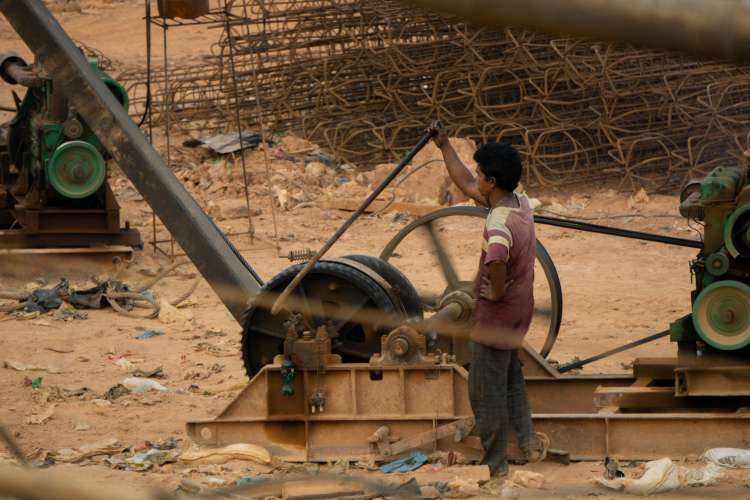
The same logic holds inside Kerala. Interstate workers arrived because the state’s labour market asked for them. Local wages are high. Educated youth have moved out of manual work. Households are ageing. Construction, hospitality, manufacturing, plantations and care work need labour that local supply cannot meet. A Gokhale Institute essay notes Kerala’s demand for interstate migrants alongside out-migration, higher casual wages and employers’ preference for migrant labour.
READ | Kerala fiscal crisis demands hard Budget choices
Estimates vary. Satheesan put the number of workers from other states in Kerala at around four million. A CMID study refers to about 3.5 million interstate migrant workers and identifies Murshidabad-Ernakulam and Nagaon-Ernakulam as among India’s longest inter-district labour corridors. These workers are not temporary guests in any meaningful economic sense. They are part of Kerala’s production system.
Migrant workers and rights
Calling them guest workers softens exclusion. A guest can be hosted, watched and asked to leave. A worker has claims on wages, safe housing, schooling for children, health care, grievance redress and protection from assault.
CMID’s Ernakulam study found poor access to welfare schemes, crowded housing, financial exclusion, low trade union membership and high vulnerability to accidents and disease. Almost 95% of workers in the study lacked ESI, PF or gratuity. Nearly 80% did not purify drinking water before use. These are not cultural inconveniences. They are failures of labour administration, housing regulation and public health outreach.
Claims about strain on Kerala’s public systems need data. Schools tell a different story from the rhetoric. The Jyothi programme sought to bring migrant children into anganwadis and public schools. Migrant student enrolment in Kerala schools rose from 21,299 in 2023-24 to 24,525 in 2024-25. That still falls well short of the estimated number of migrant children in the state, but it shows why welfare cannot be treated as charity.
Kerala needs a migration framework
A state built on mobility cannot treat mobility from other states as a defect. Kerala can demand better worker registration, employer accountability, safe housing, portable ration access, health coverage and coordination with source states. It cannot make the worker’s remittance to Murshidabad morally inferior to the Malayali remittance from Dubai.
India’s internal migration regime remains scattered across labour, food, housing, schooling and policing. Kerala’s answer should be enforceable labour standards and portable social protection, not a hierarchy of deserving migrants.
Those who send money from Kerala to Murshidabad or Nagaon are doing what Malayalis did from Muscat and Dubai. They earn, consume, save and support families. Treating one flow as pride and the other as leakage is bad economics. In Kerala, it is also bad history.
Ganga S is a Research Scholar at National Institute of Educational Planning and Administration (NIEPA), Delhi. Navas M Khadar is a Research Scholar at School of International Relations and Politics, Mahatma Gandhi University, Kerala.