





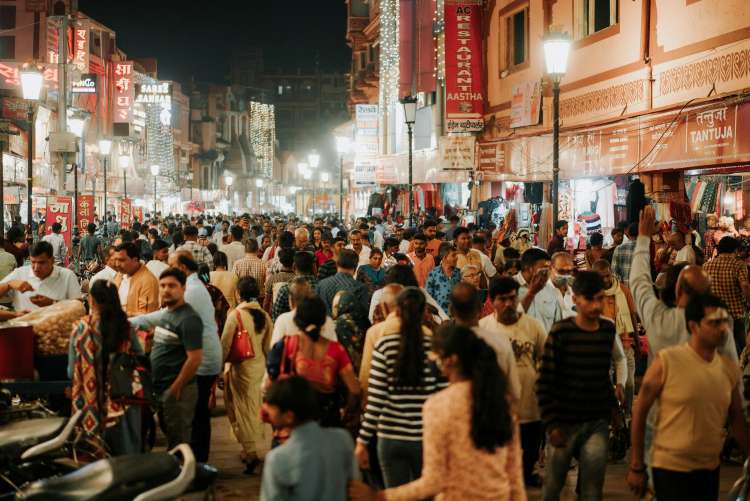
India’s population: India overtook China in 2023 to become the world’s most populous country. Its population is now around 1.5 billion, and its density is estimated at about 497 people per square kilometre. The comparison with other large countries is stark. China has far lower density, while the United States and Brazil have only a fraction of India’s demographic pressure on land.
This is not merely a statistical milestone. It is an economic constraint. India wants fast growth, fiscal stability, industrial jobs, better cities, cleaner air, and higher living standards. Each of these ambitions must now be tested against the same question: can a country of this size deliver inclusive prosperity without changing the way it manages land, labour, skills, public services, and natural resources?
READ I Kerala ageing population needs rights-based elder care
India’s economic debate is often framed around GDP growth, stock markets, unicorn valuations, and the promise of a large domestic market. That is not wrong. But it is incomplete. For millions of Indians, the economy is experienced through congestion, insecure jobs, high housing costs, weak public transport, shrinking personal space, stressed schools and hospitals, and intense competition for every credible route to upward mobility.
The real challenge, therefore, is not India’s population alone. Fertility has already fallen sharply in many parts of the country. The challenge is population scale. India must convert a very large population into a productive workforce, and do so before the demographic window begins to narrow.
READ I Lok Sabha reform: Delimitation must look beyond population logic
India’s population growth and resource pressure
Rapid population growth has always had two sides. A larger population can expand demand, deepen labour markets, and support economies of scale in production, transport and communications. It can also raise national income by increasing the number of workers and consumers.
But these gains are not automatic. They depend on the quality of jobs, education, public health, urban planning, and institutions. Without them, population becomes pressure. It strains land, water, agriculture, housing, schools, hospitals, roads, courts, and local governments.
India’s population rose from around 361 million in 1951 to more than 1.4 billion today. The pressure is visible most sharply in states such as Bihar, Uttar Pradesh and West Bengal, where population density is high and public infrastructure has struggled to keep pace. Unplanned urbanisation has deepened land degradation, groundwater depletion, waste stress and air pollution. Agriculture, too, carries more people than it can productively support.
This is why aggregate GDP can mislead. A large economy can still leave average incomes low if population growth and low productivity dilute the gains. India’s per capita GDP remains modest by global standards despite its rise as the world’s fifth-largest economy. World Bank data place India’s GDP per capita at about $2,695 in 2024.
The implication is clear. India cannot rely on headline growth alone. It must raise output per worker, improve the quality of employment, and reduce the number of people trapped in low-productivity work.
READ I India must move workers out of low-productivity work
Jobs and the demographic dividend
The labour market is the most important test of India’s demographic story. A rising working-age population can be an asset only if the economy creates enough productive jobs. India has not done so at the required scale.
Too many workers remain dependent on agriculture, not because farming offers high returns, but because industry and modern services have not absorbed them fast enough. The result is familiar: underemployment, informal work, low wages, weak social protection, and a job market in which millions of young people compete for a limited number of secure positions.
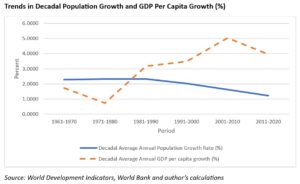
This is the weak link in the demographic dividend. A young population is not a dividend by itself. It becomes one only when young people are healthy, educated, skilled, mobile, and employed in productive sectors. Otherwise, the dividend can turn into social frustration and political pressure.
Technology complicates the picture. Artificial intelligence, automation and digital systems can raise productivity. They can also reduce the demand for certain categories of labour. Global companies have already begun restructuring workforces while increasing investment in AI and automation. For a labour-abundant economy such as India, this makes the old development route harder.
India cannot respond by slowing technology adoption. That would damage competitiveness. The better response is to invest more aggressively in education, vocational training, applied research, digital capability, and labour-intensive manufacturing. The employment challenge will not be solved by celebrating startups alone. It requires firms that can scale, export, train workers, and create steady jobs outside a few large cities.
Human capital and India’s development gap
Lower fertility and slower population growth create an opportunity. They allow households and governments to spend more per child on nutrition, schooling, healthcare, and skills. They can reduce the dependency burden and raise savings and investment per person. But India will capture these gains only if public policy shifts from population control rhetoric to human capital formation.
India’s human development record shows the scale of the task. The UNDP’s 2025 Human Development Report ranks India 130 out of 193 countries, with an HDI value of 0.685 for 2023. India remains in the medium human development category, just below the 0.700 threshold for high human development.
That ranking should temper triumphalism. A country cannot become a high-income economy with weak schools, poor learning outcomes, fragile primary healthcare, low female labour-force participation, and uneven access to nutrition. Nor can it build a competitive manufacturing base without disciplined investment in skills and public health.
The task is not to reduce people to numbers. It is to raise the productivity and dignity of each person. India’s population will remain large for decades even as fertility declines. United Nations projections suggest that India’s population could peak around the early 2060s at about 1.7 billion before declining.
That gives India time, but not much. The next two decades will decide whether the country enters the next phase with a skilled workforce or with a large pool of underemployed citizens.
India’s population and the Malthusian trap
Thomas Robert Malthus argued in 1798 that population growth could outrun food supply and depress wages through pressure on land. Technology has repeatedly proved the strict Malthusian forecast wrong. Agricultural science, trade, public health and industry have expanded the resource base far beyond what early economists imagined.
Yet the Malthusian warning cannot be dismissed entirely. In many developing societies, poverty, inequality, poor nutrition, weak public services and environmental stress still produce Malthusian outcomes in localised forms. India is not trapped in the old sense. But parts of India still face the conditions that make population pressure economically damaging.
The policy answer is not coercive population control. That would be both unjust and unnecessary in a country where fertility has already declined sharply. The answer lies in better state capacity: planned urbanisation, stronger local governments, water security, land-use reform, higher farm productivity, labour-intensive manufacturing, public health, and serious investment in education.
India’s demographic future will not be determined by the size of its population alone. It will be determined by whether the state and the market can create enough productive opportunity for that population. A large population can support a large economy. It can also expose the weakness of institutions. The difference lies in policy execution.
India has crossed the numerical threshold. It must now cross the productivity threshold.
Chinmay Joshi is a Research Associate at Bhavans’ SP Jain Institute of Management and Research, Mumbai and a Research Scholar at Gokhale Institute of Politics and Economics (GIPE), Pune.