





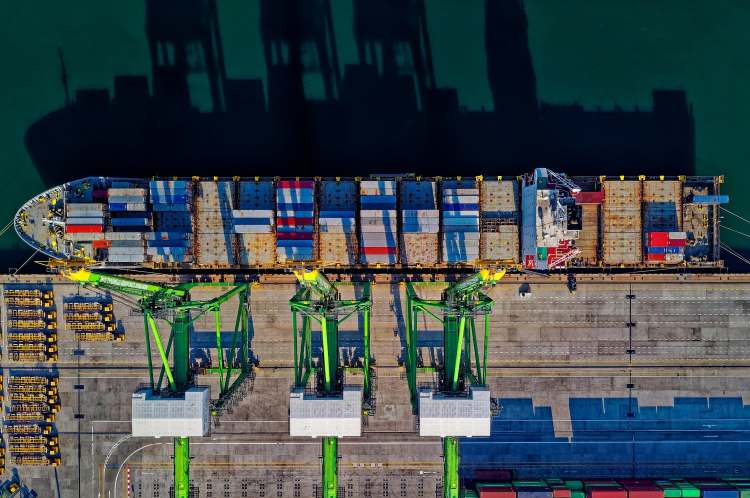
Global trade and supply chain resilience: For three decades, the architecture of globalisation rested on a deceptively simple premise. Production gravitated to where it was cheapest, logistics optimised efficiency across continents, and capital pursued opportunity with minimal regard to politics. Supply chains became intricate webs of economic rationality that connected factories, ports and markets across the world.
That era is now receding.
The global trading system is undergoing a profound recalibration in which economic relationships are increasingly filtered through the prism of national security, technological rivalry and geopolitical alliances. What once appeared as neutral commercial networks are being reinterpreted as strategic assets. In this emerging order, supply chains are becoming instruments of power.
The Economic Survey 2025–26 captures this shift with unusual clarity. Global foreign direct investment declined by about eleven percent in 2024, reflecting the growing weight of geopolitical risk and policy uncertainty in investment decisions. Governments across the world are deploying tariffs, export controls, subsidies and sanctions as instruments of economic statecraft.
Strategic sectors such as semiconductors, artificial intelligence, critical minerals and advanced manufacturing have become arenas of geopolitical contestation. The global economic order is gradually shifting away from the hyper globalised model that defined the late twentieth century towards a more fragmented and security driven architecture of trade. These developments represent a structural transformation in the logic of global commerce.
READ I Trump tariffs and the new grammar of global trade
Global trade fragmentation is redrawing supply chains
In fact, the volatility of global trade policy has now become measurable in ways that underline the depth of this transition. The Trade Policy Uncertainty index and the Global Economic Policy Uncertainty index both surged to historic levels during 2025, reflecting the scale of tariff disputes, export controls and strategic trade restrictions now shaping global commerce.
In April 2025 the trade policy uncertainty index rose sharply following sweeping tariff announcements across major economies, signalling a sharp escalation in policy unpredictability. Such uncertainty is no longer a peripheral irritant to markets. It now directly influences corporate investment decisions, capital flows and the long term configuration of global production networks.

The world is moving away from the hyper globalised model that dominated the late twentieth and early twenty first centuries. That earlier phase of globalisation was characterised by frictionless capital mobility, dispersed production networks and an overwhelming emphasis on cost efficiency. Firms built supply chains that were optimised for scale and speed. The doctrine of just in time production was celebrated as the pinnacle of logistical sophistication.
But that model assumed a relatively stable geopolitical environment in which economic interdependence could deepen without significant strategic friction. Recent developments have shattered that assumption.
READ I Iran conflict exposes India’s oil and trade vulnerabilities
Strategic competition between major powers has intensified across technology, trade and investment. Export restrictions on advanced semiconductors, industrial subsidies designed to repatriate manufacturing capacity and tariffs aimed at strategic sectors have become common instruments of policy. Governments are increasingly determined to secure domestic control over technologies that will shape the next generation of economic power.
The distortions produced by this environment are already visible in global trade data. A noticeable portion of trade growth during the past year has been driven by companies accelerating shipments ahead of anticipated tariff increases.
Firms have rushed to place orders before new trade barriers take effect, creating a temporary surge in trade volumes that masks the deeper slowdown beneath. Such front loading of global orders is a short term tactical response rather than a sign of renewed globalisation. It reflects the reality that supply chains are increasingly being reorganised in anticipation of political risk rather than purely economic opportunity.
READ I Digital trade agreements will test India’s data sovereignty
Supply chain resilience is replacing cost efficiency
Multinational corporations are therefore revisiting assumptions that once seemed axiomatic. The lowest cost location is no longer automatically the preferred destination for manufacturing investment. Instead companies are factoring geopolitical risk into the calculus of production and sourcing decisions. Political alignment, regulatory compatibility and strategic reliability are acquiring new importance alongside cost competitiveness.
The vocabulary of global trade is evolving accordingly. Terms such as friend shoring, strategic autonomy and supply chain resilience have entered mainstream policy discourse. Firms are diversifying suppliers, creating redundancy in production networks and maintaining larger inventory buffers after decades of relentless efficiency optimisation.
This shift marks a deeper philosophical change in how the global economy is organised.
In the past, economic interdependence was widely viewed as a stabilising force in international relations. The integration of markets was expected to reduce the incentives for geopolitical confrontation. Trade created mutual dependence, which in turn encouraged cooperation.
Today the opposite logic is gaining ground. Interdependence is increasingly perceived as a vulnerability. Dependence on foreign suppliers for critical technologies or raw materials is now interpreted as a strategic risk. The policy response has therefore been to reduce exposure to potential adversaries while strengthening economic ties with trusted partners.
The semiconductor industry illustrates this dynamic with particular clarity. Chips have become the central nervous system of the modern digital economy. They power everything from artificial intelligence and telecommunications to defence systems and consumer electronics. Unsurprisingly, governments now view semiconductor supply chains as critical infrastructure and a strategic asset.
Major economies are investing heavily in domestic manufacturing capacity, imposing export restrictions and offering subsidies to attract advanced chip fabrication facilities. What was once a globally integrated ecosystem is gradually fragmenting along geopolitical lines.
Similar dynamics are unfolding across other strategic sectors. The race to secure access to critical minerals required for batteries and renewable energy technologies is reshaping investment patterns. Governments are competing to establish domestic production capabilities in electric vehicles, clean energy equipment and advanced computing systems.
Such policies inevitably introduce inefficiencies into the global trading system. Supply chains designed around political alignment rather than economic optimisation are inherently more expensive. Yet policymakers appear willing to accept these costs.
Economic efficiency is no longer the sole metric of policy success. Strategic resilience has become an equally important objective. Governments are prioritising the security of supply over the optimisation of cost.
India manufacturing strategy must adapt
This new reality presents both challenges and opportunities for countries such as India.
On one hand, fragmentation of the global trading system introduces uncertainty into investment flows and supply networks. Firms may hesitate to commit long term capital in an environment where trade rules and geopolitical alignments remain fluid.
On the other hand, the reconfiguration of global supply chains creates space for new production hubs to emerge. Countries that combine political stability, regulatory predictability and strategic credibility may find themselves increasingly attractive as alternative manufacturing and technology destinations.
India’s economic policy must therefore navigate a delicate balance. It must position the country as a reliable node within emerging supply chain networks while preserving openness to global trade and investment. Excessive protectionism would undermine competitiveness, yet passive integration into existing structures may not fully capture the opportunities created by geopolitical realignment.
The essential task is to build credibility.
Ultimately the transformation underway in global trade reflects a deeper truth about the relationship between economics and power. Markets rarely exist in isolation from politics. They are embedded within the strategic priorities and security concerns of states.
For several decades, globalisation encouraged the belief that economics could transcend geopolitics. Supply chains were built on the premise that efficiency alone would determine the geography of production.
That assumption is no longer tenable.
The global economy is entering an era in which trade networks double as strategic infrastructure and economic relationships are increasingly shaped by geopolitical alignment. Supply chains, once the invisible machinery of commerce, are increasingly becoming instruments through which geopolitical leverage is exercised. The next phase of globalisation will not be defined by the absence of politics, but by its decisive presence within the architecture of trade.
READ I Remittances rise as war triggers panic transfers

Srinath Sridharan is a strategic counsel with 25 years experience with leading corporates across diverse sectors including automobiles, e-commerce, advertising and financial services. He understands and ideates on intersection of finance, digital, contextual-finance, consumer, mobility, Urban transformation, and ESG. Actively engaged across growth policy conversations and public policy issues.