





Tier II cities infra push lacks climate resilience: India’s urban transition has reached a point where policy can no longer treat Tier II and Tier III cities as peripheral. They are becoming the next sites of growth, migration, and infrastructure demand. The World Bank has long pointed to the scale of India’s urban expansion, while the Economic Survey 2025-26 notes that towns and cities could house about 600 million people by 2036. Urban centres already generate roughly two-thirds of GDP while housing less than half the population.
The Union Budget 2026-27 recognises this shift. It re-emphasises secondary cities through City Economic Regions (CERs) and targeted infrastructure investments aimed at dispersing growth beyond Mumbai, Delhi, Kolkata and Bengaluru. That is sound economic logic. What remains unclear is whether the fiscal design can also deliver climate resilience and environmental sustainability in the same geographies.
READ | Budget 2026: India needs urban governance, not big transport assets
City economic regions and tier II cities push
The budget’s infrastructure-led approach is explicit. Connectivity and urban development are central to the plan. It proposes allocations for CER development over the next five years, with a focus on Tier II and Tier III cities and select temple towns.
The CER framework is intended to integrate industry, housing, transit and public services so that growth is distributed across regions instead of concentrating in a few metros. The emphasis on rail connectivity, including proposed high-speed corridors such as Delhi-Varanasi and Varanasi-Siliguri, fits this logic. The policy intent is clear: decentralise economic activity and build capacity in smaller urban centres that will drive the next phase of growth.
That is a necessary shift. It is also overdue.
Urbanisation and climate risk in secondary cities
Rapid urbanisation in smaller cities will intensify pressure on housing, transport, water, sanitation and public infrastructure. That same pressure will amplify exposure to heatwaves, flooding and air pollution. The budget acknowledges the urban stress problem and responds with investments in transport, connectivity and city infrastructure, partly to reduce pressure on major metros.
Some of this push has environmental value. Electric buses, rail-based freight movement, waterways, and cleaner urban transport systems can lower emissions over time. These measures could make Indian cities less carbon-intensive.
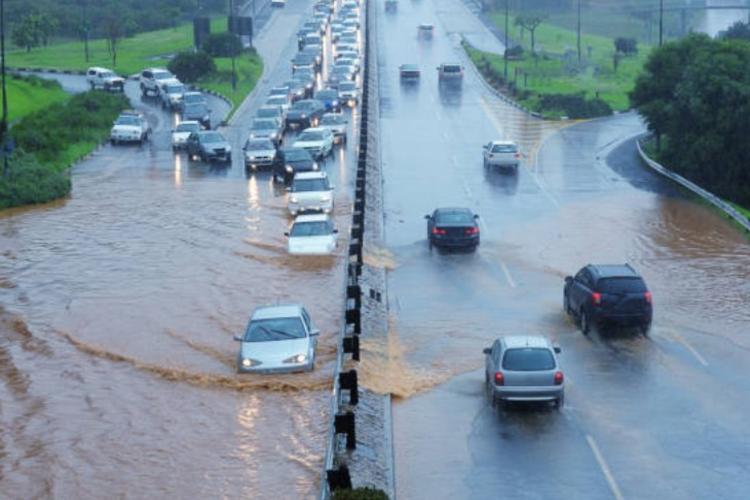
But the green intent remains mostly implicit. The budget still treats speed, connectivity and growth returns as the organising principles, with environmental outcomes attached as co-benefits. Climate preparedness does not appear as a standalone urban policy objective. There is no clearly articulated city-level programme for heat mitigation, flood resilience, or climate-sensitive urban design in the secondary-city expansion strategy.
That gap matters because climate risk in Indian cities is not a future problem. It is already shaping infrastructure performance, public health, and municipal finances.
READ | RoDTEP scheme after Budget 2026: Fiscal tightening, strategic risks
Budget 2026-27 climate spending is mitigation-heavy
A closer reading suggests that the budget is more aligned with industrial decarbonisation than with climate-resilient urbanisation. The emphasis remains mitigation-heavy, with limited visible attention to heat resilience, flood control, drainage redesign, or adaptation planning in fast-growing secondary cities.
The environmental measures highlighted in the budget are largely tied to energy transition and industrial supply chains. Customs duty relief on selected inputs for battery and solar manufacturing, and the extension of duty exemptions linked to nuclear power projects, support low-carbon energy capacity. These are important measures. But they address energy supply and industrial competitiveness more than sustainable urban form.
This is the central imbalance in the budget’s environmental framing: climate change is treated primarily as an energy and manufacturing challenge, not equally as an urban planning challenge.
CCUS and rail efficiency cannot substitute urban design
The budget’s capital-intensive environmental posture is also visible in the Rs 20,000 crore allocation for carbon capture, utilisation and storage (CCUS). CCUS may be justified for hard-to-abate sectors. But it is a downstream response. It manages emissions after production rather than reducing the carbon and ecological footprint of how new urban regions are built.
The same limitation appears in the transport strategy. High-speed rail is more efficient than road transport on key corridors, and that is a real gain. But environmental performance in Tier II and Tier III cities will depend heavily on last-mile mobility, land use, drainage, walkability, and service access. A top-level connectivity push cannot by itself solve those problems.
Without local urban design reform, even efficient inter-city systems can feed carbon-intensive and heat-stressed urban sprawl.
READ | Budget 2026: Semiconductors drive MeitY’s recalibrated tech spend
Municipal finance and the climate resilience gap
The financing architecture raises another concern. The budget’s municipal bond incentive structure favours issuances above a high threshold. That may deepen capital-market participation for stronger urban local bodies. It may also widen inequality across cities.
Most Tier II and Tier III municipal corporations still lack the credit ratings, revenue depth, and administrative capacity needed to issue large municipal bonds. These are often the same cities that need the most investment in drainage, waste systems, green spaces, heat management, and basic resilience infrastructure.
The result could be a familiar fiscal divide: financially stronger cities attract sustainability-linked capital, while more vulnerable cities remain dependent on weak municipal budgets and irregular transfers. If that happens, the budget’s decentralisation strategy will expand growth without proportionately expanding resilience.
Decongesting megacities is right, but incomplete
The budget is right to pursue decongestion of megacities by building economic strength in Tier II and Tier III centres. The CER strategy, combined with transport links and industrial capability building, reflects a serious attempt to widen India’s growth geography. The emphasis on critical minerals, semiconductor capacity and renewable-energy-linked manufacturing also signals an industrial policy aligned with long-term competitiveness.
But the ecological integration of this urbanisation strategy remains incomplete. The current framework assumes that climate risk can be addressed largely through clean energy, industrial technology and emissions-management tools. It gives much less policy weight to blue-green infrastructure, urban water systems, heat-resilient layouts, and local adaptation planning — precisely the areas that will determine how liveable secondary cities remain as they grow.
India has started building the physical platforms of its urban future. It has not yet built the fiscal and institutional architecture for climate-safe urban living in those same cities.
Next fiscal step for sustainable urban transition
Infrastructure expansion without matching climate preparedness will lock many cities into recurring environmental stress. The gap between green power generation and green urban living now needs explicit fiscal correction.
Future budgets should move beyond implicit sustainability and formalise city-level climate budgeting, with ring-fenced adaptation funding for Tier II and Tier III cities. Without that shift, decentralised urban development may reduce pressure on megacities while creating a new layer of ecological vulnerability across the rest of urban India.
The budget has identified where India’s next urban growth will happen. It has not yet shown how that growth will remain climate-resilient.
Yashwant Rai, Nikita Suri and Prisha Mehta are students and Dr Barun Kumar Thakur is Associate Professor of Economics at FLAME University, Pune.