





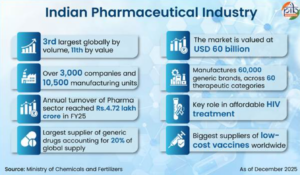
Trump’s generic drug tariffs: The pharmaceutical trade rests on a division of labour. Drug companies in the developed world have concentrated on patented medicines, while India has built a formidable generics industry. India now supplies about a fifth of global demand for generic drugs by volume.
That arrangement has cut treatment costs across rich and poor countries. It has also earned India the description “pharmacy of the world”. In FY2024-25, the country exported medicines to 191 countries. Pharmaceutical exports were worth $30.47 billion.
READ | UK-India pharma corridor links British research with Indian scale
President Donald Trump now wants to redraw this market. Imported generic drugs will remain tariff-free until August 2028, after which the US proposes to levy a 100% tariff for one year and 200% thereafter. The aim is to force manufacturers to shift production to America.
This would be a large experiment with the world’s cheapest medicines. Generic manufacturing cannot be moved as readily as the production of cars or electronic goods. Nor can companies absorb tariffs of this order without raising prices, withdrawing products or cutting supplies.
US generic drug tariffs threaten India’s largest market
India supplies about 40% of the generic medicines used in the US. It also meets more than half of Africa’s requirement and supplies roughly a quarter of medicines used in the UK. The US is its biggest and most profitable export market.
The proposed tariffs therefore threaten more than Indian export earnings. They could weaken the model that has kept essential medicines affordable in the US.
Generic drugs are approved as substitutes for branded medicines because they have the same active ingredients, dosage, strength and therapeutic effect. Once patents and regulatory exclusivities expire, several manufacturers can enter the market. Competition drives prices down.
Generics account for about 90% of prescriptions dispensed in the US but only a small share of drug spending. Patented medicines produce much larger returns because manufacturers enjoy temporary protection from competition. Generic producers work with thinner margins and depend on large volumes, low costs and efficient plants.
This explains why American pharmaceutical companies put more capital into discovering and marketing patented drugs, while Indian companies built scale in generics. Research costs can be recovered through the higher prices charged during the patent period. A generic manufacturer has no comparable cushion.
READ | Pharma market growth shifts to chronic care
Reshoring generic medicine production will take years
India’s advantage was built over several decades. It includes manufacturers of active pharmaceutical ingredients, formulation plants, trained chemists and teams familiar with US Food and Drug Administration rules. A tariff does not reproduce those assets in Ohio or New Jersey.
A new plant can take two years or more to build. The manufacturer must then complete validation, stability studies and regulatory inspections. Each drug transferred to a new site requires filings with the FDA. A company with hundreds of products could spend several years moving even part of its portfolio.
Pharmaceutical plants cannot start supplying the US merely because equipment has been installed. The FDA approves the manufacturing site as well as the medicine. Production cannot be shifted before that process is complete.
Some Indian companies are better placed than others. Aurobindo Pharma and Senores Pharmaceuticals have manufacturing capacity in the US. Dr Reddy’s Laboratories, Lupin, Cipla and Zydus Lifesciences also have an American presence, but remain dependent on Indian plants. Biocon’s biologics capacity is concentrated in India and Malaysia. Alkem Laboratories and Torrent Pharmaceuticals have less exposure to the US generics market.
These differences may alter the immediate effect on individual companies. They do not resolve the shortage of low-cost manufacturing capacity in the US.
READ | Pharmaceutical industry risks rise amid US tariff threat
American patients will bear the tariff cost
Generic manufacturers cannot readily absorb a 100% tariff, let alone a 200% levy. Many products already earn margins too small to justify fresh investment. Manufacturers would have to raise prices, stop exporting particular drugs or leave the US market.
American patients and health programmes would bear much of the cost. The US depends on imported generics because they reduce the price of prescriptions for cancer, diabetes, cardiovascular disease and bacterial infections. Hospitals and pharmacies also rely on them for medicines that attract little investment from manufacturers because the returns are poor.
Higher prices may not produce the investment Washington expects. Semiconductor plants receive large subsidies because chips can generate substantial returns and governments regard them as strategic assets. Generic medicines have high social value but often offer little commercial reward. Tariffs do not correct that mismatch.
India cannot assume that its present advantage will protect it indefinitely. Companies with large US revenues will have to decide whether to build plants there, seek exemptions, absorb part of the tariff or surrender low-margin products. The two-year tariff-free period gives them time, but the regulatory timetable leaves little room for delay.
The dispute also exposes a weakness in India’s pharmaceutical industry. Its global position still rests heavily on low-cost generic production. Greater investment in drug discovery, complex generics and biologics would reduce that dependence. Those capabilities, however, take longer to build than a formulation plant.
Washington can make imported medicines more expensive. It cannot quickly replace the manufacturing network that produced them. If the tariffs proceed as announced, America may discover that reshoring generic drugs begins with dearer prescriptions and fewer suppliers.