





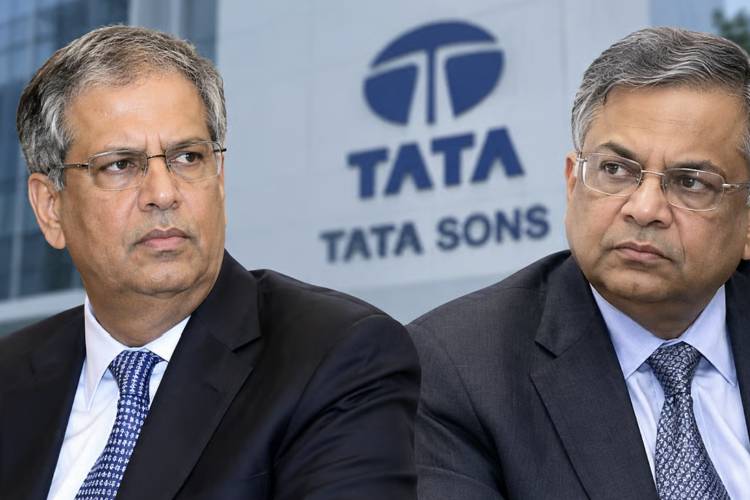
Tata Sons IPO: Tata Sons, the principal holding company of the Tata Group, is caught in a boardroom dispute over whether it should become a listed company. The immediate trigger is regulatory. The deeper issue is the ownership structure of one of India’s oldest business groups.
On September 17, the Tata Sons board decided to initiate steps to comply with the Reserve Bank of India’s regulatory framework and seek guidance on the requirements. Tata Trusts, which controls about 66% of Tata Sons, said on the same day that it had not agreed to a listing and that all available options should be examined. The Trusts also pointed to a unanimous Tata Sons board decision in March 2024 to remain unlisted, followed by similar resolutions by the two principal Tata trusts in July 2025.
READ | Indian steel industry: From capacity comfort to global ambition
The disagreement matters because Tata Sons is not an ordinary promoter holding company. It sits above businesses such as Tata Consultancy Services, Tata Motors, Tata Steel, Titan, Air India and Indian Hotels. About two-thirds of its equity is held by charitable trusts whose dividends finance philanthropic activities. That arrangement places a commercial empire under the effective control of institutions whose stated purpose is charitable.
The question now is whether that model can coexist with the regulatory and governance requirements attached to a large listed financial holding company.
Why the RBI listing requirement matters
Tata Sons was classified by the RBI as an Upper Layer non-banking financial company in September 2022. Under the RBI’s scale-based regulatory framework, NBFCs placed in the Upper Layer are required to list within three years of identification. The original deadline for Tata Sons was September 30, 2025.
Tata Sons did not list. Instead, it pursued a different route. After repaying ₹21,813 crore of debt in 2024, it applied to surrender its registration as a Core Investment Company. The logic was straightforward: if it could exit the regulatory framework applicable to the CIC, the listing requirement attached to its Upper Layer status could potentially fall away.
That route has now been blocked. The RBI rejected Tata Sons’ application in September 2026. Tata Sons has assets of about ₹2.01 lakh crore as of March 31, 2026, well above the ₹1 lakh crore threshold relevant under the revised regulatory framework.
This is why the current dispute cannot be reduced to a disagreement over whether Tata Sons wants to raise money from the stock market. The company is already under a regulatory framework that carries a listing requirement. The issue is whether there is another legally sustainable way to meet the regulator’s requirements without altering the ownership structure.
Tata Trusts has argued precisely for that approach. Its September 17 statement did not reject compliance with the RBI. It said the company should examine all permissible options rather than assume that listing is the only answer.
READ | Competitive federalism enters its industrial phase
Tata Sons IPO: The ownership question is larger
The Tata structure is unusual because the controlling shareholder is not a family holding company or a conventional investment vehicle. The principal Tata charitable trusts hold roughly 66% of Tata Sons. The dividends generated by that ownership ultimately support charitable activities.
That structure has consequences for corporate decision-making. A conventional listed holding company has shareholders whose primary interest is financial return. Tata Sons has historically had a controlling shareholder with a different institutional purpose.
That does not mean the Tata model is insulated from commercial considerations. Tata Sons remains a large corporate holding company, and its capital allocation decisions affect businesses and minority shareholders across the group. But its ownership gives the group a governance structure that is different from that of most listed conglomerates.
A listing would not automatically remove Tata Trusts from control. The trusts could remain the majority shareholder depending on the size and structure of the public offering. The immediate change would be in the setting in which that control is exercised: greater disclosure, a public market valuation, minority shareholders and continuing scrutiny from investors.
That distinction is important. The debate is not simply about who will control Tata Sons after an IPO. It is about how a philanthropic controlling shareholder exercises that control once the holding company itself is subject to the disciplines of the public market.
READ | Can climate rankings tell us which country is a good performer?
Shapoorji Pallonji adds another pressure point
There is a second shareholder issue behind the listing dispute. The Shapoorji Pallonji Group owns about 18.4% of Tata Sons and has sought to monetise part of its holding.
On September 17, Tata Trusts said it had placed before the Tata Sons board an SP Group proposal for a transaction that could yield at least ₹25,000 crore, with the sale spread over two tranches across 18 months. The proposal was intended to provide liquidity to the SP Group without requiring an immediate public listing of Tata Sons.
The SP Group subsequently backed a public listing, putting the two major shareholder groups on opposite sides of the issue. For a minority shareholder holding a large stake in an unlisted company, liquidity is inherently more constrained than it is in a listed market. A listing would create a transparent market price and a more conventional route for monetising the investment.
This makes the IPO debate a shareholder matter as well as a regulatory one. Tata Trusts is concerned with preserving the existing ownership model. The SP Group has a direct financial interest in the liquidity and valuation of its stake. The RBI is concerned with the regulatory status of a large financial holding company.
Those interests do not naturally point in the same direction.
The Tata model faces its most consequential test
The significance of the dispute lies in what happens when these three pressures collide.
For the RBI, the issue is the application of a regulatory framework to a large entity classified as an Upper Layer NBFC. For Tata Trusts, the issue is whether a structure created around a philanthropic purpose can be preserved. For minority shareholders, the question includes liquidity, valuation and the ability to realise the value of their investment.
A public listing could bring greater transparency to Tata Sons and subject its capital allocation and investment decisions to continuous market scrutiny. It could also introduce shareholder expectations that are different from those of a charitable controlling institution. Tata Trusts has argued that this could alter the character of the Tata model. That is a claim about the consequences of listing, rather than an established outcome.
The alternative is equally demanding. If Tata Sons is to remain unlisted, it must find a restructuring or regulatory solution that satisfies the RBI while preserving the essential features of its ownership structure. The regulator’s rejection of the CIC deregistration application has made that task harder.
The dispute therefore goes beyond the immediate question of an IPO. Tata Sons is being forced to reconcile an ownership structure designed more than a century ago with a modern regulatory regime built around transparency, systemic risk and public accountability. How that reconciliation is achieved will determine not only the future of Tata Sons but also how far India’s regulatory framework can accommodate unusual forms of corporate ownership.