






India’s vulnerability to climate change is well-established. Extreme weather events are increasing in frequency and intensity, and the costs are rising each year. Green finance flows touched $50 billion in 2021-22, according to the Climate Policy Initiative, but remain well short of the capital required to meet India’s climate targets. The gap is widening as investment needs rise.
The Confederation of Indian Industry has urged the Union government to establish a Green Finance Institution (GFI) in the Union Budget. The argument rests on the scale of the challenge. India needs close to $1 trillion over the next 10–15 years and almost $10 trillion by 2070 to reach net-zero emissions. Government estimates for meeting the Nationally Determined Contribution (NDC) commitments alone point to $2.5 trillion by 2030 (MoEFCC). Current flows cover only a fraction of these requirements.
READ | Indian economy: Inflation cools but investment lags
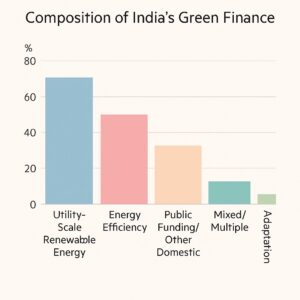
The constraints are structural. India’s green finance is concentrated in utility scale solar and wind. Distributed assets, such as rooftop solar, MSME efficiency programmes, electric mobility, and urban resilience, are underfunded. The International Energy Agency (IEA) notes that India must sharply increase clean-energy investment to meet its emissions pathway and expand electricity demand.
State finances, local capacity weak links
Climate finance cannot be driven from New Delhi alone. States control the core levers of decarbonisation: land regulation, electricity distribution, building codes, public transport, and urban planning. Yet most states lack credible climate budgeting frameworks, long-term project pipelines, or specialised climate finance cells. Many State Action Plans on Climate Change (SAPCCs) remain underfunded and outdated.

This fragmentation matters because state governments account for a large share of capital expenditure on transport, energy distribution, water systems, and municipal infrastructure. The absence of predictable multiyear funding denies states the ability to structure long-tenor projects. Without stronger state capacity, even well-designed national policies will underdeliver.
Carbon markets and green credits remain underdeveloped
India has introduced the Carbon Credit Trading Scheme (CCTS) and the Green Credit Programme, but both operate at a formative stage. The effective carbon price remains close to zero, offering little incentive for industry to shift towards low-carbon technologies. A robust compliance carbon market, with enforceable caps and transparent MRV (measurement, reporting, verification) systems, could mobilise significant private investment. India’s current setup lacks the liquidity and regulatory certainty required for scale.
The underdeveloped carbon market also limits sectors like green hydrogen, offshore wind, and industrial decarbonisation. Without a price signal, banks cannot assess risk, and businesses cannot forecast returns. Carbon markets remain a central missing piece in India’s green finance architecture.
India needs MDB support, global partnerships
Global climate finance rose to $1.9 trillion in 2023, but that remains far below what is needed. The G20 “Triple Agenda” calls for multilateral development banks (MDBs) to expand annual financing by $300 billion by 2030. India increasingly depends on concessional and blended finance from the World Bank, Asian Development Bank, Asian Infrastructure Investment Bank, New Development Bank, and others.
MDB capital is crucial not just for loans but also for guarantees, first-loss instruments, and project preparation support. These reduce financing costs and attract private capital. Without deeper MDB engagement, domestic financing costs—among the highest in the G20—will remain a barrier to investment.
Bond markets must shoulder a larger burden
India has issued sovereign green bonds worth ₹16,000 crore, but the market is still shallow. Secondary-market liquidity is thin, hedging costs are high, and foreign ESG funds remain cautious. Regulatory clarity on green taxonomies and disclosure rules is improving under SEBI’s BSR and ESG frameworks, but gaps remain.
Domestic banks carry most of the burden today. Their short-tenor liabilities cannot support long-duration green infrastructure. Without deeper bond markets, credit-enhanced pooled structures, and a stronger domestic institutional-investor base, long-term green capital will remain inadequate.
Industrial policy will shape capital allocation
Sectoral policy will determine whether India’s transition gains momentum. The National Green Hydrogen Mission, production-linked incentive (PLI) schemes for batteries and solar modules, and the push for electric mobility are steps in the right direction. But gaps persist. Investors remain concerned about off-take certainty, storage incentives, and grid readiness.
Clean manufacturing depends on secure access to critical minerals. India’s dependence on imports for lithium, cobalt, and nickel exposes it to geopolitical risks. The absence of a strong recycling and urban-mining ecosystem increases vulnerability. Mandatory recycling targets, certified scrap processing, and domestic refining incentives must become industrial-policy priorities.
Converting ambition into investible assets
Green taxonomies, disclosure rules, and verification standards are important, but they do not close the financing gap. Instruments that reduce risk—pooled vehicles, securitised renewable assets, municipal green bonds, and credit guarantees—are needed to convert future revenue streams into investible assets. Domestic capital markets must absorb more risk, lengthen maturity profiles, and crowd in global investors.
The Union Budget must recognise that signalling alone is inadequate. The design of public-private partnerships, the level of concessionality, and the intelligent use of sovereign guarantees will dictate whether India can scale green finance in this decade. Transparent and catalytic institutions will help shift the arithmetic. Without such reforms, the financing gap will widen, and the economic and human costs of delay will rise.
The politics of the transition will shape outcomes. A credible pathway must protect livelihoods, strengthen domestic capabilities, and secure supply chains. Broader public support will sustain fiscal interventions. The green funding gap is not a technical problem. It will determine whether India’s growth in the coming decades is resilient, competitive, and genuinely clean.