





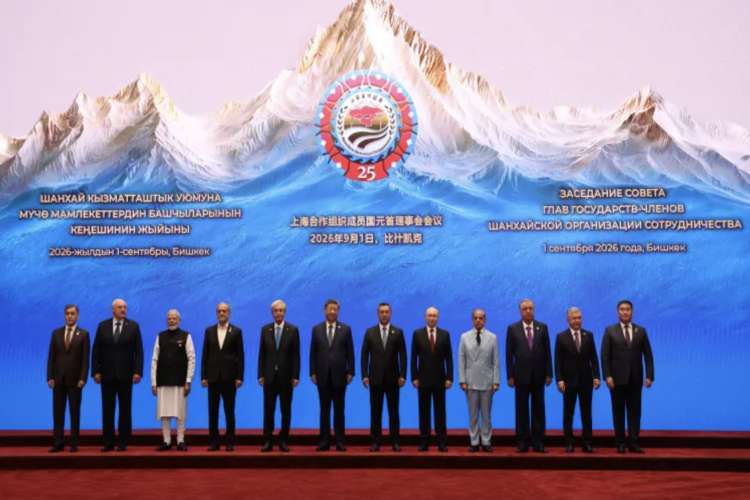
SCO summit: The Shanghai Cooperation Organisation (SCO) met in Bishkek at a time when international trade is being reshaped by geopolitics. The wars in Ukraine and West Asia, sanctions on Russia and Iran, and repeated disruptions to shipping have made access to markets less predictable. This presents India with a peculiar problem. The economy remains dependent on imported energy while seeking a larger share of global markets. The economic relevance of the SCO for India will therefore depend on whether it can widen the routes through which goods, energy and payments move when established channels come under pressure.
Prime Minister Narendra Modi’s meetings with Russian President Vladimir Putin and Iranian President Masoud Pezeshkian illustrated the problem. The discussions covered the conflicts in West Asia and the Black Sea region, commercial shipping, seafarer safety and bilateral economic relations. With Pezeshkian, Modi specifically raised freedom of navigation and commerce. With Putin, the two sides reviewed economic and energy ties against a backdrop of geopolitical uncertainty.
READ | Climate finance gap gives BRICS a larger role in 2026
India has different economic interests in each part of the SCO geography. Russia has become an important supplier of energy, though Indian exports to the Russian market remain small. Iran gives India access to Chabahar and a possible entry point to Central Asia, but sanctions limit what companies and banks can do there. Central Asia has resources and markets that India would like to reach, but Pakistan blocks the most direct overland route. The question for New Delhi is whether political relationships can overcome these disadvantages imposed by geography.
SCO summit: Trade routes are becoming strategic assets
The Strait of Hormuz demonstrates why this matters. Disruption there affects crude oil, shipping costs, insurance and merchandise trade well beyond West Asia. India’s trade deficit widened to $30.43 billion in June, from $28.21 billion in the previous month. Goods exports were $40.41 billion and imports were $70.84 billion in June, and shipping disruptions around Hormuz weighed on trade flows.
For an economy of India’s size, the lesson is less about any single month’s deficit than about exposure. Energy supplies, freight rates and export schedules can all be affected by conflicts over which New Delhi has little influence.
Chabahar has consequently acquired greater economic value for India. The agreement signed in May 2024 to operate the Shahid Beheshti terminal gives New Delhi a foothold on a route towards Afghanistan and Central Asia that bypasses Pakistan. Its usefulness could increase if the port is linked more effectively with the International North-South Transport Corridor through Iran towards Russia. That would give Indian exporters another Eurasian route at a time when disruptions in the Gulf and elsewhere have exposed the costs of relying too heavily on a few established shipping lanes.
The strategic logic is compelling. The commercial arithmetic is harder.
Businesses judge a corridor by freight cost, transit time, reliability, access to insurance and the ability to make and receive payments. A route drawn on a map has little economic value if banks will not finance transactions or shipping companies regard sanctions exposure as unacceptable.
Iran makes the difficulty clear. Tehran wants partners such as India to expand trade and investment, and Modi reiterated in Bishkek that India wanted to diversify bilateral trade. Yet Iran is under intense American economic pressure. Sanctions, restrictions on financial transactions and disruption to shipping have sharply constrained its foreign trade and oil exports. Indian companies cannot approach the Iranian market as they would an ordinary commercial destination.
Strategic autonomy does not remove compliance risk from a company balance sheet.
READ | BRICS de-dollarisation: What the numbers show and don’t
India-Russia trade exposes another weakness
The economic imbalance with Russia presents a different problem. Bilateral merchandise trade reached about $59.86 billion in FY26. India imported roughly $55.37 billion of goods from Russia while exporting only about $4.49 billion, according to Commerce Ministry data. Energy dominates the relationship.
The surge in commerce since the Ukraine war has therefore produced scale without anything close to balance. India benefits from Russian energy and other commodities, but a durable economic relationship requires a larger Indian presence in the Russian market.
The Modi-Putin meeting in Bishkek reviewed trade, energy and other economic ties and welcomed the recent meeting of the India-Russia Inter-Governmental Commission. The official readout, however, announced no new mechanism for correcting the trade imbalance.
That is the harder part of the relationship. Political goodwill can open doors. Export growth still depends on market access, logistics, payments, product competitiveness and demand inside Russia.
The same distinction applies to the International North-South Transport Corridor. A functioning route through Iran and the Caspian could improve India’s access to Russia and Central Asia. Its usefulness will ultimately be decided by firms comparing its cost and reliability with competing routes.
READ | How the US-China reset recasts the QUAD
The SCO is a difficult economic coalition
The broader SCO faces an institutional problem. Its members do not form a naturally integrated economic bloc. India and China remain strategic competitors. India continues to have sovereignty objections to China’s Belt and Road Initiative. Relations between India and Pakistan constrain regional connectivity. Russia and Iran operate under extensive Western sanctions. Central Asian states seek economic relationships with Russia, China, Europe, India and the United States at the same time.
These differences place a ceiling on economic integration. The SCO lacks the political cohesion and institutional machinery required for anything resembling a common market.
A narrower economic role is more plausible: reducing the dependence of member states on a small number of transport corridors, financing channels and markets.
There is already movement in that direction. SCO finance ministers and central bank governors discussed greater use of national currencies in settlements in May, alongside consultations on an SCO Development Bank. The Bishkek summit approved 28 documents and again placed trade, investment, energy and economic cooperation on the organisation’s agenda.
The value of these initiatives will depend on implementation. New payment arrangements matter if exporters can use them at reasonable cost. Customs cooperation matters if it reduces delays. Transport corridors matter if freight moves predictably. A development bank matters if it finances commercially credible infrastructure rather than politically favoured projects.
India needs economic redundancy
For New Delhi, the purpose of the SCO need not be the construction of an anti-Western economic bloc. India has substantial economic interests in the United States and Europe, just as it has strategic and commercial interests in Russia, Iran and Central Asia.
Its advantage lies in maintaining several channels at once.
Chabahar can supplement maritime routes through the Gulf. The North-South corridor can provide another connection with Eurasia. Russian energy can diversify India’s supply base. Greater financial connectivity with Central Asia can widen commercial options. None offers complete insulation from geopolitical risk. Together, they can reduce dependence on any single route or relationship.
That is also a more practical definition of strategic autonomy. Diplomatic relationships matter when they produce ports that function, railways that connect, payments that clear and markets that businesses can enter.
Bishkek has supplied another round of political commitments. India’s interest lies in turning some of them into economic infrastructure before the next geopolitical shock puts the existing system under strain.