





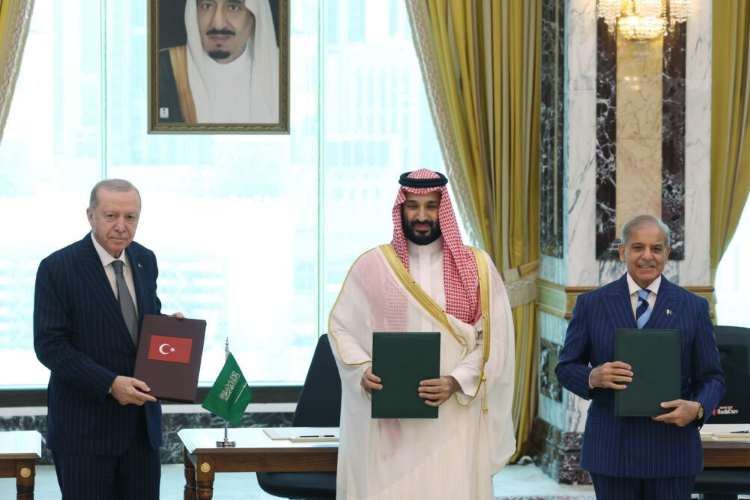
Amid conflicting reports of a deal to end the Iran war, Saudi Arabia, Pakistan and Turkey stood together in Islam’s holiest city and signed the Mecca Joint Defence Agreement, a pact declaring that an attack on one will be treated as an attack on all three. The geopolitical manoeuvring is pretty clear. Pakistani Prime Minister Shehbaz Sharif and army chief Asim Munir performed Umrah before Turkish President Recep Tayyip Erdoğan arrived, and the three leaders then sat with Crown Prince Mohammed bin Salman to put ink on a document that officials insist is purely defensive and aimed at no one in particular. That last claim calls for closer look, because everything about the timing of this pact points to a region being impacted less by the three signatories than by the power that has spent the last five months bombing Iran.
Look at what Washington has been doing in parallel. It has signed a civil nuclear agreement with Riyadh that leaves the door open to domestic uranium enrichment, a concession it refused to give the UAE. It has let Turkey host the 36th NATO summit while easing sanctions on Ankara. And it has allowed Pakistan to style itself as a mediator in the Iran war, a role that flatters Islamabad’s diplomats even as its troops, fighter jets and air-defence batteries sit inside Saudi Arabia defending the kingdom’s oil infrastructure.
READ I Japan’s rearmament is redrawing Asia’s security map
None of these three arrangements happened in isolation, and none of them happened before the Mecca pact by accident. Each state has been given a reward, a role, a status boost, precisely at the moment it deepens the military entanglement that keeps the region orbiting American strategic interests. Call it a trilateral defence pact, if you like. It reads just as easily as three subcontractors being issued fresh contracts.
That is the uncomfortable geopolitical plan that gets lost in the language of ‘strategic autonomy’ now filling newspaper columns. Analysts at the Gulf Research Center have suggested that if this mechanism becomes institutionalised, it could give all three states greater diplomatic and military weight and nudge the region toward a security order less dependent on Washington. But autonomy is not what the last week of diplomacy looks like. It looks like three governments locking themselves more tightly into an American-scripted confrontation with Iran while telling their own publics they are finally standing on their own feet.
READ I World order buckles as Iran war tests the West
Three partners, three sets of exposed nerves
Plausibly, each of these three states is negotiating from a position of real anxiety, not strength. Pakistan arrives at this pact still absorbing the reputational cost of its war with India last year, a conflict that dented the image of invincibility Rawalpindi had spent decades cultivating. Islamabad’s economy remains in distress, its currency and foreign reserves under constant pressure, which makes Saudi money and Gulf deployments a financial lifeline. Pakistan has reportedly sent around 8,000 troops along with aircraft, drones and air-defence systems to Saudi Arabia since the Iran war began, on top of the far larger commitments under last year’s bilateral defence agreement, which involved something close to 25,000 troops and roughly ten billion dollars in Saudi investment in return. That is, obviously, not the profile of an equal partner setting the terms of an alliance. It is the profile of a state renting out its army to stay financially afloat.
Saudi Arabia’s position is no less precarious. Riyadh has been a reluctant participant in the confrontation with Iran, dragged into a war that threatens the very economic transformation the Crown Prince has staked his rule on. Vision 2030 depends on stable oil exports and a peaceful investment climate, both of which the war has undermined. The Strait of Hormuz has seen most commercial shipping disrupted, and Iran-aligned forces in Yemen and Iraq have struck Saudi territory directly.
READ I NATO’s decline: Why the alliance has outlived its purpose
Meanwhile, the truce with the Houthis has collapsed, with missile and drone strikes killing dozens of Yemeni government troops in a single day and a Houthi blockade threatened against Saudi ports. Riyadh has also found itself at odds with Abu Dhabi over Yemen and over Somalia, a fracture in the Gulf’s own ranks that undercuts any chance of a unified Arab front. A kingdom this exposed on its southern flank, its western coastline and its economic ambitions is not signing pacts from a position of confidence. It is trying to buy insurance from every direction at once.
Turkey’s calculation is different, but equally driven by need rather than surplus strength. Ankara has been hunting for a new regional role since the fall of the Assad regime opened space in Syria, and Erdoğan clearly wants Turkey recognised as a Mediterranean and Middle Eastern power in its own right, not merely a NATO member kept at arm’s length by Washington and Brussels. Hosting the alliance’s 36th summit and watching sanctions ease gives Ankara exactly the kind of legitimacy it has been chasing. But Turkey’s economy needs external validation and investment just as much as its foreign policy needs new avenues, and the Mecca pact offers both a market for its Bayraktar drones and naval hardware and a seat at a table it was not previously guaranteed a place at.
Nuclear question nobody wants to answer
The most volatile thread running underneath all of this is Pakistan’s nuclear status. Riyadh’s earlier bilateral pact with Islamabad already generated speculation about an implicit nuclear umbrella, heightened when Pakistan’s defence minister suggested the kingdom could draw on ‘all’ of Pakistan’s capabilities before walking the comment back. Nothing in the public text of either agreement confirms a nuclear guarantee, and most analysts think Pakistan’s doctrine remains anchored to its rivalry with India rather than a Gulf theatre.
However, ambiguity itself is a strategic fact. Combine it with a Saudi civil nuclear deal that leaves domestic enrichment on the table, something Washington never allowed the Emiratis, and the region is edging toward a genuine hedging problem, one where formally non-nuclear states position themselves within reach of weapons capability without ever crossing the declared threshold.
Mecca Joint Defence Agreement and India
It would be naive to expect Iran to read this pact as anything other than encirclement. Tehran is now looking at a nuclear-armed Pakistan and NATO’s second-largest military sitting on either side of it, both bankrolled by a Gulf state that has spent the war absorbing Iranian and Houthi strikes. The likely response is greater reliance on Russia and China and continued use of proxy networks to probe how seriously the new pact’s members take their mutual-defence clause.
Israel’s discomfort has different roots. Normalisation with Riyadh has stalled, ties with Ankara have soured badly, and Tel Aviv now watches an alliance built on Islamic solidarity rather than the Abraham Accords framework it spent years constructing. A security structure that does not run through Washington or Jerusalem is, by definition, one Israel cannot fully monitor or influence.
New Delhi’s unease with the Mecca Joint Defence Agreement has different dimensions. India retains a substantial economic relationship with Saudi Arabia, worth tens of billions of dollars in trade and home to millions of Indian workers, so a rupture is unlikely. But the prospect of Turkish drone technology flowing more freely into Pakistani hands, on top of an already close Ankara-Islamabad defence relationship built around Bayraktar drones and joint naval projects, is not something Indian strategists can shrug off. India has already begun leaning harder on Greece and Cyprus in response to the Turkey-Pakistan defence relationship, a sign that the Mecca pact’s ripples are already reordering alignments well beyond the Middle East.
A pact built on need
What makes the Mecca Joint Defence Agreement worth watching is not the collective-defence clause itself, which officials have already hedged by calling it purely defensive and open to other states. It is the fact that three governments with serious, unresolved vulnerabilities have chosen this precise moment, in the middle of a war none of them fully wanted, to bind themselves together while the United States rewards each of them individually for playing along.
A genuinely autonomous regional bloc would be built by states negotiating from strength, setting their own terms and diversifying away from Washington in substance as well as rhetoric. What has been signed in Mecca looks more like three anxious powers hedging their bets in a war they cannot control, given just enough incentive by Washington to make the arrangement feel like their own idea. Whether it hardens into something more independent will depend on what happens the day one of these three states actually needs the others to fight, not just to talk.
This article appeared also in The Wire.
READ I Shrinking Indian middle class

Dr KM Seethi is Director, Inter University Centre for Social Science Research and Extension (IUCSSRE), Mahatma Gandhi University (MGU), Kerala, India. Seethi also served as Senior Professor of International Relations, Dean of Social Sciences at MGU and ICSSR Senior Fellow.