





Panchayat finances: India’s third tier of government still does not function as a tier of government. Panchayats have constitutional status, elected representatives and development responsibilities. What they lack is fiscal capacity, reliable accounts, and the data needed to know where money should go.
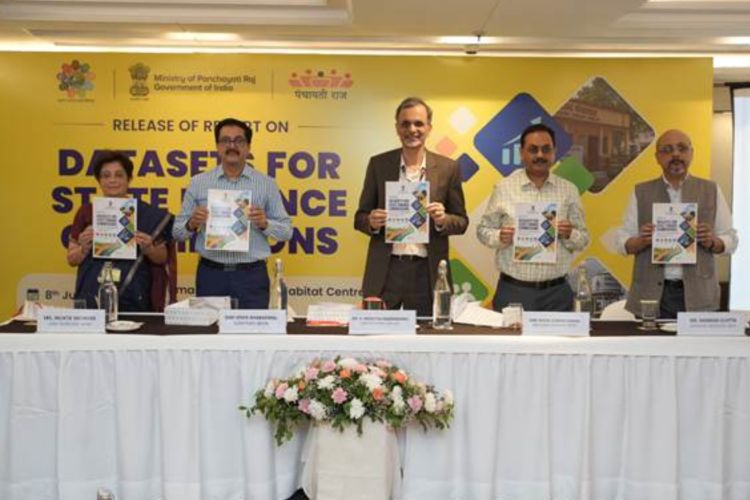
A report by the Ministry of Panchayati Raj’s Committee on Datasets for State Finance Commissions identifies the central weakness. State Finance Commissions cannot do their job because the information required to assess panchayats is missing, fragmented, outdated or unreliable. The committee has called for permanent SFC cells and gram panchayat-level databases. Fiscal decentralisation cannot work on guesswork.
READ | VB-G RAM G: Rural jobs guarantee faces fiscal test
State Finance Commissions lack data
The 73rd Constitutional Amendment, passed in 1992, sought to make panchayats the third tier of government. The logic was sound: A village road, drain, drinking water line or local market is best managed by those who use it, not by officials in Lucknow or Delhi.
This is where State Finance Commissions were meant to matter. Article 243-I requires the Governor to constitute a Finance Commission every five years to review the financial position of panchayats and recommend the sharing of taxes, duties, tolls, fees and grants-in-aid. The role broadly mirrors that of the Central Finance Commission in Union-state fiscal relations.
That parallel has remained mostly on paper. The Central Finance Commission is a serious constitutional institution. Many SFCs are treated as periodic obligations. They are constituted late, work with thin secretariats, struggle for data, submit reports and then disappear. Panchayats remain dependent on state governments for money and approvals.
An SFC has to answer basic questions. Which panchayats need more money? Which local bodies can raise more revenue? Where are the largest infrastructure gaps? How should state funds be distributed fairly?
Most SFCs cannot answer these questions with confidence. Many panchayats do not keep comprehensive financial records. Where records exist, they often fail to capture revenues, expenditure, assets and liabilities. Accounting practices differ across states and sometimes within them. Data sits in separate departmental systems that do not talk to each other. The result is a fiscal map full of blank spaces.
READ | SVAMITVA scheme turns rural land into bankable collateral
Panchayat accounts remain opaque
India has one of the world’s largest systems of democratic local governance. Yet its financial health is poorly understood. This is not because India lacks digital ambition. Over the past decade, the Union government has built platforms for direct benefit transfers, digital identity, payments and public service delivery. Data-driven administration is now official doctrine.
Nor is it because there is no digital platform for panchayats. eGramSwaraj brings together information gathering, micro-level planning and work-based accounting for panchayats. The problem is different. The data that SFCs need must be reliable, standardised, comparable across states and fit for fiscal judgement. A portal is not the same thing as an audit-grade public finance system.
Local government finance remains an exception. Panchayats spend on roads, sanitation, drinking water, housing, social welfare delivery and local infrastructure. These are not marginal functions. They determine how citizens experience the state. Yet policymakers do not have a reliable view of the money available, the liabilities incurred, or the outcomes produced.
Successive Finance Commissions have had to confront this weakness. They depend on state-level institutions to supply credible information on local bodies. When SFCs are weak, the Central Finance Commission also works with an incomplete picture of decentralisation.
The problem is no longer academic. Local governments are expected to carry a larger development burden. Rural infrastructure, sanitation, water supply, housing and welfare delivery all require capable local institutions. As responsibilities expand, poor accounting will translate into poor public spending.
Grants cannot replace autonomy
The point is not that panchayats receive no money. The Fifteenth Finance Commission grants to rural local bodies continue to flow as tied and untied grants. Untied grants can be used for local needs under the Eleventh Schedule, except salaries and establishment costs. Tied grants are restricted to sanitation, maintenance of ODF status, drinking water, rainwater harvesting and water recycling.
This design matters. A panchayat may have funds and still lack discretion. If its urgent need is a drain, road repair, streetlight or local market facility, money tied to another head is of limited use. Decentralisation is hollow if the village has elected representatives but not the fiscal choice to set priorities.
Own-source revenue is the other missing half. Panchayats cannot be real governments if they remain grant-administering agencies. Property tax, fees, user charges, market fees and returns from local assets should form part of the SFC’s assessment. A commission that only divides state transfers will not build local government. It will merely improve the formula for dependency.
READ | Below-normal monsoon may unsettle India’s rural recovery
Permanent SFC cells can fix continuity
The committee’s proposal for permanent State Finance Commission cells addresses a basic institutional failure. SFCs are episodic. Each commission spends months collecting information, prepares recommendations and then winds down. Institutional memory is lost. The next commission starts again from scratch.
Permanent SFC cells would maintain fiscal and institutional databases between commission cycles. They would keep records updated, track panchayat finances and preserve analytical capacity. Future commissions could then focus on judgement, not clerical reconstruction.
This is not a bureaucratic embellishment. Without continuity, decentralisation cannot produce accountable finance. Panchayats cannot be assessed properly if the state begins looking for their accounts only when a commission is due.
Standardised accounting is not trivial
The report also points to another weakness: the absence of standardised accounting systems. States record local revenues and expenditure differently. This makes comparison difficult, weakens oversight and encourages opacity.
Standardisation may sound like a technical reform. It is not. Comparable accounts allow states to identify laggards, reward better performers and link transfers to need and performance. They also allow citizens to ask sharper questions about their own panchayats.
A gram panchayat-level database would make this possible. It would bring together revenue, expenditure, assets, liabilities, grants, own-source revenue and service delivery indicators. That is the minimum architecture needed for serious fiscal decentralisation.
READ | MGNREGA recast: Why the mission model risks rural jobs
Decentralisation remains incomplete
The report also raises a larger question: how far has India really decentralised power? The constitutional promise was clear — functions, finances and functionaries should move to panchayats. Implementation has been uneven and often poor.
Many states transferred functions on paper without transferring money or personnel. Panchayats continue to depend on higher administrative levels for approvals. Their constitutional status has not become operational autonomy.
The recommendation for a Comptroller and Auditor General-led performance audit is therefore important. More than three decades after the 73rd Amendment, India still lacks a systematic assessment of how states have implemented the constitutional mandate. Such an audit would show which states devolved power, which retained control, and where panchayats remain elected bodies without fiscal authority.
India has created democratic institutions at the grassroots and channels for fiscal transfers. What it lacks is an information architecture equal to that ambition. Panchayats do not need another slogan on decentralisation. They need accounts, databases, audits and State Finance Commissions that can see what they are meant to judge.