





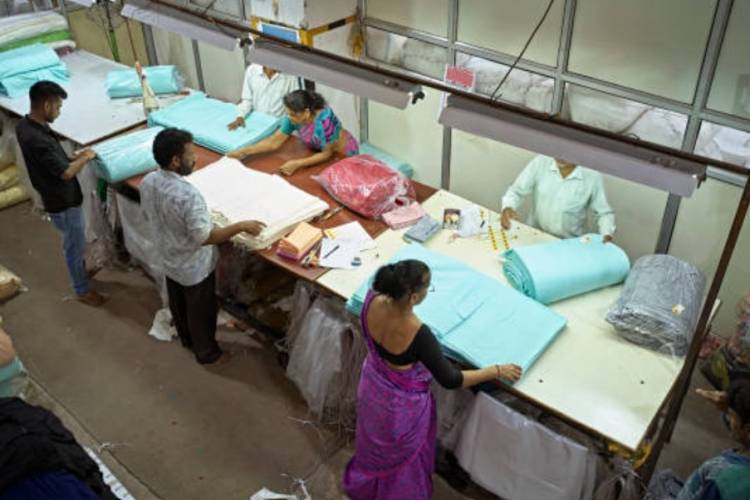
India’s informal sector: India’s growth story still rests on an informal base. Small shops, local service providers, tiny manufacturers and self-employed workers remain central to employment generation, even as the formal sector dominates headlines. The latest Annual Survey of Unincorporated Sector Enterprises shows that this vast and often undercounted non-agricultural economy expanded sharply in 2025. The number of establishments rose to 7.92 crore, employment to 12.81 crore and gross value added to nearly Rs 20 trillion.
This is not a marginal part of the economy. It is the labour market’s main shock absorber.
READ | Vishwakarma scheme struggles to reach India’s informal sector
The unincorporated sector covers enterprises that are not registered as companies under corporate law. These are proprietorships, partnerships and household-run businesses engaged in manufacturing, trade and services. Agriculture is excluded under the ASUSE framework. Even with that exclusion, the scale is striking. The sector employs far more people than the formal corporate economy.
Informal sector growth reflects India’s dual economy
The persistence of informal enterprise says something important about India’s growth path. In advanced economies, industrialisation and formalisation moved together. In India, growth has been more uneven. The formal sector has expanded, but not enough to absorb a fast-growing workforce. What has emerged instead is a dual economy, with wide differences in productivity, wages and job security across segments.
The informal sector has also recovered from the pandemic more decisively than many expected. Growth has spread across manufacturing, trade and services, with other services recording the fastest expansion in both establishments and employment. That points to resilience, but also to the economy’s continuing dependence on low-entry-barrier activities.
READ | India’s informal sector shows signs of life after Covid-19, DeMo hiccup
Digital adoption is rising, but formalisation remains partial
A quieter shift is visible here. Small businesses are becoming somewhat more productive. Earnings per worker and per enterprise have improved, suggesting better use of limited resources. Digital adoption is also rising, with 39.4% of establishments now using the internet, up from 26.7% in 2023–24. Online payments, platform commerce and cheaper connectivity have widened access to customers and lowered transaction frictions.
But this should not be mistaken for full modernisation. Nearly 95% of these enterprises remain proprietorships or partnerships, and only a small share employ hired workers. Most are own-account enterprises, which means self-employment with limited scope for scale. Productivity gains from such a low base do not yet imply convergence with the formal sector.
Another shift deserves notice. The informal sector’s expansion is also becoming more female-led at the margin. The share of female-owned proprietary establishments rose from 26.2% in 2023–24 to 27.0% in ASUSE 2025. This is a modest increase, but it matters. It suggests that the sector’s resilience is not only a story of digital adoption or rural diversification, but also of women entering or expanding small-business ownership in a labour market that still offers too few formal opportunities.
Employment quality remains the informal sector’s weak point
A large employer is not necessarily a good employer. That is the central weakness of this sector.
Most workers here are self-employed or casually employed, with little job security and almost no social protection. Wages are low, contracts are rare, and oversight is weak. The sector functions as a safety net for surplus labour, but not as a reliable route to upward mobility. That is why the expansion of informal activity, though welcome in one sense, cannot by itself be read as evidence of labour market strength.
Rural non-farm growth is reshaping the economy
One of the more significant trends in the ASUSE data is the stronger rise in rural employment and gross value added. Rural India is diversifying beyond agriculture into small-scale manufacturing and services. Urban areas, meanwhile, have recorded faster growth in the number of establishments, reflecting continued entrepreneurial churn and market expansion.
This matters because rural non-farm enterprise could become an important source of income support in regions where agriculture alone can no longer sustain households. But that transition will depend less on rhetoric and more on infrastructure, local demand, transport links, credit and market access.
Credit and compliance still hold back small businesses
The sector’s structural constraints are familiar. Access to formal finance remains weak, pushing many enterprises towards informal borrowing at high cost. Compliance burdens are often disproportionate to scale. Skill levels are uneven. Technology adoption is improving, but not uniformly. These frictions keep many firms small, vulnerable and trapped in low-productivity activity.
READ | Atma Nirbhar Bharat Package offers little to informal sector
Digital tools have lowered entry barriers and improved reach. That is real progress. But digital access cannot substitute for institutional support. Without better logistics, credit channels, skilling and simpler regulation, most firms will remain what they are today: viable enough to survive, but not strong enough to grow.
Formalisation policy has produced an in-between economy
For years, policy has tried to draw small enterprises into the formal system through GST, Udyam registration and digital payments. These measures have had some effect. But the ASUSE numbers suggest that formalisation is not a clean transition from one state to another. Many enterprises adopt selected formal practices without becoming fully formal firms.
That in-between condition may not be temporary. It may be the defining feature of Indian industry for some time.
As the economy grows, the share of informal employment should decline. But that will happen only if the formal sector begins creating jobs at scale. Until then, the unincorporated sector will remain central to livelihoods, consumption and local economic activity. India’s informal economy is growing. The harder question is whether it is graduating.