





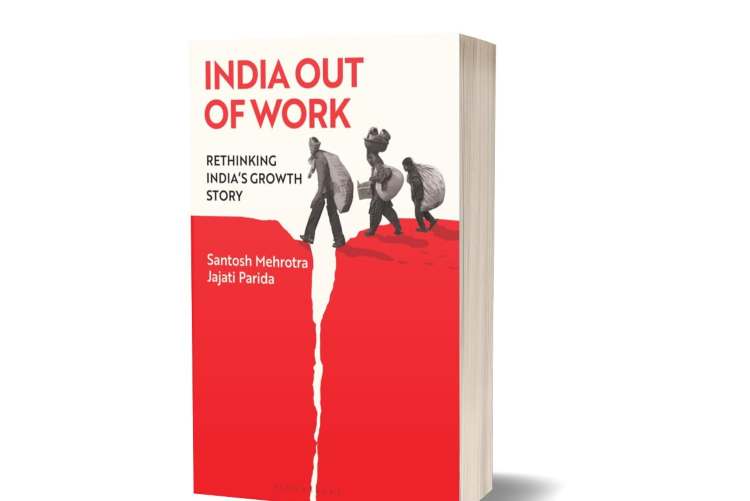
India’s growth story and jobs crisis: The release of India Out of Work: Rethinking India’s Growth Story, by Santosh Mehrotra and Jajati Keshari Parida, was a useful occasion to ask an old question that India keeps postponing: where will the jobs come from? The answer is not in doubt. They will not come from demographic arithmetic, nor from speeches on Viksit Bharat. They will come from productive enterprises that hire workers, raise wages, and move people out of low-productivity agriculture. India has too few of them.
India’s problem is not lack of growth. It is lack of the right kind of growth. The country is growing faster than most large economies. The IMF projects 6.5% real GDP growth for India in 2026. That is respectable. It is not enough to become Viksit Bharat by 2047. It is still less adequate if growth fails to move people from low-productivity work into higher-productivity jobs.
READ I Informal sector jobs expose India’s productivity crisis
India jobs crisis and the demographic dividend
Demographic dividend is not permanent. The working-age share of the population will not rise forever. It will peak around 2040. That gives India little more than a decade to turn youth into productive workers.
A demographic dividend is not a gift; it is a test. If young people find jobs, it raises savings, consumption, productivity and social stability. If they do not, it produces frustration. India cannot assume that youth itself will deliver growth.
The evidence is already troubling. India remains a lower-middle-income country. The World Bank puts India’s 2024 GDP per capita at $2,694.7. The IMF’s current estimate is about $2,810. These numbers are not compatible with developed-country status without a long spell of very high growth.
READ I Kerala remittances cannot replace jobs at home
Manufacturing jobs and structural retrogression
The hardest charge made in the discussion was “structural retrogression.” The phrase is dry. The fact is not.
Development normally moves labour out of agriculture into factories and modern services. India has partly reversed that process. Manufacturing has not become the great absorber of labour. Its share in GDP remains low. World Bank data put manufacturing value added at about 13% of GDP in 2024.
Agriculture, which should have been releasing workers, has taken them back. Mehrotra has argued that around 80 million workers were added to agriculture after the disruption of recent years. That is not disguised success. It is a warning. A labour-surplus farm sector cannot become the employer of last resort for a young country.
This is why the jobs crisis debate cannot be reduced to headline GDP. A country can grow and still fail to create enough good jobs. It can report employment gains and still move people into low-paid, low-productivity work.
READ I Bihar ITI reform must shift focus from seats to jobs
India growth and weak engines of demand
The engines of growth are not firing evenly. Consumption has been supported by household borrowing and dissaving, not by strong wage growth. Private investment remains hesitant. Public investment has done much of the heavy lifting, but the state cannot substitute for private capital forever. Exports have also slowed in a more hostile world economy.
Fiscal space is limited. The Union government met its FY26 fiscal deficit target of 4.4% of GDP, but consolidation itself limits the room for a large spending push.
The deeper problem is wages. If jobs outside agriculture do not expand, real wages stagnate. That has been the broad Indian story for much of the past decade. Growth without wage momentum weakens consumption. Weak consumption then discourages investment. The trap is circular.
Women’s work and India’s lost growth
India also wastes its women’s labour. The latest PLFS highlights show rural female labour force participation at 45.9% in 2025, but the quality of this work remains contested. The crucial distinction is between paid work and unpaid family labour. Rising participation is not enough if it only records distress work or invisible labour in family enterprises.
The speakers argued that raising women’s participation closer to levels seen in comparable economies could add one to two percentage points to growth. The estimate may vary. The direction does not. India cannot become rich while keeping a large part of its educated female population outside remunerative work.
This is not only a gender issue. It is macroeconomics. It affects household income, savings, fertility choices, child nutrition and productivity. It also affects politics. A country that underuses women will underperform.
Skills gap and the missed China-plus-one moment
India has also failed to prepare its workforce. Too many workers have little schooling. Too few have formal vocational or technical training. This is not a recent failure. It is the result of decades of weak public schooling and poor links between education and industry.
That failure now has a cost. Global firms are looking beyond China. India should have been a natural beneficiary. But labour-intensive manufacturing needs workers, supervisors, logistics, land, power, standards and predictable policy. It also needs firms that can scale.
India has many schemes. It has too few systems.
Industrial policy for labour-intensive manufacturing
The authors’ central prescription is manufacturing-led job creation. They argue that India has lacked a serious industrial policy for more than three decades. This is not a plea for old-style protection. It is a call for job-linked production strategy.
Their criticism of the Production Linked Incentive scheme is pointed. PLI has helped select sectors, especially electronics. The government says cumulative PLI incentives of ₹23,945 crore had been disbursed across 12 sectors by early 2026, with investment of ₹2 lakh crore, incremental production of ₹18.7 lakh crore, employment of 12.6 lakh and exports above ₹8.2 lakh crore.
The authors’ objection is different. PLI favours capital-intensive firms more than labour-intensive sectors. It has a high fiscal cost. It does not always require exports. It does not directly solve India’s mass employment problem.
The alternative is not romantic. It is practical. Focus on textiles and garments, food processing, wood products, leather and footwear. These sectors account for a large share of manufacturing employment. Fix inverted duties. Support the roughly 5,500 industrial clusters. Put urban infrastructure money into the towns where these clusters operate. Complete industrial corridors. Build design, testing, innovation and research capacity.
The idea of MSME universities, raised in the discussion, deserves attention. India built agricultural universities because farming needed science, extension and local problem-solving. Small firms need the same. Credit alone will not make them competitive. They need technology, design, compliance help, management training and access to markets.
Artificial intelligence and service-sector jobs
Artificial intelligence adds urgency. India’s services success was built on labour arbitrage, English skills and software capability. AI will not destroy all such jobs. But it will change entry-level hiring, back-office work and routine support functions. Women may be vulnerable if they are concentrated in roles most exposed to automation.
This does not mean India should fear AI. It means India should stop assuming that services will absorb every educated worker left out by manufacturing. The old escape route may narrow.
India cannot drift into Viksit Bharat. It cannot become developed by exporting optimism. It needs factories that employ people, services that raise productivity, schools that teach, cities that work, and women who can enter paid employment safely and profitably.
The demographic clock is not a metaphor. It is a deadline. India still has time. It does not have time to waste.
The book release function was organised by EGROW Foundation, a Noida-based think tank.