





1991 economic reforms: 35 years after India’s most consequential economic reforms, the useful question is no longer whether liberalisation worked. It did. The harder question is whether it produced the structural transformation India needed. On that test, the record is mixed.
The 1991 reforms dismantled much of the licence regime, lowered trade barriers, opened the economy to foreign investment and began reshaping taxation and financial markets. They reduced the state’s role in deciding what firms could produce and how much. A World Bank study puts average GDP growth at 5.4% during 1991-2003, against 4.3% in the preceding two decades, and attributes about a percentage point of the acceleration to the reforms.
READ | Why family businesses thrived after the 1991 reforms
Yet faster growth does not settle the argument about the reforms. In an interview with Business Standard published on August 31, former chief economic adviser Deepak Nayyar argued that the reforms were necessary but incomplete. Markets were liberalised before India had developed enough of the institutions, industrial capabilities and policy instruments needed to turn greater competition into large-scale industrialisation.
That criticism shifts attention from what India dismantled in 1991 to what it failed to build afterwards.
The 1991 crisis forced a break with the old model
The immediate problem in 1991 was a balance-of-payments crisis accompanied by severe fiscal stress. The Reserve Bank of India records that foreign currency assets fell below $1 billion at one stage in 1990-91. By June 1991, the available reserves covered barely two weeks of imports.
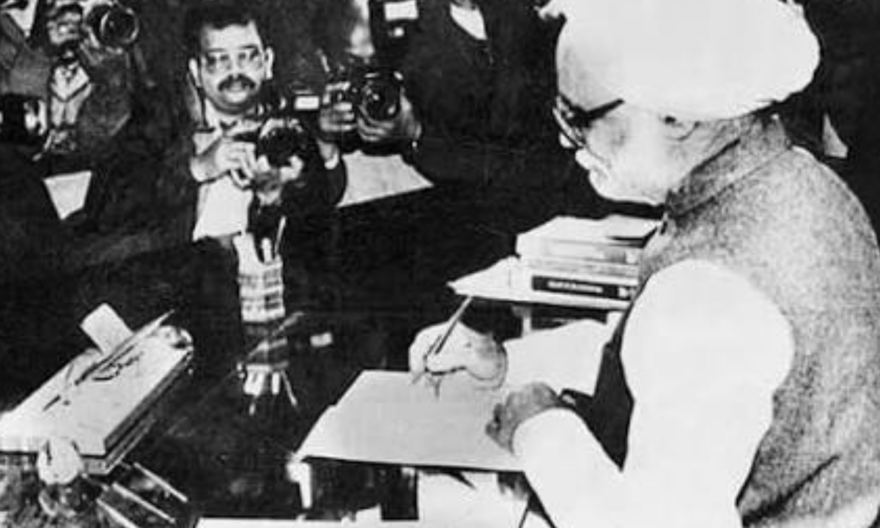
The reform programme also unfolded through a sequence of decisions rather than a single Budget. The rupee was adjusted on July 1 and 3. Import licensing began to be reduced. Industrial controls were eased and foreign investment rules liberalised. Manmohan Singh’s July 24 Budget explicitly described the shift from quantitative import restrictions towards a price-based system and proposed a more liberal regime for foreign direct investment.
Stabilisation had to come first. The economy could not continue with a system that rationed foreign exchange, protected inefficient production and left investment decisions heavily dependent on administrative permission.
The larger development question began once the immediate crisis receded. Greater freedom for firms would raise competition and investment. It did not determine what industries India would build, how firms would acquire technology or where the millions leaving agriculture would find productive work.
Liberalisation came before the industrial ecosystem
The sequencing of reforms has attracted criticism. Industrial policy removed entry barriers and restrictions on the expansion of firms. Trade liberalisation exposed domestic producers to foreign competition. Yet the supporting framework took much longer to develop.
Competition law is one example. The Competition Act was passed in 2002 and received presidential assent in January 2003, more than a decade after industrial deregulation began. Important provisions governing anti-competitive agreements and abuse of dominance came into force only in 2009.
Rapid trade liberalisation hurt parts of Indian industry because effective anti-dumping protection and a manufacturing ecosystem were lacking. Financial reforms reduced excessive regulation, in his assessment, without creating equally strong regulatory and governance structures.
The point requires qualification. The industrial regime that preceded 1991 had accumulated serious problems of its own. Manmohan Singh’s Budget speech acknowledged that import substitution had often become inefficient and indiscriminate. Protection weakened incentives to improve productivity, quality and costs. An industrial policy that restores administrative discretion, shelters firms indefinitely or rewards political access would recreate some of the weaknesses that liberalisation was meant to remove.
The policy challenge is harder. India needs a state capable of supporting industrial development while preserving competition. Firms require infrastructure, technology, finance and skilled workers. Government support has to produce investment, productivity and exports rather than permanent protection.
READ | Thirty-five years after, economic reforms confront a new constraint
Employment shows how little the economy has shifted
India’s labour market provides the clearest evidence of unfinished structural change.
The latest Periodic Labour Force Survey shows that agriculture accounted for 43% of employment in 2025. Manufacturing employed 12.1%. Both numbers improved from 2024, when the shares were 44.8% and 11.6% respectively, but the underlying imbalance remains large.
Services have generated much of India’s growth, including globally competitive industries in information technology, finance and pharmaceuticals. They have not absorbed workers leaving agriculture on anything approaching the scale achieved by manufacturing during the transformation of East Asian economies.
Santosh Mehrotra has made a similar argument in earlier conversations with Policy Circle. Manufacturing never became the lead sector capable of pulling large numbers of workers into more productive employment.
A populous country can certainly become richer through services. India has demonstrated that possibility. But the continued concentration of workers in agriculture shows the difficulty of relying on a services-heavy path when much of the labour force does not possess the education and skills demanded by high-productivity modern services.
India missed much of Asia’s manufacturing opportunity
The comparison with East Asia is striking. He puts India’s share of world manufacturing value added at 1.1% in 1970 and 1.3% in 1990. By 2025, it had reached around 3%. China started below India in 1970, was level with it in 1990 and accounted for about 28% by 2025.
South Korea, Taiwan, China and Vietnam used different economic models, but their governments played active roles in building industrial capacity. Firms received support for technology acquisition, investment and exports, usually alongside pressure to become competitive. Opening to the world economy formed part of an industrial strategy.
READ | GST reforms: Good and Simple Tax agenda remains unfinished
India opened its economy without achieving comparable manufacturing depth.
That does not diminish what 1991 accomplished. An economy still governed by industrial licensing, severe import restrictions and extensive state control would almost certainly have been poorer and less competitive. Liberalisation created opportunities that the earlier system had suppressed.
It also exposed the next constraint. Moving from a controlled economy to a market economy was one transition. Moving workers from low-productivity activities into productive enterprises has proved much slower.
The unfinished business is industrialisation
Another round of deregulation alone will not complete the transformation. The state now has to perform tasks that became more important after markets were opened: improve schools and skills, provide reliable infrastructure, support research and patient finance, enforce competition and help firms participate in global supply chains.
Industrial policy brings risks. Subsidies can become entitlements. Tariffs can protect inefficient producers. Governments can choose politically connected firms rather than competitive ones. Any new industrial strategy therefore needs measurable performance tests and an eventual withdrawal of support from firms that fail them.
The lesson from the more successful Asian economies is that capable states and competitive markets can reinforce each other. Liberalisation created the conditions for enterprise. Industrialisation requires institutions that allow those enterprises to acquire technology, expand production and sell abroad.
The IMF projects India’s nominal GDP at about $4.15 trillion in 2026. Economic size, however, is an incomplete measure of development. India’s unfinished business from 1991 is the creation of productive firms capable of absorbing labour at scale. That will determine whether a large economy also becomes a high-income one.