





India-EU FTA puts India’s car exports ambition to the test: European carmakers could use the India-EU free trade agreement to see which models sell in India before deciding what to build here. That was the prospect Commerce and Industry Minister Piyush Goyal held out at the Bharat Mobility Global Expo curtain-raiser in New Delhi on November 10. The agreement is expected to take effect in the first half of 2027, subject to the two sides completing their legal procedures.
India’s domestic market gives manufacturers a reason to consider local production. Using an Indian factory to supply other countries is a separate commercial decision. The cost of making a car and delivering it to those markets will determine whether India can win that investment. China’s experience shows how much of that cost is decided outside the assembly plant.
READ | India-EU FTA gives exporters access, not guaranteed orders
What the India-EU FTA offers carmakers
Under the published tariff schedule, India would allow up to 1 lakh eligible EU-made petrol, diesel and non-plug-in hybrid cars to enter at concessional duties in the first year. That annual quota rises to 1.6 lakh by the tenth year. Electric cars have a separate quota, and the agreement provides a tariff concession for certain completely knocked-down kits imported for local assembly.
Lower duties would let European carmakers try more models in India before committing to local production. They could also make it worthwhile to keep importing models that sell in small numbers. Even when sales justify assembly from imported kits, the economics of making more of the car in India will depend on whether local suppliers can deliver the required parts at the volumes and prices the manufacturer needs.
Competition from Chinese carmakers and the shift to electric vehicles give European manufacturers reason to review where they produce. A European Commission survey published in May shows how rarely such reviews lead to a move. Among the EU manufacturers surveyed that already had factories outside the bloc, 70% reported neither recent nor planned changes to their overseas production locations. The survey covered manufacturing broadly. The Commission pointed to the expense and disruption of moving production, as well as the time it takes. India’s more immediate prospect may be to win production of a new model as carmakers decide where to build it.
READ | India-EU FTA: Why paperless trade readiness is the real test
Why China is hard to match
The International Energy Agency estimates that a small SUV cost more than 30% less to manufacture in China than in advanced economies in 2024, whether it ran on a conventional engine or a battery. The agency attributes most of the advantage to large production runs and the integration of supply chains. Lower labour and energy costs account for a smaller part. The comparison gives a sense of what a new plant must contend with, even though it provides no direct estimate of Indian costs.
For electric vehicles, much of China’s advantage comes from what goes into the car. Its industry extends from processed battery materials to finished cells and vehicles. China produced nearly three-quarters of the world’s electric cars and more than 80% of its battery cells in 2025. An Indian plant that imports its cells and much of its electronics would still depend on overseas suppliers for some of the most valuable parts of the vehicle.
READ | India-EU FTA: Carbon rules, value chains, and export strategy
Car exports: India has the domestic scale to build on
India produced 53.8 lakh passenger vehicles in 2025, sold 44.9 lakh domestically and exported 8.6 lakh, according to industry figures reported by the Ministry of Heavy Industries. That home market gives a manufacturer enough room to build a business in India before taking on the costs of selling abroad. Maruti Suzuki offers an example of how far that can go. It exported 3.95 lakh vehicles in 2025, with established markets including South Africa and Saudi Arabia.
Yet India’s weight in global automotive trade remains modest. NITI Aayog puts India’s automotive exports at about $30 billion in 2024 against worldwide automotive imports of $2.2 trillion, a share of 1.4%. India supplied about 1% of global passenger-vehicle imports by value, compared with roughly 9% for motorcycles. The difference shows how much India’s export position varies by product, despite the size of its domestic vehicle industry.
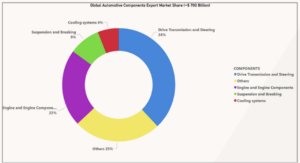
A European carmaker can use the agreement to find a model that sells in India and then assemble it here. The larger gain would come when that company qualifies Indian suppliers to make parts for the same model across several markets. Those orders could give suppliers the volumes to invest in tooling and testing, and a route into the carmaker’s next production programme. That is where a decision about what to build for India can begin to change what India sells to the world.