





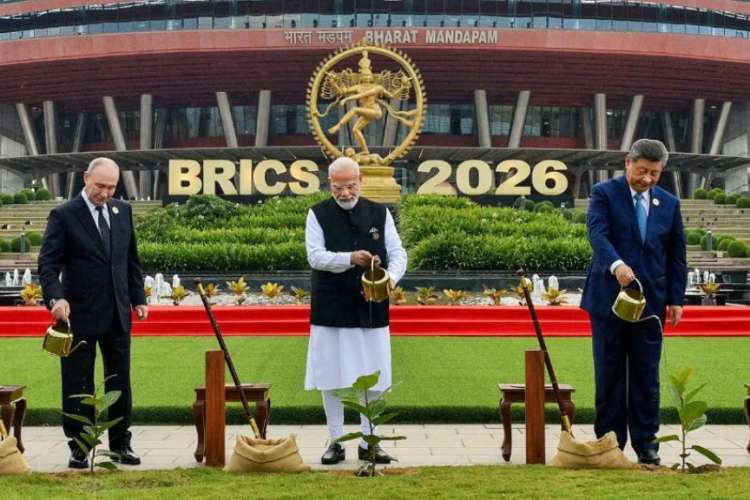
The BRICS summit in New Delhi produced an outcome that would have been difficult to predict a few months earlier. In May, the grouping’s foreign ministers failed to agree on a joint statement amid differences over the conflict in West Asia. In September, the leaders adopted a 140-paragraph declaration covering everything from global economic governance to cross-border payments and development finance. The contrast captures the strength and weakness of an enlarged BRICS: its members can agree on a broad agenda even when they cannot agree on some of the major geopolitical questions dividing them.
That is useful diplomacy. It is not yet evidence of an effective economic bloc.
READ | BRICS 2026 reveals ambition contradictions and uncertain future
The New Delhi summit did not produce a common currency or a new financial institution. Nor did it turn BRICS into an explicitly anti-Western alliance. Instead, the declaration concentrated on areas where cooperation is possible without requiring its members to share the same foreign-policy positions. That is probably the right choice. The larger BRICS becomes, the less realistic it is to expect agreement on every international conflict or a common strategic outlook.
The more difficult question is what happens after the summit. A declaration can record agreement; it cannot by itself create a payment system, finance a factory or reduce a country’s dependence on a foreign supplier.
BRICS is more useful when it avoids geopolitical grandstanding
The New Delhi Declaration describes BRICS as a platform for greater representation of developing countries in global institutions. It criticises unilateral sanctions and protectionist measures, while continuing to work through institutions such as the IMF, World Bank and WTO rather than proposing their wholesale replacement. That gives India considerable room for manoeuvre.
India has strong economic and strategic ties with Western countries. It also wants a greater voice for developing economies in international institutions. Those objectives are compatible with a BRICS that seeks reform rather than confrontation. They would become harder to reconcile if BRICS evolved into a formal anti-Western coalition.
The declaration also illustrates where the grouping’s consensus ends. The Ukraine war finds no place in it, despite Russia being one of BRICS’ founding members. References to reform of the UN Security Council largely reaffirm earlier positions. The omission of difficult issues is understandable given the differences among the members, but it also shows why BRICS should be judged primarily on areas where its members can actually work together.
Economic cooperation offers that space.
A common BRICS currency is still a remote proposition. The members have different monetary policies, exchange-rate regimes, financial systems and levels of capital-market development. Creating a currency would require a degree of economic and political integration that BRICS does not possess.
Cross-border payments are a more realistic target. The grouping has been working on greater interoperability among payment systems and on increasing the use of local currencies in trade and investment. India’s UPI gives the discussion a concrete reference point. It shows how a national digital payment system can become part of a wider payments network without creating a single currency.
That approach also avoids turning de-dollarisation into an all-or-nothing proposition. BRICS members can reduce transaction costs and increase the use of their own currencies without attempting to displace the dollar overnight.
The institutions already exist. The question is whether they can deliver at scale
The New Development Bank is the clearest example of what BRICS has achieved beyond summit declarations. By June 2026, the bank had approved 141 projects worth about $44 billion and had disbursed roughly $25 billion. Local-currency operations accounted for nearly 30% of its activity. It was also preparing its first large-scale Indian rupee bond programme.
The question, therefore, is no longer whether the NDB can lend in local currencies. It is whether it can expand that business sufficiently to make a difference to the financing constraints faced by its members.
The bank’s current strategy already envisages a larger role for local currencies, and its 2026 borrowing programme includes substantial renminbi issuance. Its next strategy cycle is expected to increase the share of local-currency financing further.
This is where BRICS can produce something more useful than political declarations. Development finance for infrastructure, energy transition, urban transport and productive investment can have a direct economic effect. NDB financing is already being used for projects in India, including urban transport and clean energy. The challenge is to increase both the scale of lending and the ability to mobilise private capital alongside it.
The Contingent Reserve Arrangement presents a different problem. Created in 2015 as a financial safety mechanism for BRICS members facing balance-of-payments pressures, it has never been drawn upon. Its continued existence provides a form of insurance, but the arrangement has yet to establish itself as a crisis-response instrument with a demonstrated record.
BRICS would gain more from making a smaller number of existing mechanisms work than from announcing another series of ambitious initiatives. Digital public infrastructure, artificial intelligence, agriculture, critical minerals and industrial supply chains all offer scope for cooperation. But these areas will require institutions, financing and identifiable outcomes. Otherwise they will remain subjects for successive summit declarations.
Continuity is particularly important. BRICS changes chairmanship every year, and each chair tends to bring its own priorities. Initiatives can therefore lose momentum before they have had time to produce results.
India has proposed a mechanism involving the previous, current and incoming chairs to preserve continuity, along with a digital repository to record decisions and implementation. The BRICS-NDB Knowledge Portal launched under India’s chairmanship is one step in that direction. The transition to China’s chairmanship in 2027 will show whether such arrangements become part of the organisation’s working machinery or remain associated with India’s presidency.
Expansion creates another institutional problem. BRICS now includes countries with very different economic structures and foreign-policy priorities, while further countries are seeking membership. Enlargement has increased the group’s economic weight, but it also makes agreement more difficult. Clearer membership criteria and a more predictable process would help prevent expansion from becoming an end in itself.
India’s China problem cannot be separated from BRICS
For India, none of these questions can be considered independently of China. The bilateral relationship is economically important and deeply unequal.
India’s trade deficit with China has continued to widen even as Indian exports have increased. Government data show that the deficit reached nearly $64 billion in the first seven months of FY2025-26. Imports include electronic components, machinery, auto parts, pharmaceutical ingredients and other intermediate and capital goods used by Indian manufacturers.
This last point is important. The trade deficit cannot simply be interpreted as evidence that India is importing finished consumer products while China captures the entire value chain. A significant part of the imports consists of inputs used by Indian industry, including products that eventually enter India’s own exports.
That does not make the dependence harmless. It makes the policy response more complicated.
An abrupt attempt to eliminate Chinese imports could raise costs for Indian manufacturers and make some of them less competitive. Leaving the existing dependence untouched would expose critical supply chains to geopolitical disruption. The sensible course lies between those extremes: diversify suppliers while building domestic capability in sectors where dependence presents a strategic risk.
That will require more than import restrictions. India needs competitive manufacturing, technology acquisition, better infrastructure and reliable access to critical minerals. Where Chinese inputs can be replaced economically, diversification should proceed. Where they cannot, policymakers need to understand the strategic exposure rather than assume that an import ban has solved it.
The same distinction should apply to Chinese investment. Investment in non-sensitive manufacturing could add capital and production capacity, while projects involving strategic technologies, critical infrastructure or sensitive data warrant closer scrutiny. Treating every Chinese investment as either acceptable or unacceptable is unlikely to serve India’s economic interests.
The border remains the harder political issue. Relations have improved since the clashes in eastern Ladakh in 2020, with diplomatic engagement and some disengagement at friction points creating greater space for economic interaction. But these developments do not amount to a settlement of the boundary dispute.
For India, maintaining peace along the border is essential if economic relations are to develop on a stable footing. That does not require either side to pretend that the territorial dispute has disappeared. It requires sufficient political and military stability to prevent it from repeatedly disrupting the wider relationship.
The next BRICS chairmanship will be a test of India’s strategy
The larger Asian picture makes this balance even more important. India does not want a regional order dominated by a single power, but neither does it have an interest in turning every area of competition into confrontation. A degree of strategic competition among major Asian powers is likely to persist. Economic cooperation will have to coexist with it.
That is also the logic India needs to bring to BRICS. The grouping can give developing countries greater influence in global economic governance without becoming an anti-Western alliance. It can develop local-currency finance without pretending that the dollar will disappear. It can cooperate with China without allowing Chinese economic weight to translate into excessive dependence.
The New Delhi summit showed that BRICS can accommodate considerable disagreement. The harder task is to make its economic institutions useful enough to survive those disagreements.
China’s chairmanship in 2027 will be an early test. If the initiatives launched under India are carried forward, BRICS will have demonstrated a degree of institutional continuity that it has often lacked. If they are replaced by another set of priorities, the grouping will remain largely dependent on the political energy of whichever country holds the chair.
For India, the stakes extend beyond BRICS. Its relationship with China will require economic engagement alongside a deliberate effort to reduce excessive dependence on Chinese supply chains. Its approach to BRICS will require much the same balance: cooperate where there is a clear economic gain, retain room for manoeuvre where interests diverge, and judge the grouping by what its institutions actually deliver.
The future of BRICS will be determined less by the number of countries around the summit table than by whether the organisation can make cooperation work despite their differences.