





Twelve years ago, Narendra Modi used his first Independence Day address from the Red Fort to call for a clean India and toilets in every school. The campaign launched on October 2, 2014, went on to change the scale of India’s sanitation effort. By June 2026, the government said more than 12.14 crore household toilets had been built under Swachh Bharat Mission-Grameen and more than 5.69 lakh villages had been declared ODF Plus.
The measure of success must now change. A household can have a toilet and still lack safe sanitation if the facility is not used regularly, water is unavailable, the containment system leaks, or faecal waste is emptied and dumped without treatment. The next sanitation challenge is therefore one of service delivery: making what has been built work safely and reliably.
READ | SDG 12 is slipping in South and South-West Asia
Earlier sanitation programmes struggled to achieve scale. Swachh Bharat brought political attention, money and mass mobilisation behind the goal of ending open defecation. Government records put rural sanitation coverage at 39 per cent when the mission began and reported universal coverage by 2019, when all villages were declared open-defecation free. The second phase broadened the agenda to sustaining ODF status, managing solid and liquid waste and improving village cleanliness.
Those achievements matter. They also mark the point at which counting toilets becomes an inadequate measure of sanitation.
Sanitation is also a nutrition intervention
The public-health gains from better sanitation are substantial. A 2024 study in Scientific Reports, examining Indian districts between 2011 and 2020, found that areas where toilet construction increased by more than 30 per cent were associated with infant mortality rates 5.3 per 1,000 births lower and under-five mortality rates 6.8 per 1,000 lower. The authors estimated that toilet provision at scale may have helped avert 60,000 to 70,000 infant deaths a year. The study establishes a strong association and plausible impact; it does not justify attributing every improvement in child mortality to sanitation alone.
The link with nutrition also deserves greater attention. Repeated exposure to faecal pathogens can cause diarrhoeal disease and intestinal inflammation, impairing a child’s ability to use nutrients effectively. The World Health Organisation lists poor sanitation among the conditions that exacerbate stunting. India’s stunting rate fell from 38.4 per cent in NFHS-4 to 35.5 per cent in NFHS-5.
There is reason, however, to be careful about causation. A recent analysis of NFHS-5 data found stunting among children with access to improved water, sanitation and handwashing at about 31 per cent, compared with 37 per cent among those without such access. After adjustment for household differences, the association became much smaller and was not significant for wasting. Sanitation strengthens the conditions in which nutrition interventions work; it cannot substitute for adequate food, maternal health, immunisation or primary healthcare.
READ | India’s urban policy neglects small towns
ODF and safe sanitation measure different things
The more difficult question is how much of the sanitation gap remains. Administrative declarations, household surveys and international monitoring systems measure different things and should not be treated as interchangeable.
NFHS-5 found that the proportion of households practising open defecation had fallen from about 39 per cent in 2015-16 to 19 per cent in 2019-21. The latest WHO-UNICEF Joint Monitoring Programme estimates open defecation at about 6.7 per cent nationally in 2024 and 10.7 per cent in rural India. The direction of travel is unmistakable, even if the numbers do not reproduce the administrative claim of complete elimination. WHO-UNICEF JMP India household data
Open defecation is only one part of the problem. The international standard for “safely managed sanitation” requires an improved facility that is not shared with other households and where excreta are safely disposed of in situ or removed and treated elsewhere. On that stricter measure, the JMP estimates India’s coverage at about 62.8 per cent in 2024, against 42.5 per cent in 2015. India has made a gain of more than 20 percentage points in nine years, but more than a third of the population still lacks safely managed sanitation.
This distinction matters for policy. A toilet is an asset. Sanitation is a chain of services covering use, containment, emptying, transport, treatment and safe disposal or reuse. Failure at any point can return human waste to the environment.
Urban India still has a treatment problem
The weakness of that chain is clearest in cities. The Central Pollution Control Board’s national inventory, based on 2020 data, estimated urban sewage generation at 72,368 million litres a day. Installed treatment capacity was 31,841 MLD, while the quantity actually treated was about 20,236 MLD, or 28 per cent of sewage generated. These figures are now dated, but they remain the principal national benchmark used in assessments of India’s wastewater deficit.
Capacity has continued to expand. The government reported in 2025 that AMRUT had added 4,447 MLD of sewage-treatment capacity, with further sewerage and septage projects under AMRUT 2.0. Yet installed capacity does not by itself establish that wastewater is being collected and treated to standard. Plants require sewer networks, power, skilled operators, maintenance budgets and regulatory enforcement.
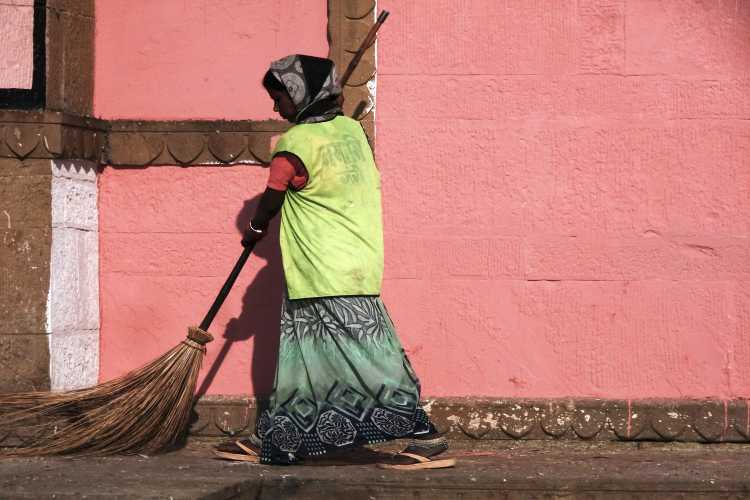
Large parts of India will also remain outside conventional sewer networks. There, faecal sludge and septage management becomes essential. Septic tanks and pits must be safely designed and emptied, transport must be mechanised and accountable, and the waste must reach treatment facilities rather than drains, vacant land or water bodies. Sanitation workers should not bear the physical risk created by failures in this system.
Policy Circle has recently examined the wider wastewater deficit and the slow pace of urban sewerage projects in its analysis of India’s worsening water shortages. Wastewater crisis is worsening India’s water shortages
National averages hide the remaining gaps
The unfinished task is concentrated among particular states and communities. NFHS-5 data show large differences in improved sanitation, from about 99 per cent in Kerala to 49 per cent in Bihar. The same survey found access to a toilet at 69 per cent among Scheduled Tribe households, compared with 93 per cent among households outside the Scheduled Caste, Scheduled Tribe and Other Backward Classes categories.
Urban informal settlements, migrant populations and households without secure land tenure pose a different problem. Individual household toilets may be impractical in some locations. Community facilities then need dependable water supply, cleaning, repairs and a clearly identified operator. A public toilet without an operating budget is an asset on a register, not a dependable service.
READ | Multidimensional poverty gains and fiscal federalism
Behaviour remains part of the equation. Toilets may fall out of use because of seasonal water shortages, damaged fixtures, poorly constructed pits or uncertainty over emptying them. The Union government has itself identified inadequate maintenance funds, unclear ownership and weak awareness about regular use and upkeep among the problems affecting community sanitary complexes.
Behaviour-change campaigns therefore still have a role, particularly through schools, anganwadis, panchayats and local community institutions. But the balance of the sanitation effort now has to move towards the less visible work of maintenance and service management.
Climate risks reinforce the need for that shift. Floods can damage toilets, overflow pits and spread faecal contamination. Schools, anganwadis, health centres, transport hubs and other public facilities also need more than toilets on paper. Water, handwashing facilities, menstrual-hygiene provision, cleaning and repairs determine whether those assets remain usable.
Local governments must own the sanitation chain
Monitoring should reflect the changed nature of the task. Toilet construction and one-time verification tell policymakers little about whether a service continues to function several years later. Useful measures now include actual use, year-round water availability, safe containment, frequency and method of desludging, treatment outcomes, facility downtime and worker safety.
That will require greater responsibility and predictable financing for panchayats and urban local bodies. Capital grants can create infrastructure. Sanitation services require recurring expenditure, trained personnel, contracts, supervision and enforcement. Those functions are harder to mobilise around than a construction target, but they will determine whether the gains of the past decade endure.
Swachh Bharat showed that political priority could transform a neglected public service. Its next test is less visible and more demanding. By 2047, the relevant measure will be whether households and communities have sanitation that works every day and whether human waste is safely managed after it leaves the toilet. A developed India cannot afford to treat that service chain as the unfinished business of an earlier campaign.
This article is written with inputs from a discussion organised by EGROW Foundation.