





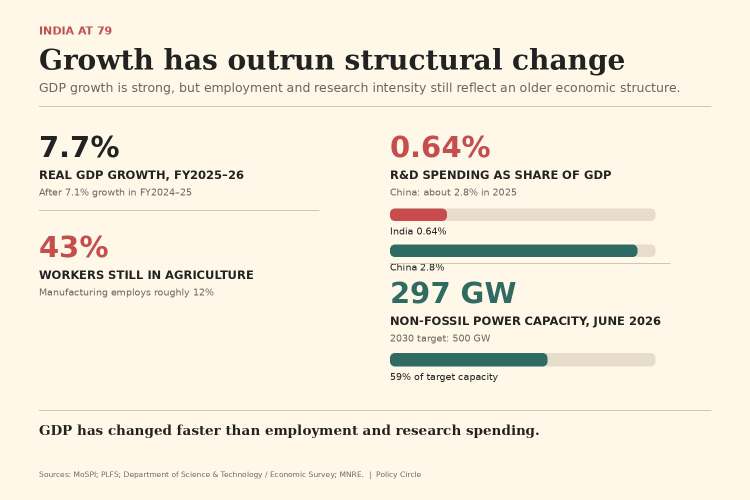
As India completes 79 years of Independence, its growth record is no longer in doubt. The GDP grew 7.7% in 2025-26 after 7.1% in the year before. The RBI expects 6.7% this year. India has left the 3-4% growth rates of the 1960s and 1970s far behind. Yet much of the employment structure associated with that older economy survives. About 43% of workers are still in agriculture. Manufacturing employs roughly 12%.
That is a poor fit for a country adding millions of people to its working-age population. Services have supplied much of India’s growth since the reforms of 1991. Software exports, finance and business services have generated income and foreign exchange. They employ only a fraction of the labour that a broad manufacturing expansion can absorb.
READ I India debt-to-GDP ratio faces a harder FY27 test
Growth, employment moving at different speeds
The share of workers in agriculture has been falling, though slowly. Manufacturing’s share has risen only modestly. The result is familiar across much of India. Workers leave villages, but many find construction work, delivery jobs, petty trade or other informal employment rather than factory jobs with higher productivity and regular wages.
Make in India and the production-linked incentive schemes have increased manufacturing investment. Electronics has recorded the strongest gains. Automobile and pharmaceutical production has also expanded. The improvement has not been large enough to alter the national employment structure.
Arvind Panagariya has argued for faster urbanisation organised around employment centres. India has reason to take that argument seriously. Much recent urban growth has been an extension of existing cities, where land is costly, commutes are long and basic infrastructure often arrives after population growth. Industrial towns built where firms can hire and workers can afford to live would give urbanisation a stronger economic purpose.
The aspiration to become a $30 trillion economy by 2047 depends on sustained high growth in dollar terms for more than two decades. Exchange rates will affect that arithmetic as much as domestic growth. The employment composition of the economy will tell us more about the quality of the transformation.
READ I RBI interest rate pause reflects caution on fuel-led inflation
External sector exposed to crude oil, China
The West Asia conflict has brought an old Indian vulnerability back into view. The country is dependent on imports for most of the crude oil it consumes. Iran war and the disruption around the Strait of Hormuz saw freight and insurance costs shooting up even before physical shortages were felt. Higher oil prices feed into the import bill, the rupee and domestic inflation.
The RBI can smooth disorderly currency movements and make foreign-currency deposits more attractive. It cannot remove the oil dependence behind the pressure. Reducing that exposure will take changes in transport, electricity generation and domestic energy production over many years.
Trade with China raises another concern. India’s merchandise trade deficit with China reached $99.2 billion in 2024-25. Imports stood at $113.5 billion and exports were just around $14.3 billion. Indian factories depend on Chinese machinery, electronic components, chemicals, solar equipment and other intermediate goods.
Reducing these imports by administrative order could make Indian manufacturing more expensive. Domestic producers have to replace Chinese supplies at prices and quality levels that allow firms using those inputs to compete. The same discipline applies to exports. Bangladesh and Vietnam have taken market share in garments despite their smaller domestic markets. Preferential access through free trade agreements helps only when Indian products can compete after reaching the buyer.
READ I India’s energy intensity falls, but oil risk remains
India R&D spending does not its match ambitions
India’s strength in software has sometimes obscured its weakness in research spending. Gross expenditure on research and development is about 0.64% of GDP. China spent around 2.8% of its GDP on R&D in 2025.
The difference shows up in industries India now wants to build. Semiconductor fabrication requires continuing work on materials, processes and equipment. Advanced batteries require improvements in chemistry and manufacturing yields. Government incentives can help establish plants. They cannot replace research inside companies.
India has seen a sharp rise in patent filings and startup activity. Private spending on research is still low compared with the contribution made by companies in the major technology economies. The ₹1 lakh crore Research, Development and Innovation Fund seeks to draw more private capital into research. Its usefulness will be measured by what firms spend after receiving support, rather than by the size of the fund announced by the government.
China’s industrial lead cannot be explained by cheap labour alone. It spent heavily on manufacturing capacity, engineering and research while building supply chains at home. India started from a different base and need not reproduce the Chinese model. India’s ambitions in semiconductors, artificial intelligence and advanced manufacturing cannot be achieved with an R&D spending of less than 1% of the GDP.
Economic inequality complicates growth record
Income distribution remains highly unequal. Estimates differ because household surveys, tax records and national accounts give divergent pictures. The World Inequality Lab estimates that the top 10% receive about 58% of national income, while the bottom half receive less than 16%.
A large low-income population constrains household demand. Families spending most of their earnings on food, rent and transport have little left for healthcare, education and manufactured goods. Weak public services increase the amount households must pay themselves.
Direct benefit transfers have reduced leakage in many welfare programmes and put money directly into bank accounts. Their success does not settle the employment question. A regular job paying more than agricultural or casual wages raises income without requiring another transfer from the budget.
Education has the same connection with the labour market. More young Indians now enter colleges and universities, while employers continue to complain about inadequate skills. Adding training programmes after graduation cannot compensate indefinitely for weak schooling, poor teaching and a shortage of suitable jobs.
Clean energy has moved faster than other sectors
Non-fossil electricity capacity reached about 297 GW by June 2026. India has committed to 500 GW by 2030. It has also pledged to cut the emissions intensity of GDP by 45% from the 2005 level and reach net zero by 2070.
The expansion of solar and wind power reduces part of India’s dependence on imported energy. It does not remove the need for coal in the near term or substitute for crude oil used in transport and industry. Storage, transmission capacity and grid management will determine how much additional renewable electricity the system can use reliably.
Air pollution receives less attention in discussions of economic capacity. Gita Gopinath has argued that pollution imposes a serious structural cost through illness and lost productivity. Anyone familiar with winter in northern Indian cities knows that this is not an abstract environmental debate. Workers fall ill, schools close and companies struggle to persuade employees to move to polluted cities.
India’s record since Independence contains achievements that once seemed improbable. A country long associated with foreign-exchange shortages now holds large reserves. An economy once identified with chronic slow growth has become one of the fastest-growing large economies.
The unfinished part is easier to identify than to fix. With about 43% of workers still in agriculture and R&D spending at about 0.64% of GDP, the structure of the economy is changing more slowly than GDP. The Independence Day balance sheet should be judged increasingly by those numbers.
READ I Cybersecurity has become a boardroom risk

Dr Ravindran AM is an economist based in Kochi. He has more than three decades of academic and research experience with institutions such as CUSAT, Central University of Kerala, Cabinet Secretariat - New Delhi, and Directorate of Higher Education Pondicherry.