





Sport can survive a poor referee. It cannot easily survive the suspicion that a referee’s decision, once made, can be negotiated with the head of state.
FIFA’s decision to suspend the implementation of Folarin Balogun’s automatic one-match ban at the World Cup has caused more institutional damage than the red card itself. Balogun had been sent off after a VAR review in the United States’ win over Bosnia and Herzegovina. President Donald Trump later confirmed that he had called FIFA president Gianni Infantino to seek a review. FIFA did not rescind the red card. It kept the sanction on paper, but suspended its operation for a one-year probationary period, allowing Balogun to play against Belgium.
The difference is legally tidy and institutionally thin. FIFA’s disciplinary code allows a judicial body to suspend the implementation of a disciplinary measure. The same code says a sending-off automatically incurs suspension from the next match. FIFA therefore had a textual hook. It did not supply the public with a persuasive reason for using it in this case, at this stage of the tournament, after a call from the president of the host country.
READ I Trump’s foreign policy: India should read the pattern correctly
Political interference in sports rules
The question is not whether Balogun deserved a red card. Reasonable football people can disagree on that. The question is whether every team in the tournament would have received the same late relief after the same offence, under the same rule, with the same urgency. Belgium plainly thought not. Its federation called the decision astonishing and said it contradicted tournament regulations. UEFA said FIFA had crossed a line and warned that the certainty of rules had been damaged.
A rulebook is not self-enforcing. It draws authority from the belief that it will be applied without regard to nationality, audience size or political convenience. Once that belief weakens, every subsequent decision becomes evidence in a case that the governing body itself has invited. Thomas Tuchel’s reaction after England’s Jarell Quansah was sent off was the natural consequence: who overturns it, when, and on what grounds?
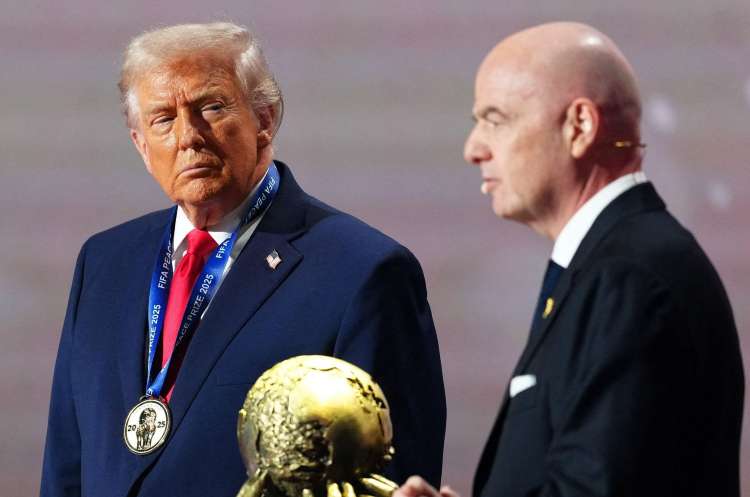
FIFA has tried to frame the Balogun ruling as a normal disciplinary act. That argument may have worked had the case remained within the walls of its judicial machinery. It did not. Trump praised FIFA after the decision and the White House celebrated the player’s reinstatement. Infantino had already given Trump the inaugural FIFA Peace Prize at the 2026 World Cup draw. These facts do not prove instruction. They make independence harder to believe.
READ I China’s global governance bid tests India’s diplomacy
FIFA credibility and the cost of discretion
FIFA has lived with a credibility deficit for more than a decade. In 2015, the US Department of Justice unsealed charges against FIFA officials and sports marketing executives in a racketeering and corruption case that alleged a 24-year scheme involving bribes for media and marketing rights. By 2022, US prosecutors said the wider FIFA cases had produced charges against more than 50 individual and corporate defendants from more than 20 countries.
That history matters because discretion is expensive for a body with a damaged reputation. When an institution trusted by all sides uses an exceptional power, it may get the benefit of doubt. When FIFA uses one in favour of the host nation’s leading scorer after a presidential intervention, it spends credibility it does not have.
There is also a category error in FIFA’s defence. It is true that red-card sanctions are sometimes reviewed or modified in football. It is also true that Article 27 permits suspension of a sanction’s implementation. But legality is the minimum standard. Tournament legitimacy requires a reasoned process, a published rationale, equal access for affected teams, and a firewall against external pressure. FIFA offered process language when the controversy required institutional proof.
The 4-1 Belgian win did not cure the damage. A wrong beneficiary can still win or lose. The injury is to the competition’s authority. Belgium’s victory removed one practical grievance. It did not answer the governance question.
READ I Rupee weakness is not RBI’s biggest currency risk
Global sports bodies and state power
FIFA is not alone. The International Olympic Committee has just provisionally lifted the suspension of the Russian Olympic Committee, saying Russian athletes should not pay for the actions of their government, while leaving unresolved questions on flag, colours and anthem for Los Angeles 2028. Ukraine and athlete groups have criticised the decision, and World Athletics continues to maintain a separate ban.
The parallel is not exact, but it is instructive. Global sports bodies pretend to stand above politics while relying on states for visas, policing, stadiums, tax treatment, broadcast access and diplomatic cover. Host governments know this. So do federations, sponsors and athletes. The fiction of neutrality collapses when private conversations with heads of government appear to shape eligibility, sanctions or participation.
The problem is sharper in football because FIFA sells certainty. Fans can tolerate controversy over a foul. They cannot tolerate the thought that a suspension depends on who can reach the FIFA president. Players are asked to accept VAR, disciplinary committees and strict liability. Federations are asked to accept draw rules, appeal limits and match bans. That bargain fails if power can enter through a side door.
FIFA’s commercial rise has made it more exposed to such pressure. Expanded tournaments need more hosts, more infrastructure, more security cooperation and larger political commitments. The larger the event, the more the host state matters. The more the host state matters, the more important the wall between tournament administration and political authority becomes.
Repairing sports governance
FIFA can still limit the damage. It should publish a reasoned order in the Balogun case, disclose all external contacts received by FIFA officials on the matter, and clarify whether Article 27 may be used to defer automatic red-card suspensions during knockout rounds. It should also give directly affected opponents limited standing before an emergency appeals body when a player is made eligible after a sanction.
The larger reform is simpler to state and harder to implement. Disciplinary panels in global competitions should be structurally separate from the executive leadership of the governing body. Ex parte political contact should be recorded and disclosed. Emergency decisions should come with written reasons. CAS fast-track review should be meaningful before kick-off, not theoretical after the match.
These measures will not keep politics out of sport. Nothing will. They will at least prevent governing bodies from asking the public to accept independence as a press release.
A red card is a small event in a World Cup. Institutions often reveal themselves in small events because the temptation to bend a rule looks harmless. Once the rulebook appears to have a phone number, every decision after it carries a shadow.