





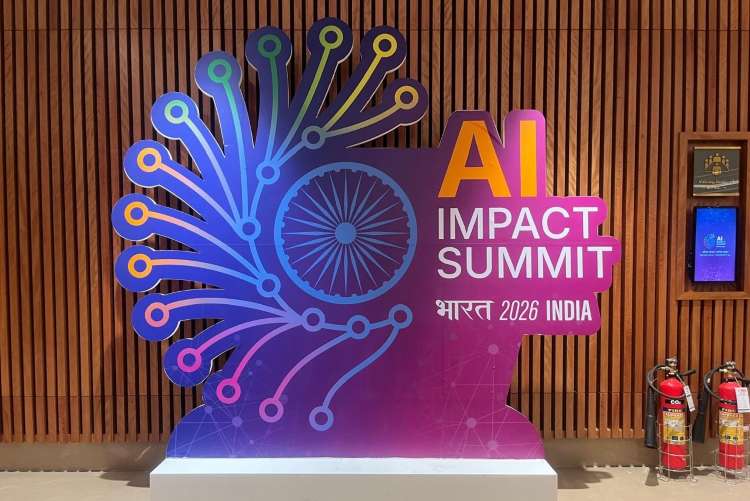
India used the AI Impact Summit 2026 to make a geopolitical and developmental claim. Artificial intelligence, in the Indian telling, should not remain a contest among a few firms or a regulatory argument among rich countries. It should serve people, widen access, and reflect the priorities of developing economies.
That pitch matters. The AI Impact Summit was the first global gathering of its kind to be hosted in the Global South. It brought to India heads of government, ministers, technology firms, researchers and entrepreneurs at a scale that made clear India wants a seat not at the edge of the AI conversation, but near its centre. Official figures point to representatives from 118 countries, more than 100 global AI leaders, and attendance running into lakhs.
READ I Can India power the artificial intelligence dream?
AI Impact Summit and the Global South
India’s framing of the AI Impact Summit was deliberate. Instead of beginning with fear, it began with use. The official vocabulary was “People, Planet and Progress”. The stress was on public service delivery, multilingual access, agriculture, health, education, finance, and governance. That is a different emphasis from the West’s more familiar fixation on frontier risk, liability, and model safety, though those issues were not absent in New Delhi.

The difference is not merely rhetorical. India’s argument is that AI will matter politically only if it reaches beyond English-speaking urban users and works in real institutions. That means language tools, voice interfaces, lower-cost deployment, and models trained for Indian conditions. It also means public infrastructure, not just venture capital. On that count, India has at least built a policy template. The IndiaAI Mission, approved in 2024 with an outlay of ₹10,371.92 crore, is meant to combine compute, datasets, model development, skilling, and public-interest applications.
READ I What hypnosis can teach us about artificial intelligence
Sovereign AI models and domestic capacity
The AI Impact Summit’s most important message was not that India can host a large technology event. It was that India is trying to reduce dependence on foreign models and infrastructure without pretending it can decouple from them.
That explains the prominence given to sovereign AI. Official material says 12 indigenous AI models are being developed under the IndiaAI Mission. Sarvam AI and BharatGen were projected as examples of India’s attempt to build models rooted in Indian languages and public use cases. Sarvam has also been tied to state and public-sector deployments, while BharatGen is positioned around multilingual foundation and multimodal models.

This is where India’s AI strategy is at its most sensible. It does not need to win the race for the largest frontier model. It needs models that work reliably across Indian languages, within Indian administrative systems, and at costs that public institutions and domestic firms can bear. That is a narrower goal, but it is also a more serious one.
READ I Can artificial intelligence strengthen democracy? Italy offers a test case
The compute constraint
Still, the AI Impact Summit also exposed the gap between aspiration and capacity. India’s AI policy now speaks the language of sovereignty. Its infrastructure remains constrained by imported hardware, cloud dependence, and energy intensity.
The government has expanded common compute capacity to 34,333 GPUs and has moved to subsidise compute access for domestic model builders. That is useful progress. But it does not erase the basic asymmetry. The global concentration of chips, cloud infrastructure, and frontier research remains intact. India can narrow dependence. It cannot wish it away.
The same applies to semiconductors. Official statements now say 10 units are under construction, four have entered pilot production, and the first commercial output is expected shortly. India also has 315 universities using major EDA tools. This is movement, not maturity. The summit rightly linked AI ambition to semiconductor depth, but the ecosystem is still early-stage.
New Delhi Declaration is useful, but limited
The New Delhi Declaration gives India a diplomatic outcome to point to. As of February 21, 88 countries and international organisations had endorsed it; by February 24, that number had risen to 91. That is a respectable coalition and a useful marker of broad support for international cooperation on AI.
But declarations do not solve the hardest problems. They do not allocate compute. They do not settle cross-border data rules. They do not answer who bears liability when AI systems fail in welfare delivery, finance, policing, or health care. Nor do they resolve the tension between democratic access and national control, both of which India wants to defend.
That tension runs through the summit’s language. India wants AI to be open enough to democratise access, but sovereign enough to protect data, public systems, and national autonomy. Those aims can coexist only up to a point. The larger the system, the more trade-offs appear.
Jobs, skills and the social cost of transition
The draft was right to dwell on employment. AI will not eliminate work in one dramatic sweep. But it will change the content of work, compress some tasks, weaken demand for some skills, and create pressure for retraining across services, administration, and technology functions.
That matters especially in India, where the argument for AI cannot be separated from the argument for jobs. Official messaging around the summit leaned heavily on innovation, startups, and scale. That is understandable. But the next phase will need more candour. Firms that deploy AI at scale will have to map which roles are being redesigned, what new skills are required, and how transition costs are shared. It is neither efficient nor fair to shift the burden entirely onto workers.
Educational institutions will also have to move faster than they do now. Schools, colleges, and technical institutions cannot treat AI as a specialist domain. They must prepare students for workplaces in which humans increasingly work with machines, supervise them, and correct them.
Human-centric AI needs enforceable institutions
India’s strongest claim at the summit was moral and political. AI must remain human-centric. Final responsibility must stay with human beings. Transparency, fairness, safety, and protection against abuse cannot be treated as optional extras.
That principle is easy to endorse. The difficulty is institutional. India already has pieces of a governance architecture in place through the DPDP Act, the IT Rules, and emerging AI governance guidelines. But the real test will come from enforcement in actual sectors: public databases, education systems, credit scoring, health diagnostics, policing tools, and welfare platforms. The summit identified these risks. It did not resolve them.
India’s AI moment will be judged by deployment
The AI Impact Summit succeeded in one important respect. It made India’s AI ambitions legible to the world. It showed that the country does not want to import models and call that strategy. It wants domestic capacity, multilingual reach, and a voice in global rule-making.
That is a credible ambition. It is not yet an accomplished one.
India’s AI story will be judged less by the applause in Bharat Mandapam than by whether its models work in Indian languages, whether public systems can deploy them safely, whether domestic firms can afford the infrastructure, and whether workers are helped through the transition.
If that happens, the summit will be remembered as more than a spectacle. If not, the New Delhi Declaration will read like many international declarations before it: worthy, broad, and easier to sign than to implement.
READ I Iran conflict could trigger a global energy shock

Dr Ravindran AM is an economist based in Kochi. He has more than three decades of academic and research experience with institutions such as CUSAT, Central University of Kerala, Cabinet Secretariat - New Delhi, and Directorate of Higher Education Pondicherry.