





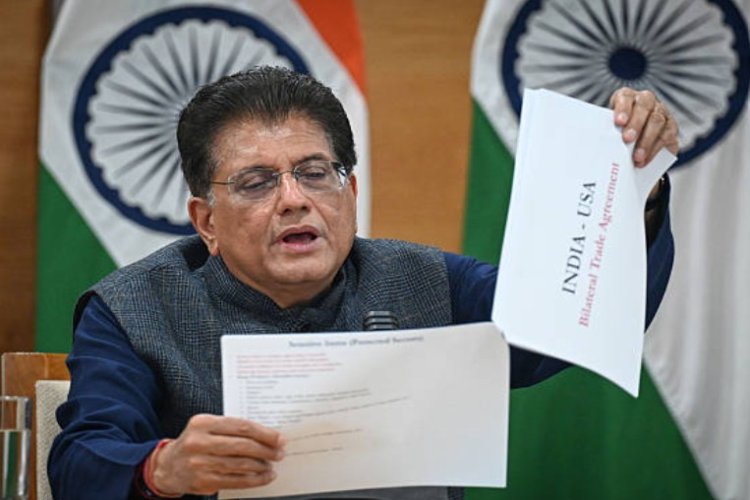
The new India-US trade framework is being presented as a diplomatic success. Headlines speak of American tariffs falling from 50% to 18% and of a new era of partnership. However, the celebrations seem to belie the reality. The United States has used trade as a tool of pressure to force India to change its trade regime and energy policy, compelling it to buy more American goods and to distance itself from Russia. This is not a normal trade negotiation. It is economic coercion draped as cooperation.
Supporters of the deal point to the joint statement released in Washington and argue that it does not mention Russian oil. They claim there is no direct pressure on India. But on the same day, President Donald Trump issued another executive order that tells a harsher story. That order openly links tariff relief to India ending Russian oil purchases. It states: “India has committed to stop directly or indirectly importing Russian Federation oil, has represented that it will purchase United States energy products from the United States.” This sentence removes all ambiguity. The tariff cut was not a friendly gesture. It has turned out to be a reward for compliance.
The order goes further and warns that the US will monitor India’s actions: “If the Secretary of Commerce finds that India has resumed directly or indirectly importing Russian Federation oil… [officials] shall recommend whether… I should reimpose the additional ad valorem rate of duty of 25 percent.”
READ | US-India tariff deal: What it means for Indian economy
India’s energy choices are now placed under American surveillance. Market access for Indian goods is tied to obedience in foreign policy. This is a dangerous precedent.
India-US trade: Myth of a Big Tariff Concession
Indian officials celebrate that American tariffs will fall from 50 percent to 18 percent. The comparison is misleading. Before the tariff war began in 2025, the United States applied normal MFN tariffs of only about 3.3 percent on Indian goods, one of the lowest rates in the world. The “reduction” to 18 percent is therefore not a gain. It is still six times higher than what Indian exporters faced earlier. India is being asked to treat an inflated rate as a concession. Meanwhile, India has promised to eliminate or cut tariffs on a wide range of American products. The balance is clearly tilted.
Before 2025, India and the US traded under normal WTO rules. India’s average tariff was around 17 percent, while the US average was just 3.3 percent. The gap already favoured the United States. Instead of negotiating within that framework, Washington imposed punitive duties and now presents partial withdrawal as generosity.
The $500 Billion Purchase Trap
The joint statement announces that India will buy $500 billion of US energy, aircraft, and technology over five years. This is not ordinary trade growth. It is a politically fixed target. Strategic analysts warned that forcing India to import nearly $100 billion a year from the US could almost double India’s trade deficit.
Washington is not only selling goods. It is selling dependency. The “America First Arms Transfer Strategy” issued on the same day shows the intention clearly. Arms sales are to be used to “expand domestic production and capacity” and to convert foreign purchases into American industrial revival. India is being turned into a captive market for American weapons and technology.
READ | US-India trade: Weaponised tariffs put export growth at risk
The Russian Oil Question
The heaviest pressure concerns Russian oil. After the Ukraine war, India bought discounted Russian crude to protect its consumers. This helped keep fuel prices stable. Now Washington wants that lifeline cut. Indian refiners have already begun stepping back from Russian purchases. Reports say Indian Oil, Bharat Petroleum, and Reliance are avoiding new Russian cargoes for March and April. Another Reuters report confirms that Russia’s share in India’s imports has fallen from 1.7 million barrels per day last year to around 1.2 million in January. These changes are not market decisions. They follow political signals from Washington. The US president openly said tariffs were lifted because India had “committed” to halt Russian purchases.
However, New Delhi has not confirmed such a promise. The Ministry of External Affairs keeps repeating that energy security of 1.4 billion Indians is the supreme priority and that sourcing will be diversified according to market conditions. The contradiction is obvious. Washington claims a commitment. Delhi denies it. The executive order stands as proof of where the pressure lies.
The Cost of Obedience
Stopping Russian oil will be costly. Analysts estimate that shifting to American or Venezuelan crude could add $9–11 billion a year to India’s import bill. Russian Urals crude has been $10–20 cheaper per barrel than global benchmarks, while Venezuelan oil offers only small discounts and higher transport costs. Indian refineries are designed for Russian grades. Venezuelan oil is heavier and needs complex processing. Many plants cannot handle it. A sudden shift would squeeze refinery margins and raise fuel prices at home. Analysts estimate even a partial switch to US crude could add $4 billion annually. This is the real price of the “concession.”
READ | US-India trade deal nears; digital, dairy disputes weigh
Surveillance Over Sovereignty
The most alarming part is the monitoring clause. The US commerce secretary is formally tasked with tracking Indian oil imports. Trade access becomes conditional on foreign policy behaviour. India is treated not as an equal partner but as a country under probation. The executive order even titles the action as addressing “threats to the United States by the Government of the Russian Federation.” India is punished for relations with a third country. This logic has little to do with free trade.
Arms Sales and Strategic Dependence
The new American arms strategy completes the picture. It openly states that foreign purchases will be used to reindustrialise the United States and strengthen its defence base. The India–US statement talks of buying aircraft, aircraft parts, and advanced technologies worth hundreds of billions. India is expected to fund American factories while its own trade position weakens.
The full bilateral trade agreement is still to come. But the direction is clear. Russian oil imports are falling. Refiners are adjusting behaviour even before any formal Indian decision. Washington has converted tariffs into a whip. Energy policy has become a bargaining chip. A country of 1.4 billion people is being asked to restructure its economy to fit American priorities.
India needs affordable energy and balanced trade, no matter what the geopolitical conditions are. The current framework runs the risk of higher fuel prices, a wider trade deficit, and long-term dependence on a single supplier.
A true partnership would respect India’s autonomy and sovereignty. What we see, instead, is uncouth pressure politics. The language of friendship hides a hard bargain. If this is the opening chapter, the coming trade deal may demand an even higher price.
READ | Trump-Munir optics undermine US-India ties

Dr KM Seethi is Director, Inter University Centre for Social Science Research and Extension (IUCSSRE), Mahatma Gandhi University (MGU), Kerala, India. Seethi also served as Senior Professor of International Relations, Dean of Social Sciences at MGU and ICSSR Senior Fellow.